
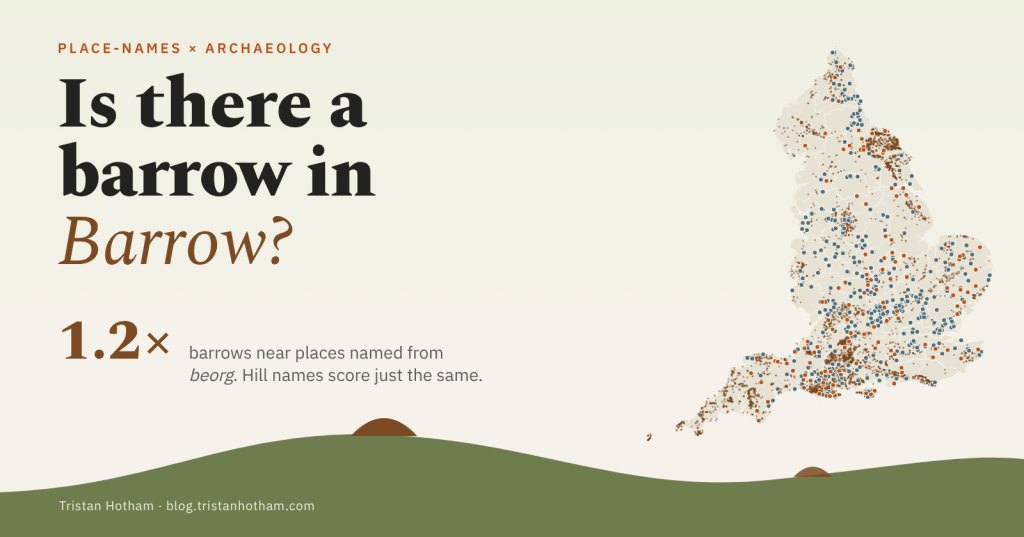
Old English beorg meant a mound or a rounded hill, and it gives us the word barrow. I tested 129 English places named from it against 6,100 protected burial mounds to see whether the names lead to the barrows.
Place-name dictionaries often gloss beorg as “burial-mound/hill”, because nobody can tell which the namers meant. There is a way to check, though. If a place was named after a barrow, more barrows should survive near it than near a place named after an ordinary hill.
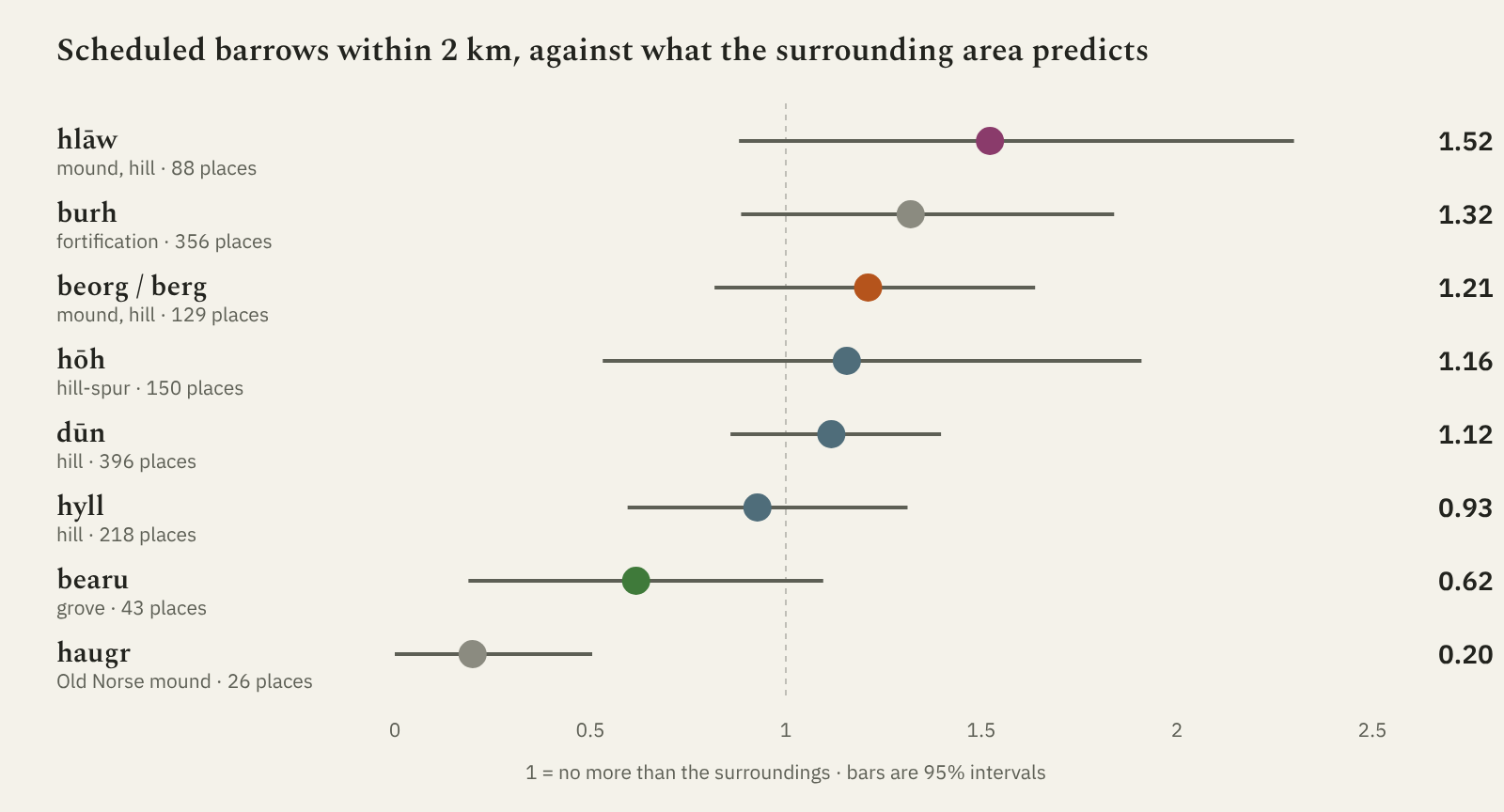
So I took every place the Key to English Place-Names (KEPN) lists under beorg, and under seven other elements for comparison: hlāw and Old Norse haugr (both mound or hill), dūn, hyll and hōh (hill words), burh (fortification) and bearu (grove). For each place I counted the scheduled barrows, tumuli and round cairns within 2 km. Barrows cluster on the chalk and the moors, so I compared each count with the number the surrounding 30 km would predict.
A hill word, not a grave word
Beorg places have about 1.2 times the barrows their surroundings predict, with a 95% interval of 0.8 to 1.6. Places named dūn or hōh, plain words for a hill, score 1.1 to 1.2. The difference is well inside the noise. In most cases a beorg was a hill.
Most Barrows were groves
The village names that look most like “barrow” are the weakest evidence of all. Of the places in KEPN called Barrow-something, eight come from bearu, “grove” or “wood”. They include Barrow upon Soar, Barrow upon Trent, Barrow upon Humber, Barrow Gurney and Barrowford. Only four come from beorg. Barrow-in-Furness has a different origin again.
Even where the dictionaries do say “burial mound”, the mound has usually gone. KEPN glosses 12 beorg names as burial mounds, and nine of them have no scheduled barrow within 2 km. That includes Barrow in Rutland, where the editors point to a tumulus near The Green, and Barrowden, “burial-mound hill”, where “a number of tumuli” are known.
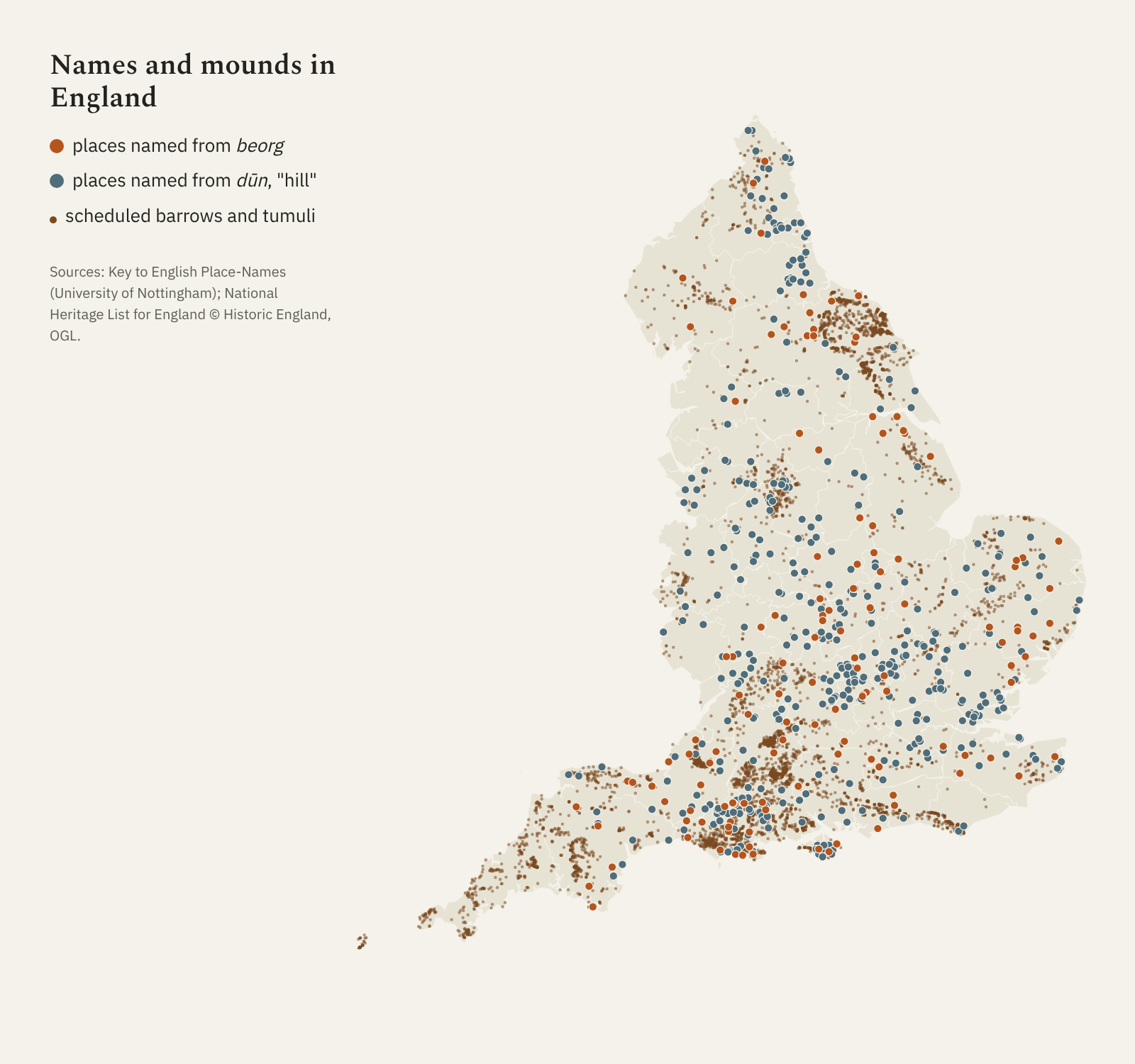
One caution matters here. Scheduled monuments are only the barrows that survive well enough to protect. Centuries of ploughing have levelled thousands more, especially in the arable east where many beorg names sit. A zero means no surviving, scheduled barrow, not that there never was one.
The one that might
Hlāw, the word behind Taplow and many northern “laws”, scores highest: 1.5 times the expected barrows within 2 km. Taplow itself is named after a real Anglo-Saxon burial mound in its old churchyard. With only 88 places the interval runs from 0.9 to 2.3, so this is a lead rather than a finding. Bearu, which has nothing to do with mounds, sits well below 1, as it should.
Sources
- Key to English Place-Names, Institute for Name-Studies, University of Nottingham.
- National Heritage List for England, scheduled monuments © Historic England, Open Government Licence. Contains OS data © Crown copyright and database right.
- Data and code: GitHub, archived as doi:10.5281/zenodo.23676162.
- AI use: written with drafting, data and coding help from Claude (Anthropic).

