
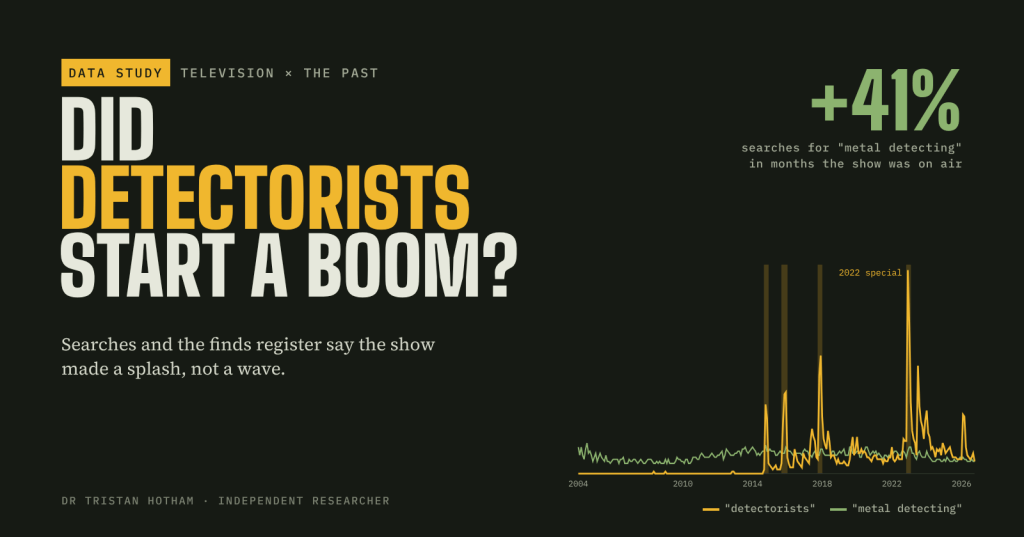
A gentle BBC comedy about two men and a field became a national favourite, and people often say it got Britain out detecting. Here is what the searches and the finds register show.
Mackenzie Crook’s Detectorists began on BBC Four on 2 October 2014. Two more series followed in 2015 and 2017, and a Christmas special on BBC Two in December 2022. It won a BAFTA, and it is often credited with making metal detecting respectable, even fashionable.
That claim can be tested. Google Trends shows when people in the UK searched for the hobby. The Portable Antiquities Scheme, run by the British Museum, records objects found by the public in England and Wales, and almost nine in ten of its records come from metal detectorists. If the show drew people into the fields, both should move when it aired.
What the searches say
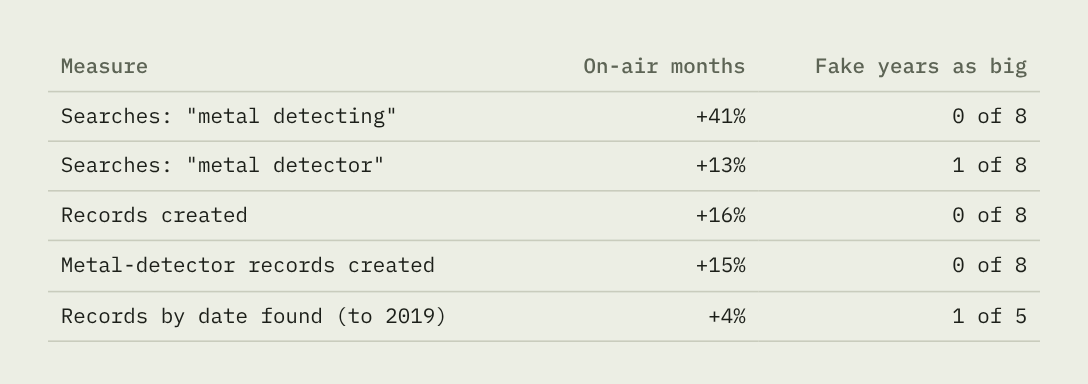
Searches for the show itself jump every time it airs, highest of all for the 2022 special. Searches for “metal detecting” jump in the same months, by about 41% compared with the same months in other years. That is bigger than any of the fake broadcast years I tested.
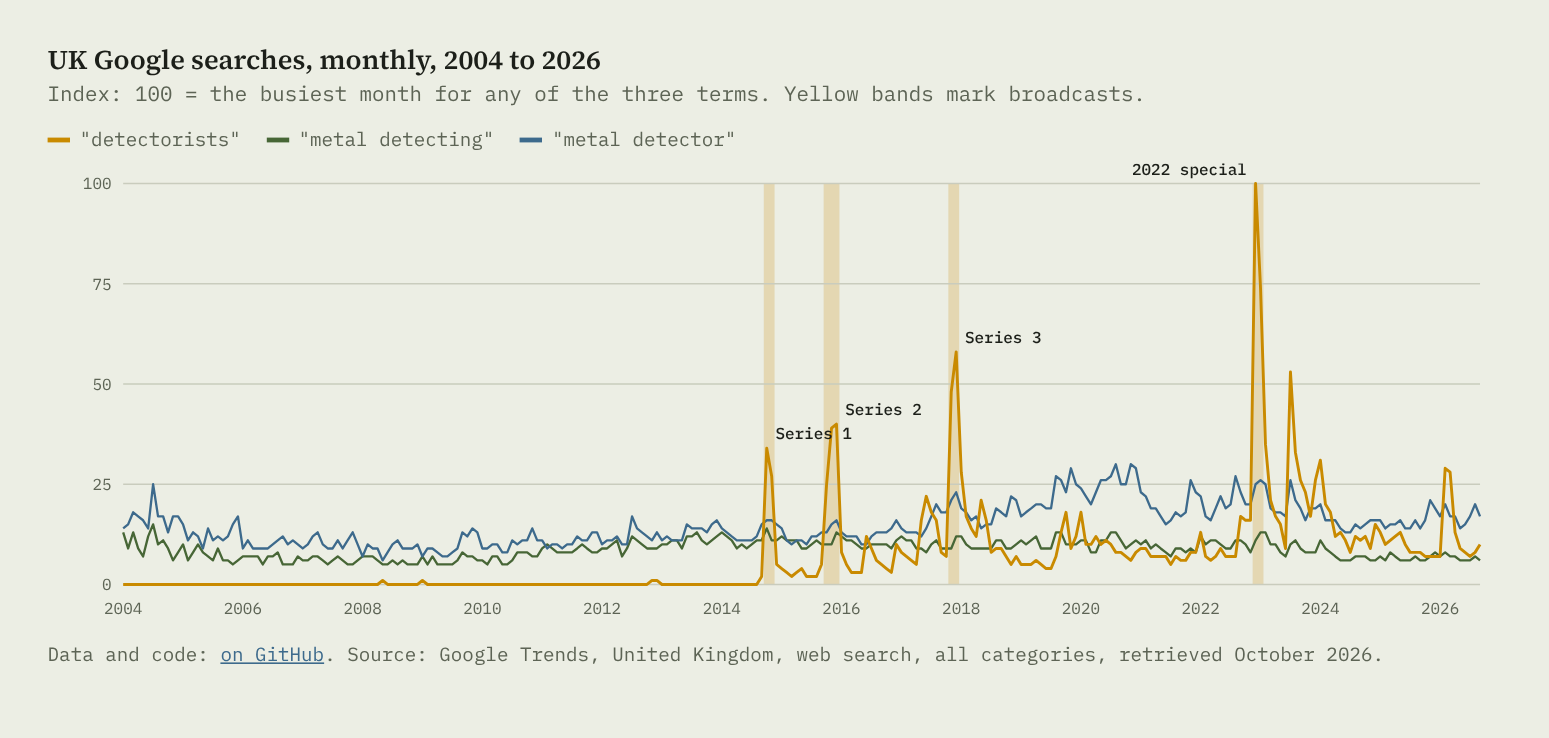
But the jump does not last. Interest in “metal detecting” had already doubled between 2008 and 2013, before the show existed. After 2014 it stays at that level and then slowly falls. The show arrived at the top of a rise; it did not start one.
What the finds say
The finds register tells a similar story. October 2014, the month series one began, was the busiest month the scheme had ever had, apart from two bulk data uploads. Across all four broadcasts, months with the show on air saw about 16% more records than the same months in other years.
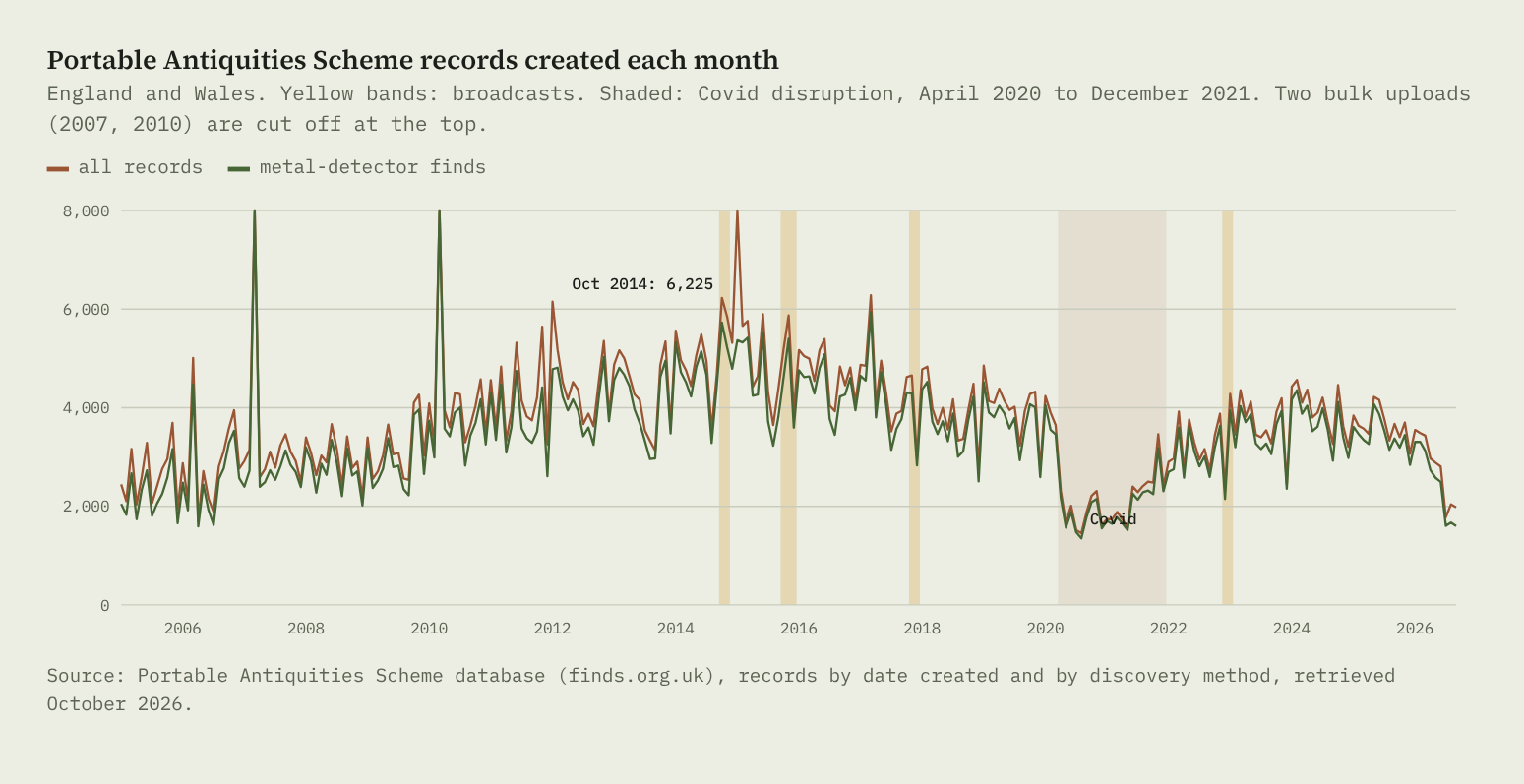
Yet 2014 and 2015 turned out to be the peak. Recording fell slowly after 2015, collapsed when Covid stopped finds officers meeting the public, and has only partly recovered.
There is a twist. If the show sent new people out detecting, you would expect more objects to be found in those months, not just recorded. The register also says when each object was found. By that measure, broadcast months were only 4% busier than usual, well within normal variation. The extra records look like detectorists bringing in objects they already had, perhaps prompted by seeing the hobby on screen, rather than new finds.
The real boom came later
One search term did change for good. Searches for “metal detector”, the thing you buy, were flat for a decade and then rose by about three-quarters between 2016 and 2019. They peaked in 2020, when lockdown sent people looking for outdoor hobbies they could do alone.
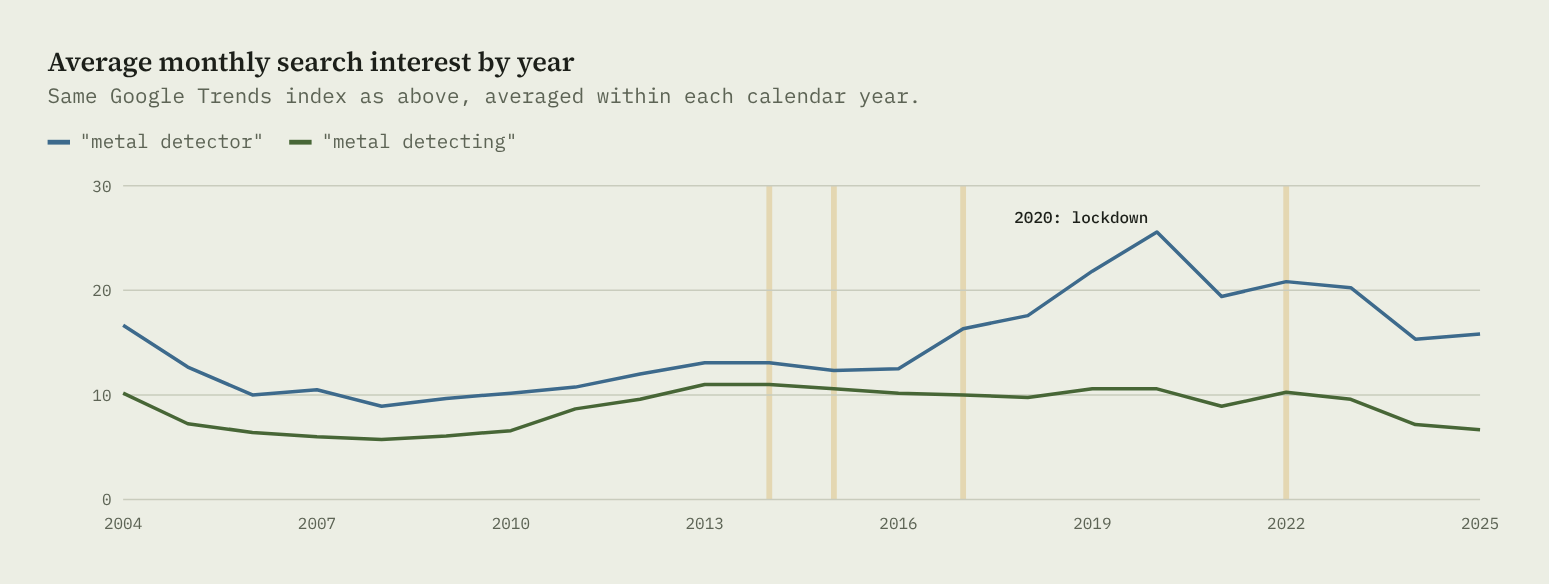
Series three aired in late 2017, in the middle of that rise, so it may have helped. But the timing points to a broader trend, cheaper machines and online videos among them, and above all to the pandemic.
So, did it?
Detectorists left a clear mark: every series sent people searching for the hobby, and finds officers saw more objects in the months it was on. But it did not start a lasting boom. The hobby was already growing before the show, recording peaked while it was on air, and the biggest change since came with lockdown, not with Lance and Andy. A splash, not a wave.
How I tested it
I used monthly data from January 2004 for searches and January 2005 for finds, to September 2026. Each series is modelled on a log scale with a linear trend, a separate level for each calendar month to remove the seasons, a Covid term, and a term for the months the show was on air. A second model adds a lasting step after each series.
To check the on-air effect, I moved the broadcast months to fake years, the same calendar months one to nine years earlier or later, and refitted. The real effect on “metal detecting” searches and on records created was bigger than every fake. To check for lasting steps, I tried a fake break at every month from 2006 to 2023 that was at least a year from a real broadcast. The real breaks were no bigger than many of the fakes, so I do not read them as effects of the show.
Some caveats. The finds register measures recording, not detecting: how many finds get recorded depends on how many finds liaison officers there are and how much time they have, so a flat line does not prove no one took up the hobby. Google Trends gives relative interest, and small values are rounded, so the early “detectorists” series is noisy. Bulk uploads of older records in March 2007, March 2010 and January 2015 are treated separately. Only eight fake-year tests were possible without overlapping a real broadcast, so that check is indicative rather than precise.
Sources
- Google Trends, United Kingdom, web search, all categories, retrieved October 2026.
- Portable Antiquities Scheme database, records by date created, date found and discovery method, retrieved October 2026.
- Data and code: GitHub, archived as doi:10.5281/zenodo.23666468.

