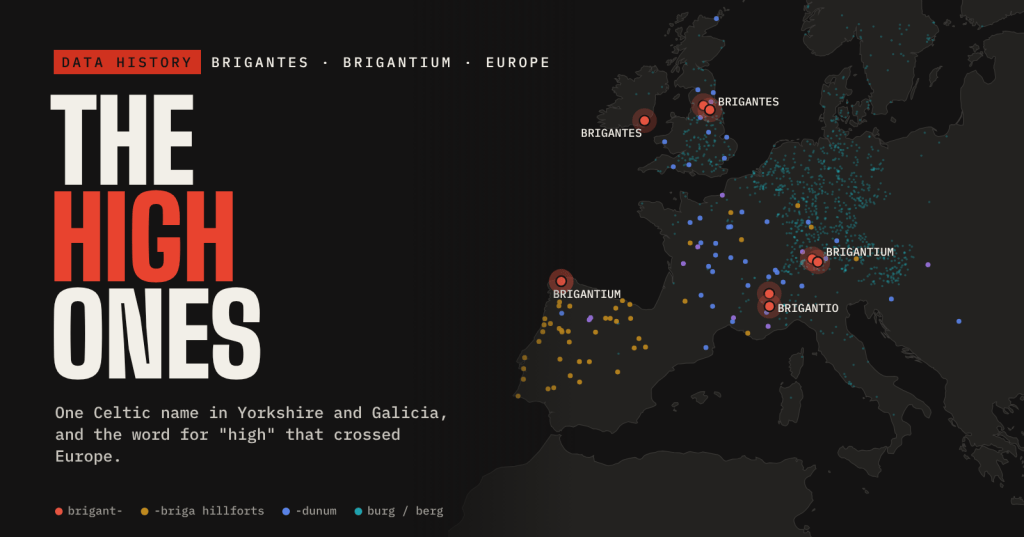
The Brigantes of northern England and the Brigantium of A Coruña share a name. Here is what 105 ancient places, 1,161 modern towns and twenty Roman inscriptions say about why.
I live near Clitheroe, in what was once Brigantes country. My wife is from Aldán, on the Galician coast a couple of hours south of A Coruña, the Roman Brigantium. My surname comes from a village in East Yorkshire. So when I read that the Brigantes and Brigantium might be connected, I wanted to know whether the evidence holds up. It turns out the answer is bigger than either place.
The full interactive version has a clickable family tree of the word and a zoomable map of every place that carries it.
The legend
The story is old. In the medieval Irish Lebor Gabála Érenn, a king called Breogán builds a city called Brigantia and a great tower. From the top his son Íth sees Ireland, and the Gaels sail north to settle it. The tower is usually taken to be the Tower of Hercules in A Coruña, a Roman lighthouse known as Farum Brigantium until the twentieth century. Galicia’s anthem still calls the land the home of Breogán.
Across the sea, the Brigantes were the largest tribe in Roman Britain, centred on the Pennines and Yorkshire, with their capital at Isurium Brigantum, now Aldborough. Their queen Cartimandua handed the rebel Caratacus to Rome in AD 51. Ptolemy also places a people called Brigantes on the south-east coast of Ireland.
So we have a Brigantium in Galicia, Brigantes in England and Ireland, and an Irish legend linking Galicia to Ireland. Is that a trail, or a coincidence? Scholars call the Breogán story synthetic pseudohistory, built on likenesses like Iberia and Hibernia. But you can test the name itself with data, and that turns out to be the interesting part.
One root, many branches
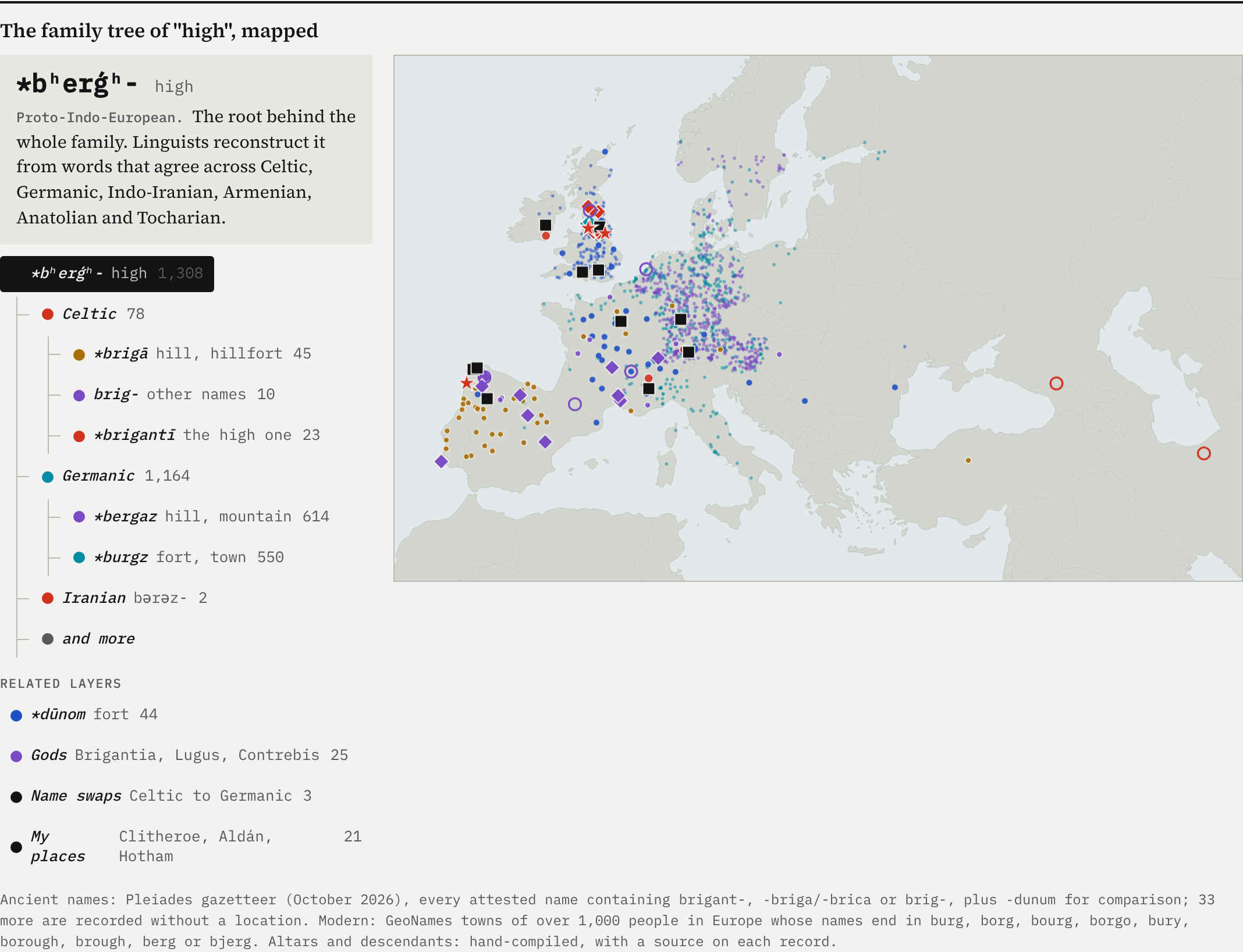
Brigantes comes from a Celtic word, *brigantī, “the high one”. That word grows from an older root, Proto-Indo-European *bʰerǵʰ-, “high”. The same root gave Celtic *brigā, “hill” or “hillfort”, and on the Germanic side *bergaz, “hill” (German Berg, English barrow). It probably gave *burgz, “fort” too, the source of burg, borough and ‑bury, though some scholars put that one on a neighbouring root meaning “protect”. In Iran the same root names the Alborz mountains, from Avestan Harā Bərəzaitī, “high watch”.
I mapped the whole family: ancient names from the Pleiades gazetteer of the classical world, modern towns from GeoNames, and Roman altars from the inscription corpora. In the interactive version you pick a branch on the tree and the map shows every place that carries it.
Two words for a hillfort
The first thing the map shows is that Celtic speakers had two everyday words for a fortified hilltop, and they used them in different places. In Iberia it was ‑briga: Conimbriga, Segobriga, Mirobriga, Iuliobriga. In Gaul and Britain it was ‑dunum: Lugdunum (Lyon), Camulodunum (Colchester), Sorviodunum (Old Sarum).
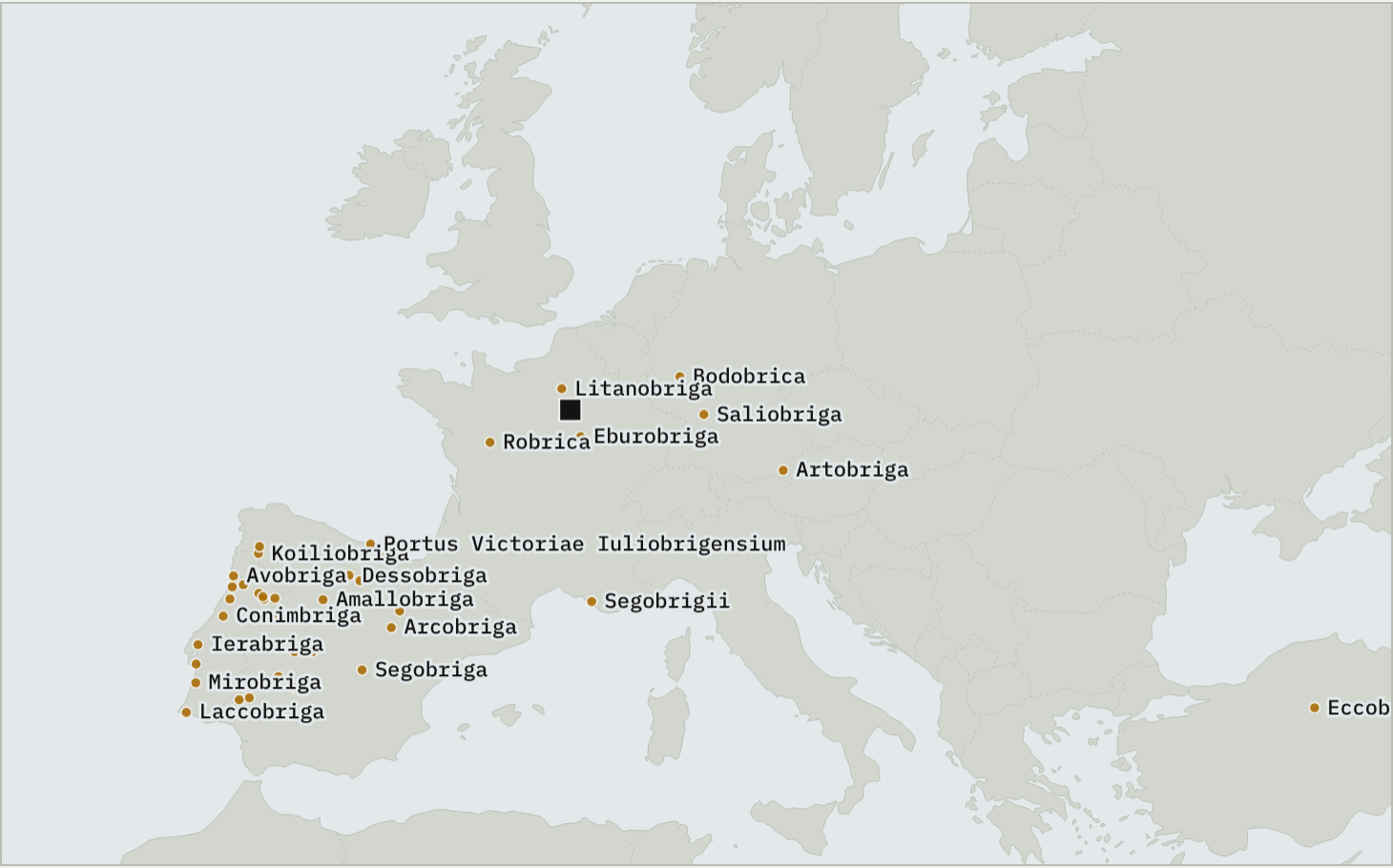
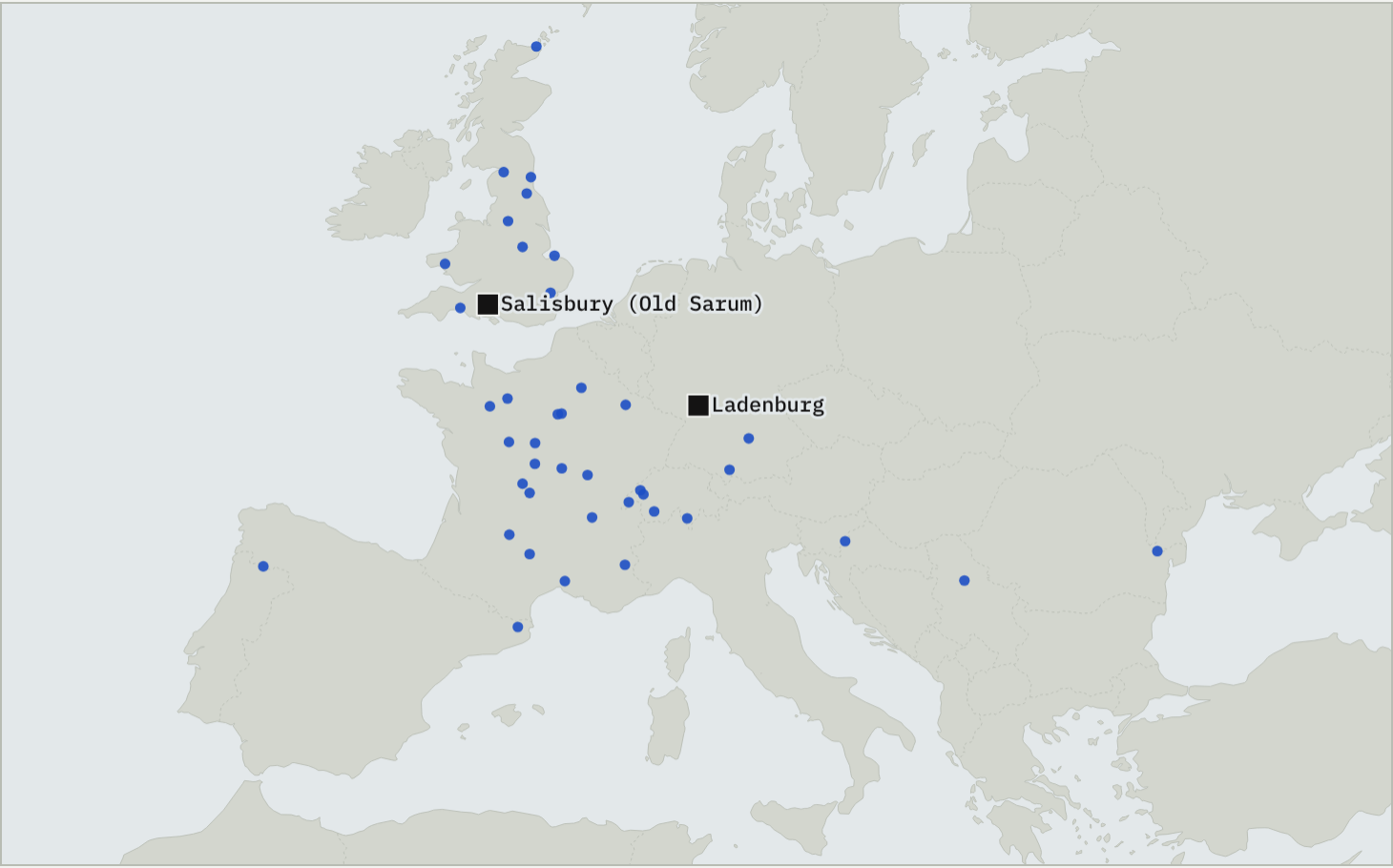
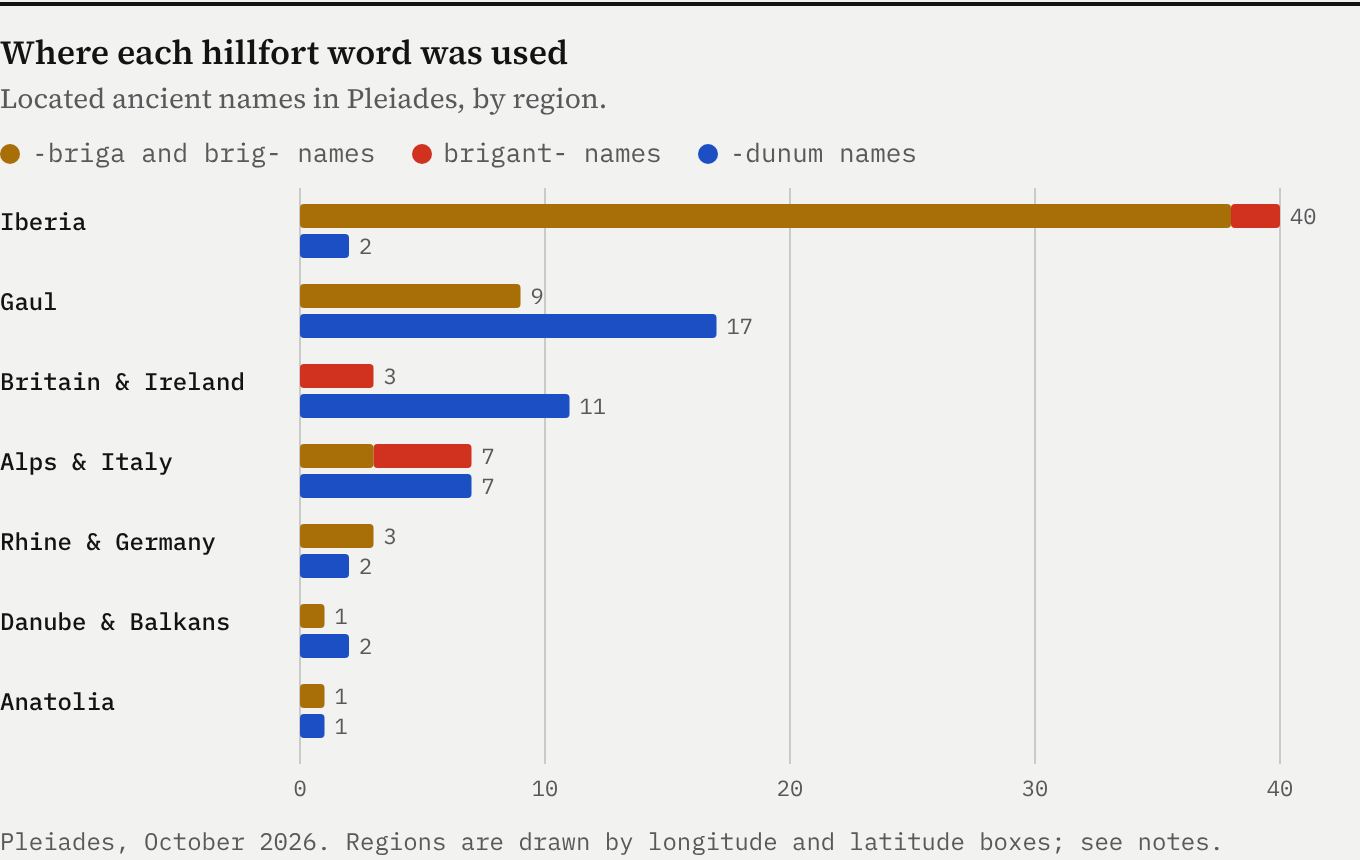
That split is old news to Celtic scholars, but it is satisfying to see it fall out of an open dataset. Patrick Sims-Williams counted 153 Celtic-looking place names in ancient Hispania and found 62 of them, 41%, contain BRIG. The Pleiades data agrees: 36 of the 40 located brig- names it holds for Iberia are ‑briga compounds, against just two ‑dunum names.
It also matters for the Brigantes question. Galicia’s Brigantium sits inside the densest brig- landscape in Europe. Northern England’s Brigantes sit in a ‑dunum landscape, with no ‑briga towns at all. If a single group of people had carried the name from Galicia to Yorkshire, you might expect them to bring their naming habits too. They did not.
The high ones
Narrow the search to the full word, brigant-, and only nine located places remain in Pleiades: two in north-west Iberia (Brigantium and its lighthouse), four in the Alps (two Brigantio, Brigantium at Bregenz and Lake Constance, the “Brigantine lake”), and three in Britain and Ireland (two Brigantes and their capital).
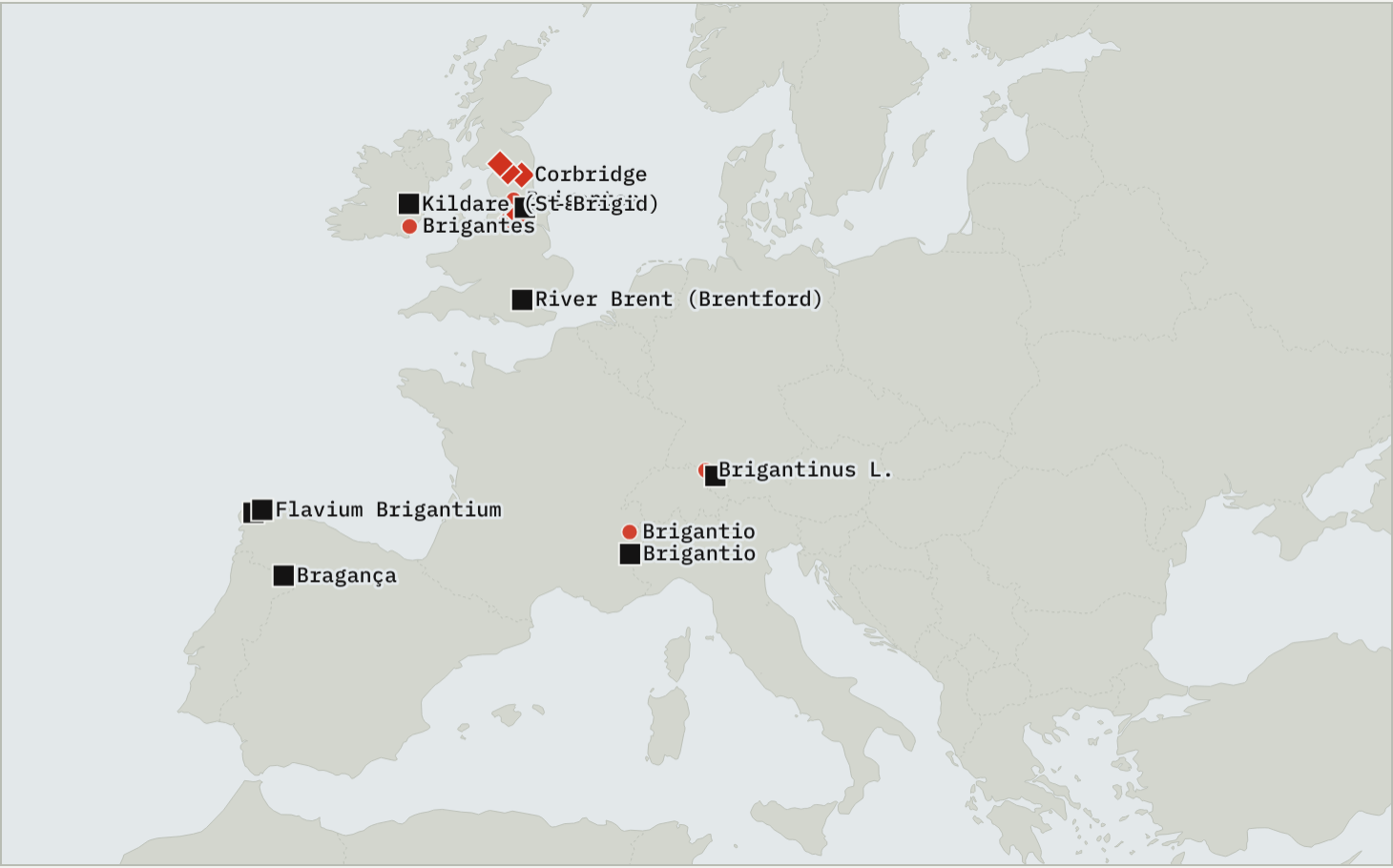
Three clusters, up to 1,500 kilometres apart, and nothing in between.
That is the mystery in data form. Brigantium names do not trail across France like footprints from Galicia to Yorkshire. They pop up at the edges: the Atlantic headland of Galicia, the high Alpine passes, the Pennines. All three are high or remote places, which fits a name meaning “the high ones” or “the high place”. The most economical reading is that a common Celtic word was used for high places and the people who lived in them, wherever Celtic was spoken.
Gods in the mirror
Inscriptions tell us what people actually said. Here the two regions show a curious mirror image.
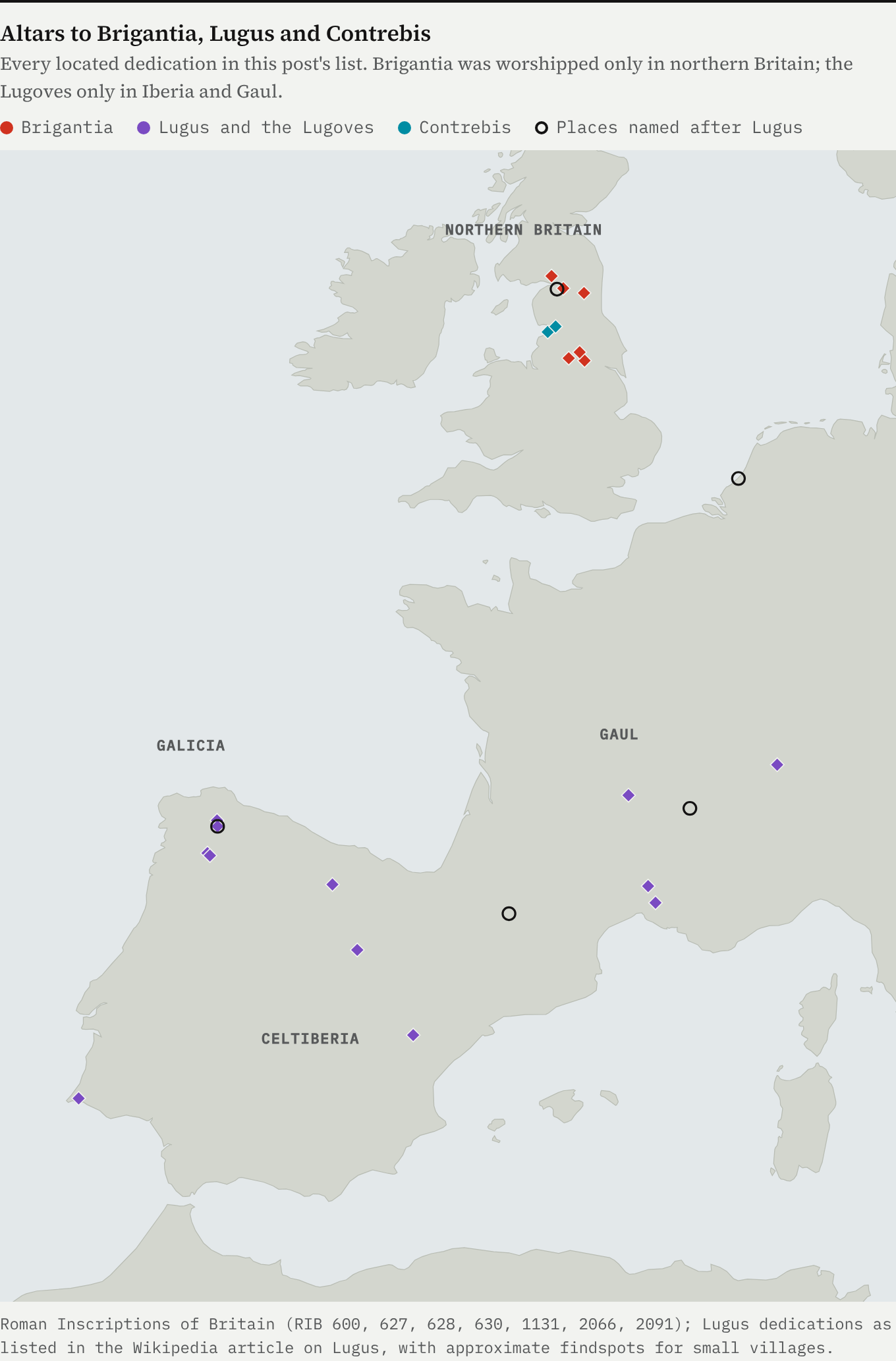
Northern England worshipped a goddess called Brigantia: about eight altars are known, from Greetland and Castleford in West Yorkshire to Corbridge and Birrens on the Scottish border. One, at Adel near Leeds, was set up by a woman called Cingetissa. None is known from Iberia. Galicia worshipped the Lugoves, the plural form of the god Lugus, especially around Lugo. Carlisle’s Roman name, Luguvalium, may carry the same god’s name.
So Yorkshire has the goddess and Galicia has the place; Galicia has the gods and Cumbria may have the place. Then there is Lancaster. An altar found by a spring there in 1802 is dedicated to Ialonus Contrebis, and another to Contrebis comes from Overborough up the Lune valley. Contrebis means something like “he who dwells among us”, from con- “together” and treb- “dwelling”, the same compound as the Celtiberian towns called Contrebia in Spain.
| Galicia / Iberia | Northern England | Shared root? |
|---|---|---|
| Brigantium (A Coruña) | Brigantes, Brigantia | Yes: Celtic *brigantī, “high one” |
| Contrebia (Celtiberian towns) | Contrebis (Lancaster) | Yes: Celtic con- + treb-, “dwelling together” |
| Lucus Augusti (Lugo), the Lugoves | Luguvalium (Carlisle) | Possibly: the god Lugus, if not Latin lucus or a personal name |
| Lugo | River Lune (Lancaster) | No: Lune is from *lǭn, “full”, or the god Ialonus |
Every real match is a Celtic word, and every one also turns up elsewhere in Europe. That is what you would expect from two peoples speaking related Celtic languages, using the same stock of words for gods, high places and settlements. It is not what you would expect from a migration that left a signature only in these two places.
Then came the burgs
The root did not stop with the Celts. On the Germanic side it became Berg (hill) and Burg (fort), and those words now mark more than a thousand European towns of over 1,000 people.
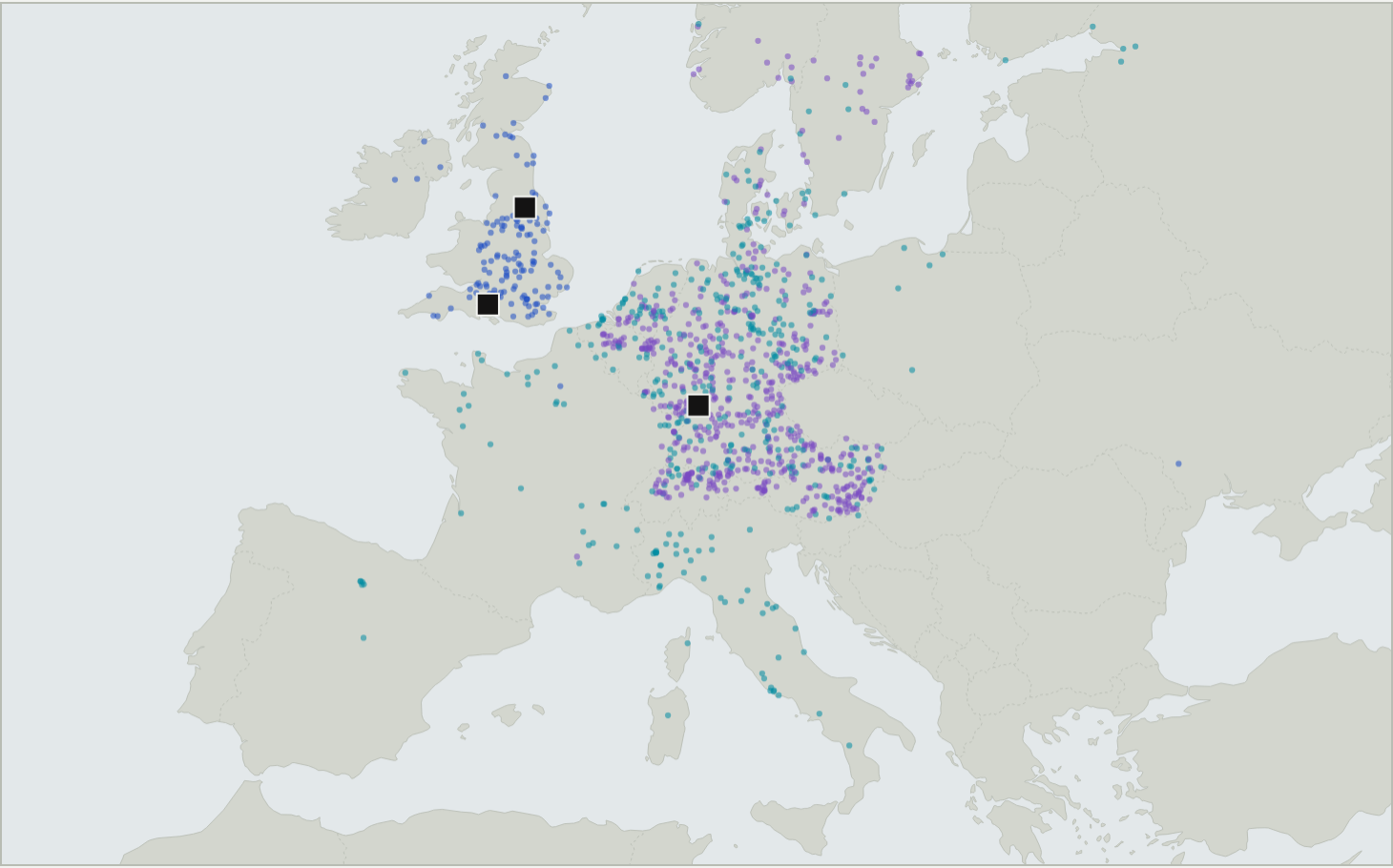
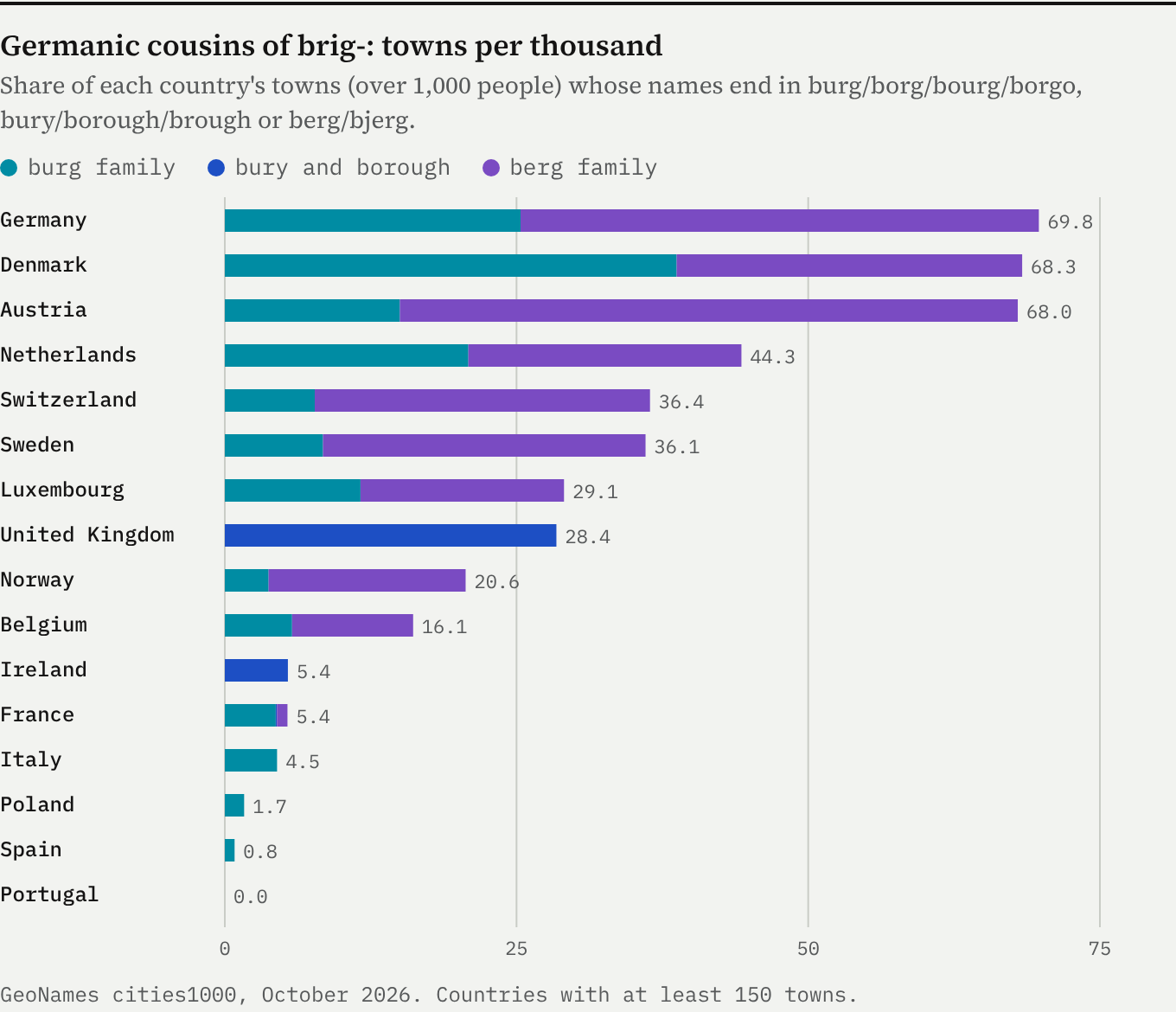
Britain has its own form, ‑bury and ‑borough, from Old English burh, in 132 of its towns. Spain has six, Burgos among them, through Late Latin burgus. Galicia got its own Germanic wave too: the Suebi ruled it from the fifth century, and Aldán has a Suebic cemetery on the hill in the village centre.
The best part is where the two branches meet in one place. In three famous cases a Celtic hillfort name was replaced or translated by its Germanic equivalent:
- Isurium Brigantum → Aldborough. The Brigantes’ capital. By 1086 it was simply Burgh, Old English burh; “ald”, old, was added by 1145.
- Sorviodunum → Salisbury. English speakers kept Sorvio- as Searo- and swapped ‑dunum for ‑byrig, fort.
- Lopodunum → Ladenburg. Celtic Lokudunom on the Neckar; Frankish speakers made it Lobdenburg, so ‑dunum became ‑burg.
Elsewhere the Celtic name survived: Brigantium is still Bregenz on Lake Constance, and Brigantia is Bragança in Portugal, recorded as Bregancia in AD 666. At A Coruña the name was lost, though the lighthouse kept it.
Aldborough is the one that matters here. The capital of the Brigantes, the “high ones”, is today called by the Old English word burh. Both words, quite possibly, grew from the same Indo-European root. The Brigantes did not vanish from their capital’s name; they were translated.
What the DNA says
Names travel without people, so the strongest test of a Galicia–Yorkshire connection would be genetic. Here is the current state of the evidence, as far as I can find it.
- c. 4000 BC: Britain’s first farmers came with ancestry traced back to Anatolia and the Aegean, largely along the Mediterranean and Atlantic route. Iberia and Britain share this deep layer.
- c. 2450 BC: with the Beaker culture, about 90% of Britain’s gene pool was replaced by people with steppe-related ancestry. Iberia’s turnover around 2500 to 2000 BC replaced about 40% of its ancestry and nearly all its male lines.
- c. 1000 to 875 BC: a migration from across the Channel, from people genetically similar to ancient France, raised early-farmer ancestry in southern Britain. The authors suggest it may help explain how early Celtic languages reached Britain.
- Iron Age Britain: a 2025 study of 57 genomes found continental links across the Channel. It does not identify Iberia as a source.
- Galicia: I could not find a published study comparing Iron Age genomes from Galicia directly with Iron Age northern England. That is the missing test.
So the genetics points to a France-centred route for the people, and possibly the language, that reached Britain in the late Bronze Age. It does not rule out Atlantic contact, but it gives no direct support to a Galician origin for the Brigantes.
Where did Celtic come from?
The Brigantes question is a small part of a big one. There are three main theories of where the Celtic languages began:
| Theory | Claim | What the name map shows |
|---|---|---|
| Celtic from the East | Celtic spread west from central Europe with the Hallstatt and La Tène cultures, from about 750 BC. | Harder to square with the densest brig- names sitting in far-western Iberia. |
| Celtic from the West (Koch, Cunliffe) | Celtic grew along the Atlantic coast in the Bronze Age, carried by sea networks. | Fits the Atlantic edge of the brigant- names, and the Galicia–Britain–Ireland triangle. |
| Celtic from the Centre (Sims-Williams, 2020) | Celtic radiated from France in the first millennium BC. | Fits the lack of variety in Iberian names, which he argues points to a young layer, and the DNA arriving from France. |
The name data alone cannot settle that argument. What it can do is show that the Brigantes–Brigantium likeness belongs to the shared vocabulary of a Celtic-speaking world from Galicia to the Alps and Yorkshire, whichever way that world formed.
The verdict
| Line of evidence | Finding | Verdict |
|---|---|---|
| Name | Same Celtic word, *brigantī, “high one” | Real |
| Spread of the name | Three separate clusters, Galicia, the Alps and Britain/Ireland, with nothing between | Shared word, not a trail |
| Hillfort words | Galicia uses ‑briga; Brigantes country uses ‑dunum | Against |
| Gods | Brigantia only in Britain; Lugoves mostly in Iberia; Contrebis–Contrebia shared | Shared vocabulary |
| Legend | Breogán’s tower is medieval, 11th century | Myth |
| DNA | No direct Iron Age comparison; Bronze Age migration from France | Not shown |
My reading is that the Brigantes and the people of Brigantium were not one tribe, and there is no good evidence that one came from the other. But they were connected, in a way that is arguably more interesting. They spoke related Celtic languages and drew on the same words for the sacred and the high. That word, *bʰerǵʰ-, had already split into Celtic brig-, Germanic Berg and burg, and Iranian bərəz-. Two thousand years later it is still on the map, in Bregenz, Bragança, Brigid, Brendan, Salisbury, Edinburgh and the Alborz.
What would settle it is the genetic test nobody seems to have run yet: Iron Age genomes from Galician castros compared with Iron Age burials from Brigantes country. Until then, the most honest thing to say is that the Brigantes and Brigantium share a language, not a family tree.
Notes and sources
- Legend and tower: Breogán; Tower of Hercules. Brigantes: Brigantes; Aldborough.
- Etymology: Wiktionary, Proto-Celtic *brigantī and *brigā, Proto-Germanic *bergaz, *burgz and *tūną; Indo-European Lexicon, University of Texas; Encyclopaedia Iranica on Alborz.
- Ancient places: Pleiades gazetteer dumps, 25 October 2026, names matched on brigant-, ‑briga/‑brica and brig-, excluding false matches such as fabrica and the Gaulish ‑broges names. Located: 9 brigant-, 44 ‑briga, 10 other brig-, 42 ‑dunum; 33 more unlocated.
- Modern towns: GeoNames cities1000, European towns of over 1,000 people ending in burg, borg, bourg, borgo, bury, borough, brough, berg or bjerg.
- Inscriptions: Roman Inscriptions of Britain 627, 628, 630, 1131, 2066, 2091, 600; Brigantia; Lugus; Ialonus Contrebis; River Lune.
- Name swaps: Old Sarum; Ladenburg; Bragança.
- Celtic origins: Sims-Williams, “An Alternative to ‘Celtic from the East’ and ‘Celtic from the West’”, Cambridge Archaeological Journal 30(3), 2020; Celtic from the West; García Alonso, -Briga toponyms in the Iberian Peninsula, 2006.
- Ancient DNA: Brace and others 2019 (NHM); Olalde and others 2019; Patterson and others 2022 (summary); Iron Age Britain, Nature 2025.
- Personal places: Aldán; Hotham (Old English hōd, “shelter”).

