
The triple spiral is sold as an ancient Celtic sign of the Atlantic coast. The data tells a newer story.
Walk through Quimper, Santiago de Compostela or Oviedo and the triple spiral is everywhere: on flags, café signs, earrings, football crests and car stickers. It comes with a story. The symbol, we are told, is the ancient mark of a Celtic people who once lined the Atlantic edge of Europe, from Galicia to Brittany to Ireland.
Part of that story is true. The triple spiral really is old, and it really does turn up on Atlantic stones. But when you count where and when it actually appears, a different picture emerges. The triskell as an emblem of identity is largely a twentieth-century creation, and most of its growth has happened in living memory.
Five thousand years on one map
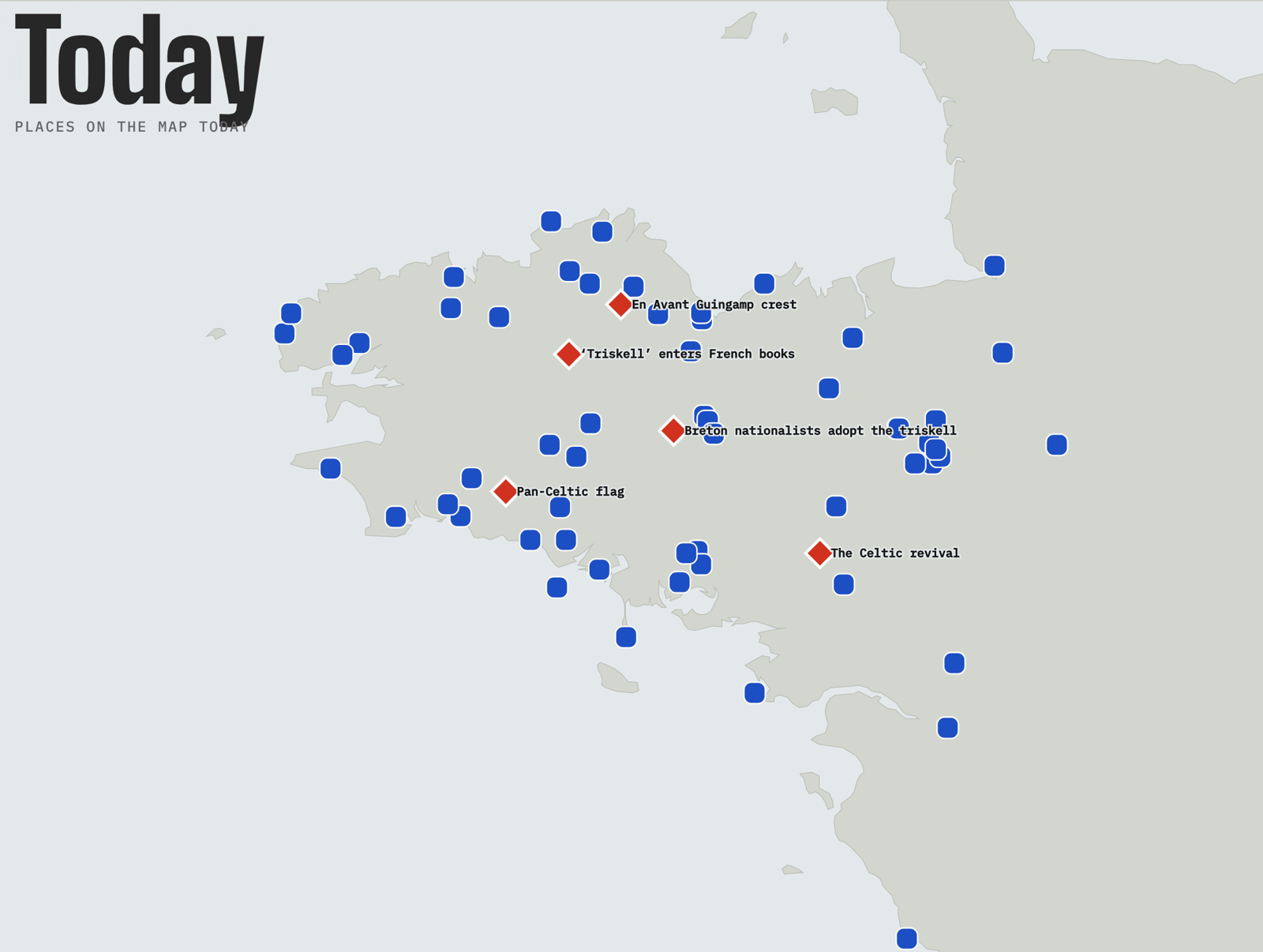
I put every triple spiral I could place on one map: ancient sites, objects found in English and Welsh fields, modern emblems and movements, and the 127 shops, bars, streets and halls named after it today. Here it is at four moments.
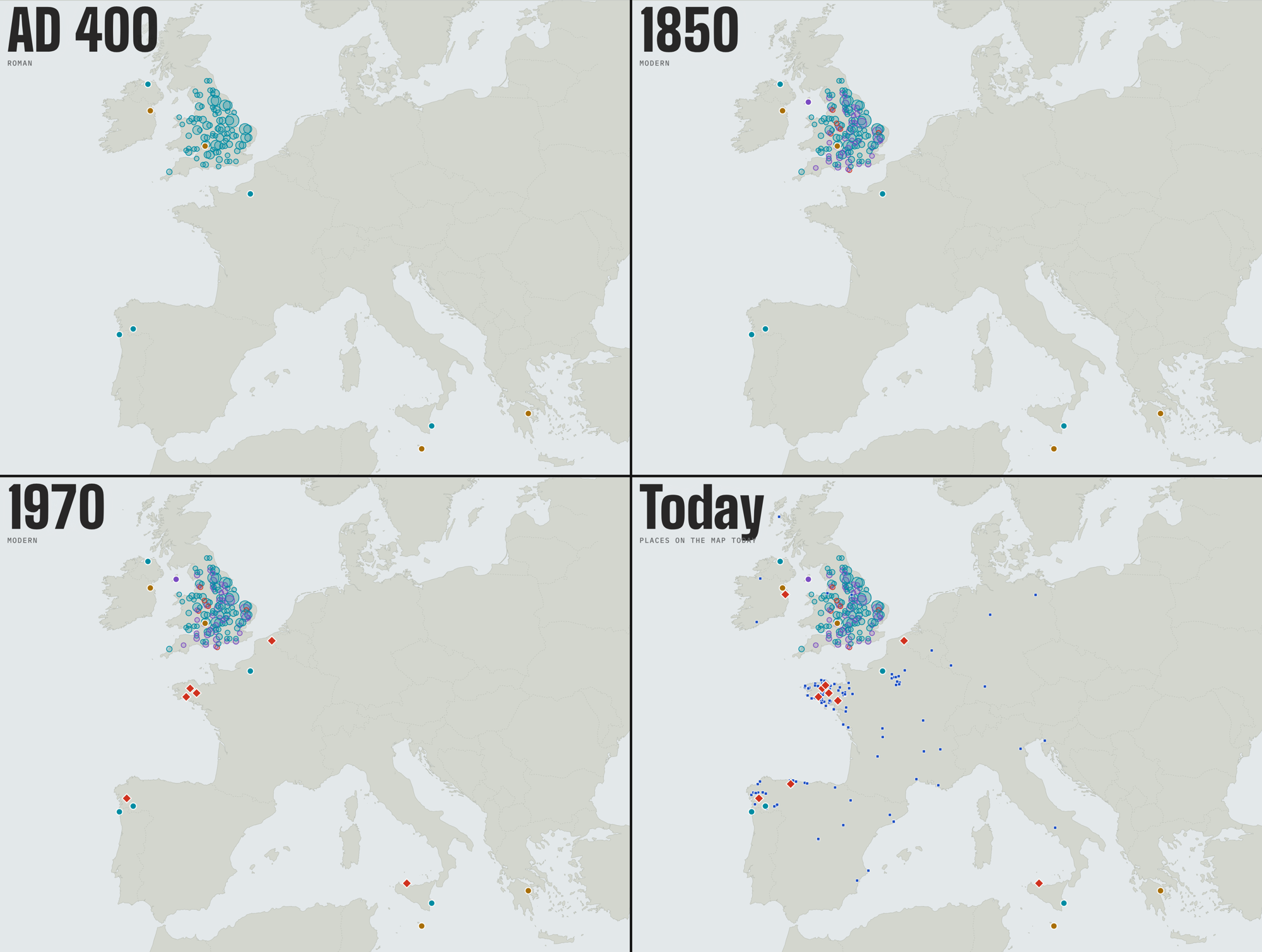
Two things stand out. For four thousand years the spiral is everywhere and nowhere in particular: Malta, Mycenae, Sicily, Normandy, the Boyne valley, and hundreds of brooches and harness fittings in English fields. Then, after the Middle Ages, it almost vanishes from these records. When it comes back, it comes back in one place. Brittany takes it up between the wars, and the modern map fills in from there.
What the stones say
Triple spirals are among the oldest designs in Europe. They appear in Malta’s temples in the fourth millennium BC, and on a carved stone inside Newgrange in Ireland around 3200 BC. They return in Iron Age metalwork of the La Tène style, and they are carved into the stones of Castro culture hillforts in Galicia, Asturias and northern Portugal.
But the ancient examples are scattered across thousands of years and the whole continent, from Mycenae to Sicily to the Boyne valley. The three-legged version belongs to Greek Sicily, on the coins of Syracuse, before it belongs to anyone on the Atlantic. Nothing in the record marks the spiral out as a particularly Atlantic or Celtic sign.
What the fields say
A bigger sample comes from the Portable Antiquities Scheme, which records objects found by the public in England and Wales, mostly by metal detectorists. Searching its database for “triskele” returns 438 records. About 44% are Iron Age, 32% Roman and 18% early medieval. They are small, everyday-luxury objects: brooches, harness and strap fittings, decorative fobs, and the fittings of early medieval hanging bowls.
If the triskele were a sign of the Atlantic Celtic fringe, you might expect these finds to cluster in Cornwall, Devon and Wales. They do the opposite. A third come from eastern England and Lincolnshire, and another fifth from Yorkshire and the North East. Cornwall and Devon together have three. All of Wales has seventeen.
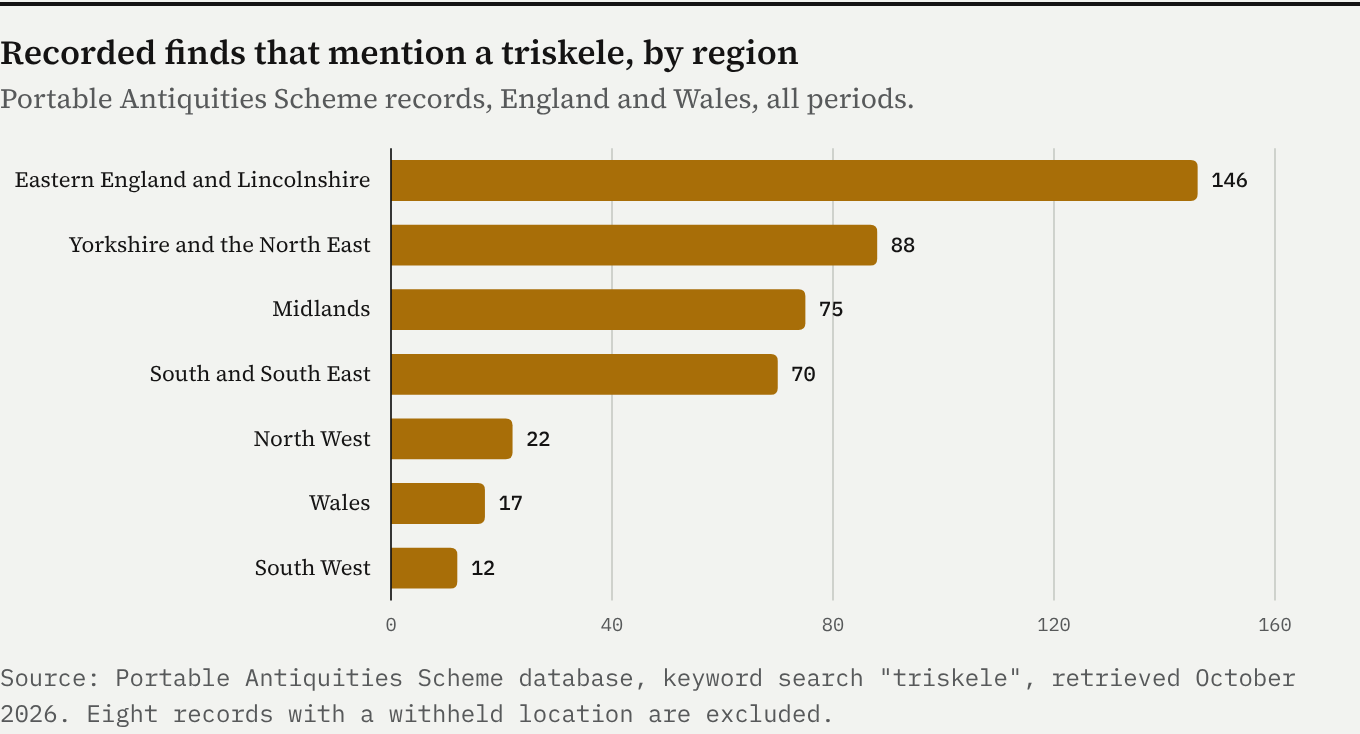
This has a big bias built in. Detectorists work ploughed arable land, which is mostly in the east, and far more finds of every kind are reported from Lincolnshire and Norfolk than from Cornwall. So the chart says more about where people look than where the spiral was used. But it does show that, in Britain, the triskele was at home across the whole Iron Age and Roman world. Nothing in the finds marks it out as a western or “Celtic fringe” design.
What the books say
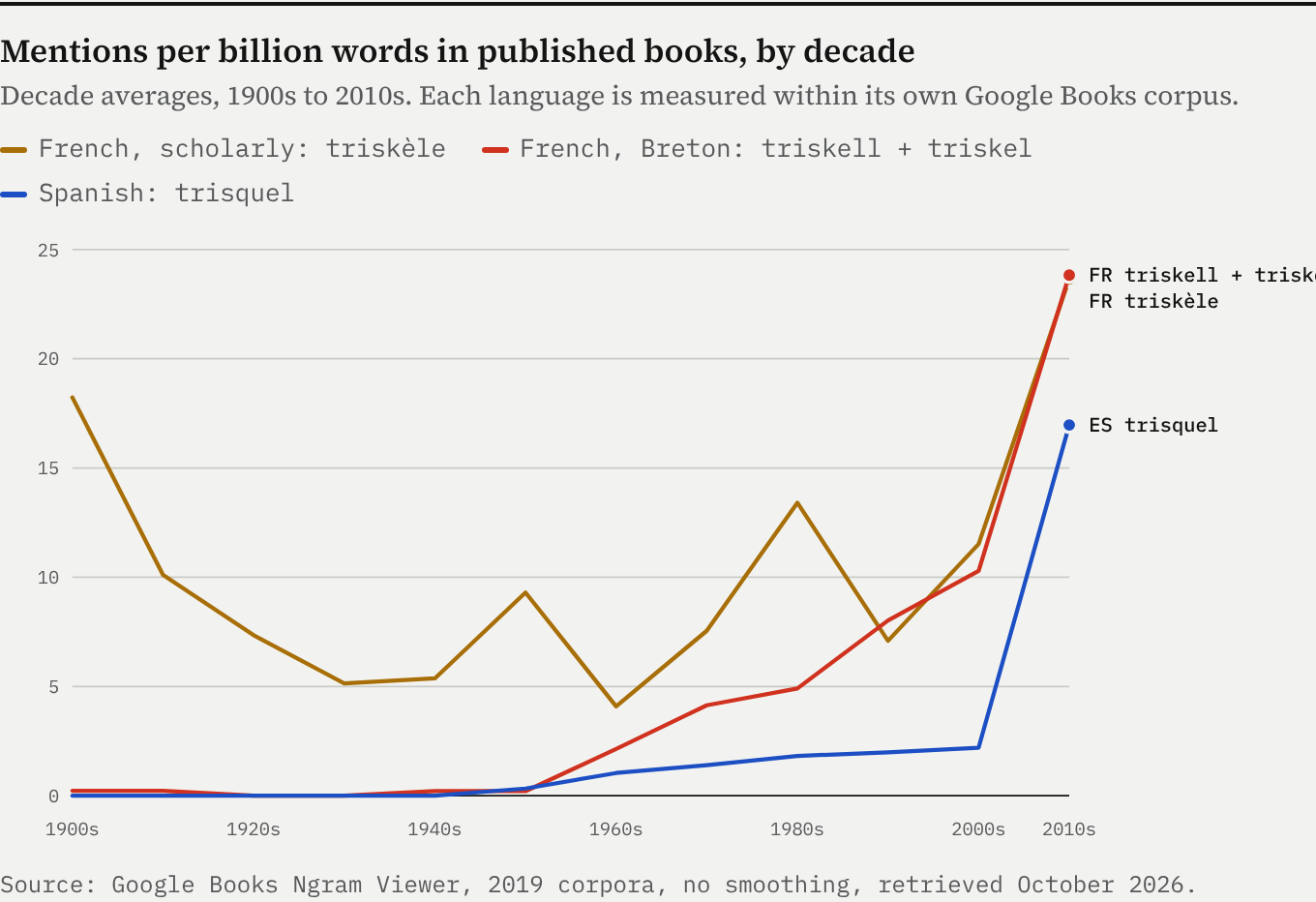
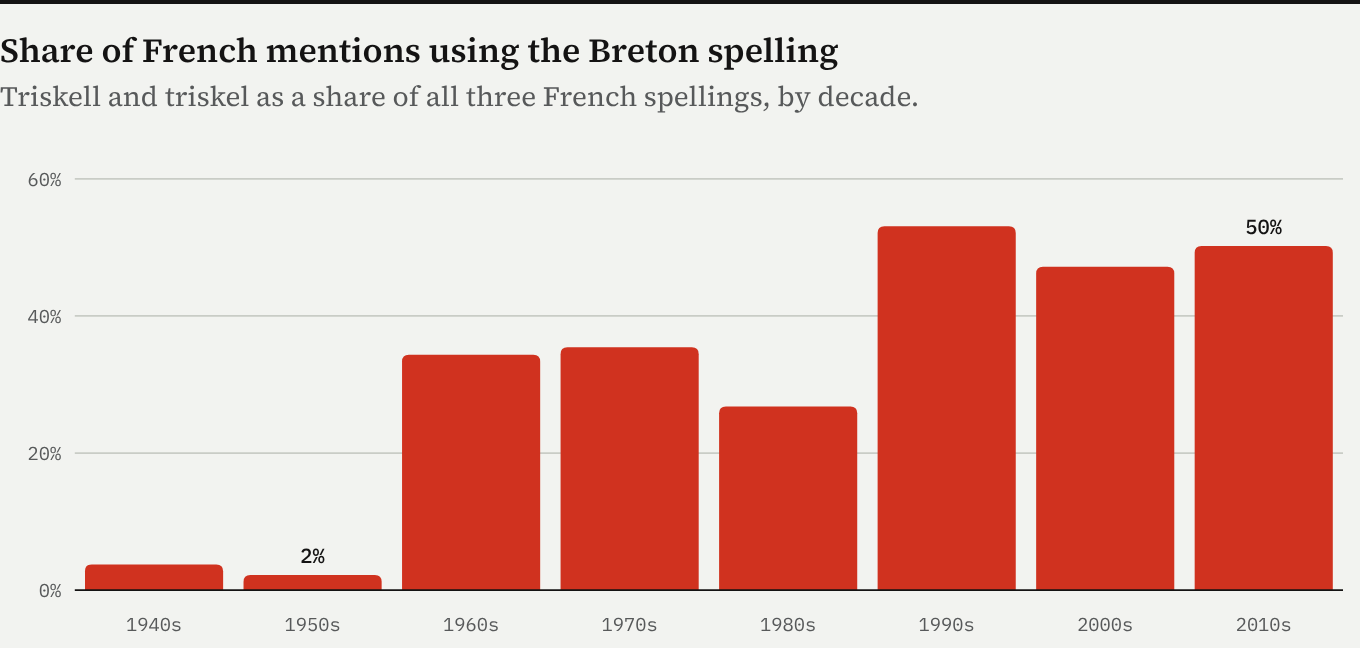
Google Books counts how often a word appears in each year’s published books. That makes it a rough but useful measure of when a term entered everyday writing. French gives a neat test, because it has two spellings. Triskèle is the scholarly form used by archaeologists and art historians. Triskell and triskel are the Breton forms.
The scholarly spelling is present all through the twentieth century, at a fairly steady level. The Breton spelling triskell does not appear in the French corpus until 1949. From the 1960s the Breton forms climb steadily, and in the 2010s they appear as often as the scholarly word. Spanish trisquel first appears in 1957, stays rare for half a century, then rises about eightfold in the 2010s.
What the streets say
The last test is today’s landscape. OpenStreetMap, the volunteer-built map of the world, holds the name of almost every shop, café, street and sports hall in Europe. Across France, Spain, Portugal, the British Isles and the countries around them, I counted every named place called Triskel, Triskell, Triskèle or Trisquel. There are 148.
Nearly two-thirds of them, 93, are in just three regions: Brittany, Galicia and Asturias. Those three regions hold under 3% of the named places in the area searched. Brittany alone has 70: nineteen places called simply Le Triskell, a dozen Triskell roundabouts, estate agents, an insurer, a driving school, a sports complex and a greengrocer.
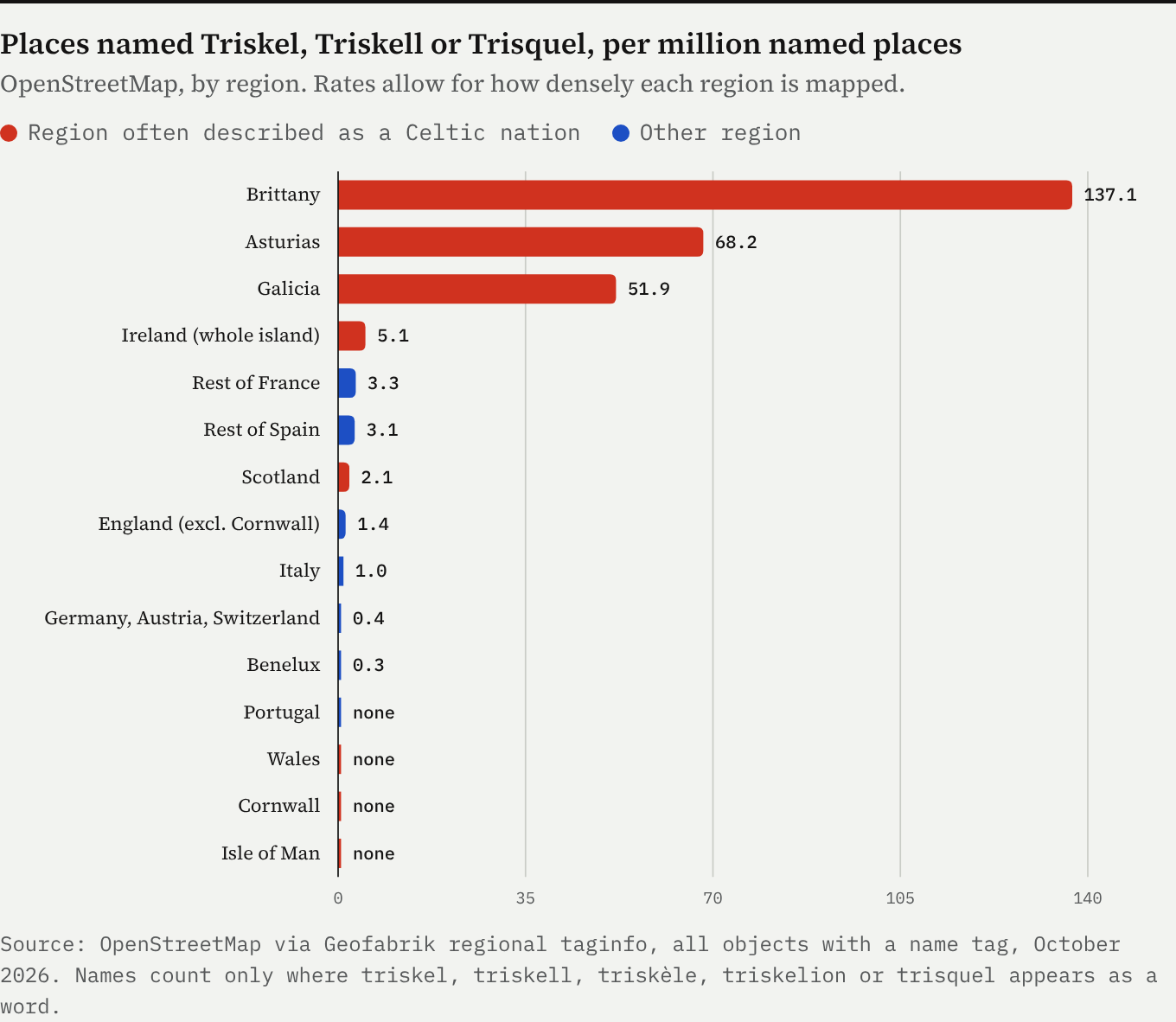
The bottom of the chart matters as much as the top. Wales, Cornwall and the Isle of Man are all counted among the Celtic nations, and none of them has a single place with the name. Ireland, home of the Newgrange spiral, has three, one of them a Cork arts centre. Scotland has one. The modern triskell is not a pan-Celtic sign. It belongs to Brittany, and to the two Spanish regions that most often present themselves as Celtic.
Why now?
The timing fits what historians of Breton identity have described. The symbol’s popularity in Brittany has been traced to the period between the two world wars, when nationalist parties adopted it as a marker of Celtic identity. In the 1950s a Breton designer, Robert Berthelier, put triskells at the centre of a pan-Celtic flag. The Celtic music revival of the 1970s, led by figures like Alan Stivell, carried the spiral to a mass audience.
Galicia and Asturias joined the same family of symbols later. Both now present themselves as Celtic nations, and both appear alongside Brittany, Ireland and the Isle of Man on Manx stamps celebrating Celtic links. The Spanish curve suggests that the trisquel’s spread as a popular emblem is largely a story of the last twenty years.
None of this makes the symbol fake. Castro culture carvings show that Iron Age Galicians used it. What the data show is that the link between the spiral and a shared Atlantic Celtic identity is recent. It was chosen and promoted, and it took off within living memory.
The maths of a whirl
Why does this shape keep being invented? Part of the answer is geometry. The triskele is one of the simplest shapes that turns without being able to be flipped, and its arms are curves that nature draws on its own whenever something spins and drains at once.
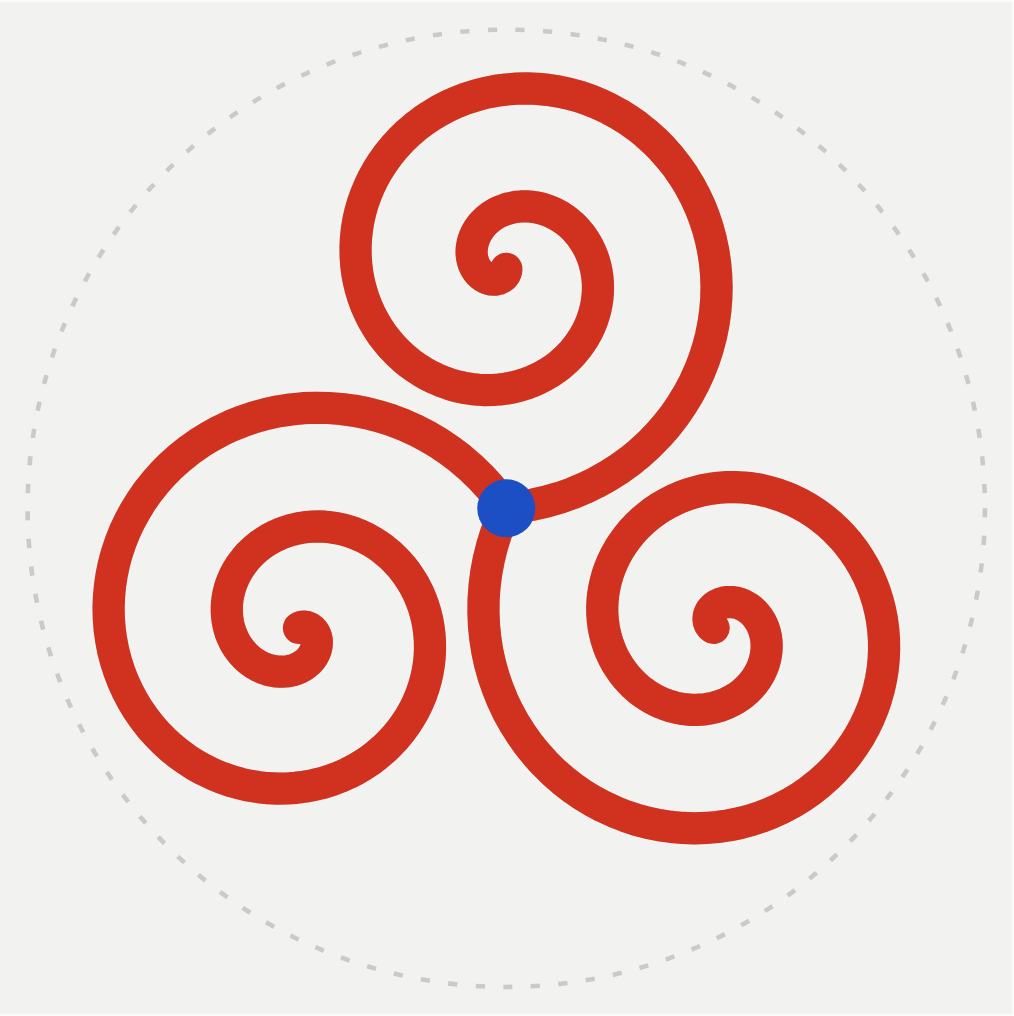
Here is the model. Pick a centre and place three spiral eyes evenly around it. Each arm starts at the centre and winds into its own eye. In polar form around its eye, with θ the angle turned so far and Θ the total turn, an arm is either Archimedean, r(θ) = R(1 − θ/Θ), or logarithmic, r(θ) = R e−bθ. Copy the arm three times, each turned by 120°, and you have the triskele.
The two spirals look alike but behave differently. In an Archimedean spiral the gaps between turns stay the same, like a coiled rope or a groove pecked at a steady spacing. In a logarithmic spiral each turn is a fixed ratio bigger than the last, so it looks the same at every scale and always crosses its own radius at the same angle. Evenly spaced carved grooves are closer to the Archimedean kind; whirlpools and storms draw the logarithmic one.
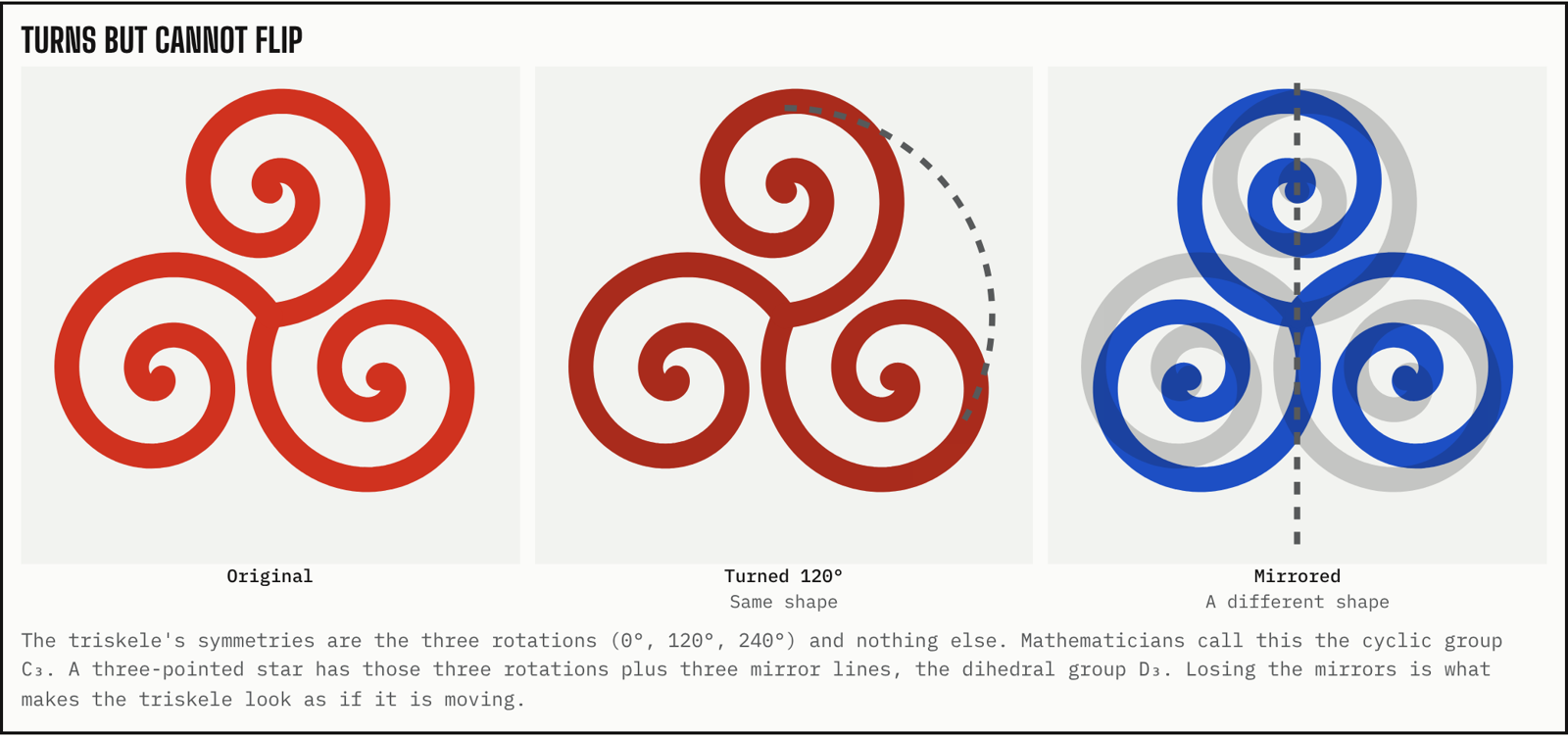
The triskele’s symmetries are the three rotations (0°, 120° and 240°) and nothing else. Mathematicians call this the cyclic group C3. A three-pointed star has those three rotations plus three mirror lines, the dihedral group D3. Losing the mirrors makes the triskele chiral, like a left and a right hand, and it is what makes it look as if it is moving.
Spin plus drain makes a spiral
Logarithmic spirals are what moving fluid draws when it does two things at once: it circles a point and it is drawn into it. Call the strength of the circling Γ and the strength of the draining m. Every particle then crosses the lines out from the centre at the same angle α, where tan α = m/Γ. That constant angle is exactly the defining property of a logarithmic spiral, and it is why bathwater, hurricanes and the arms of galaxies all curl the same way.
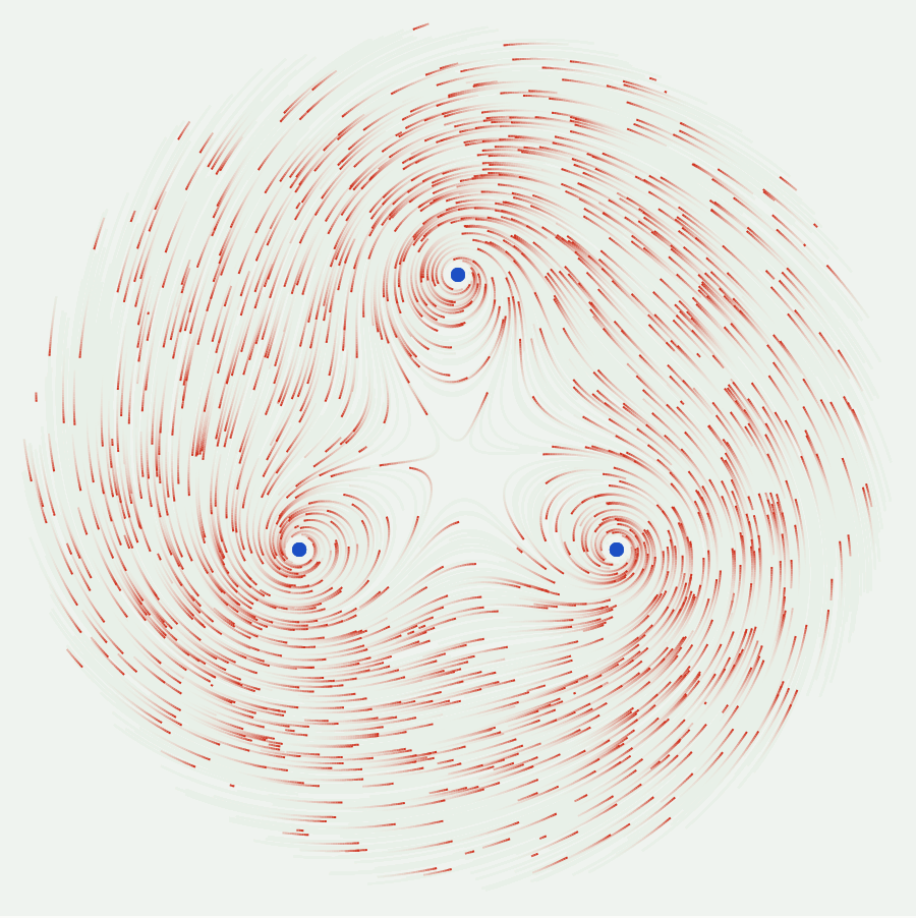
Put three of these spinning drains, called spiral vortices, at the corners of a triangle and let particles flow. With pure spin you get circles. Add some drain and the paths become spirals feeding three eyes. So the shape is not only a human idea. Anyone who has watched water turn in a river eddy has seen something close to it, which may help explain why it appears independently in so many places.
In short
The ancient triple spiral turns up across Europe, from Malta to Mycenae to the fields of Lincolnshire. The modern triskell is concentrated in Brittany, Galicia and Asturias, and it spread mostly after 1960. The two maps barely overlap. The symbol is old, but its job as a badge of Atlantic Celtic identity is new.
Notes and sources
- Google Books Ngram data are case-sensitive word counts in scanned books, with some scanning errors. Figures are decade means of yearly frequencies, per billion words. Trisquel is also the name of a Linux distribution, which probably inflates the Spanish figures for the 2010s. Queries: French spellings, Spanish trisquel.
- Portable Antiquities Scheme: keyword search for “triskele”. A match means the record mentions a triskele, usually in describing the decoration. Finds on the map are placed at county centres and dated to the start of their broad period.
- OpenStreetMap counts come from Geofabrik’s regional taginfo, keeping names where triskel, triskell, triskèle, triskelion or trisquel stands as a word (so not Kiltrisk in Ireland or the Breton cooperative Triskalia). Map locations come from the Overpass API; 127 of the 148 counted names returned locations. A long road split into sections can count more than once.
- Ancient sites and modern uses are hand-compiled and are a starting sample, not a census. Sources: Triskelion (Wikipedia); Tarxien Temples (Wikipedia); Nakajima, on the triskell in modern Brittany; Flags of the World, pan-Celtic flags; Copeps, on the triskell and the 1970s revival.

