
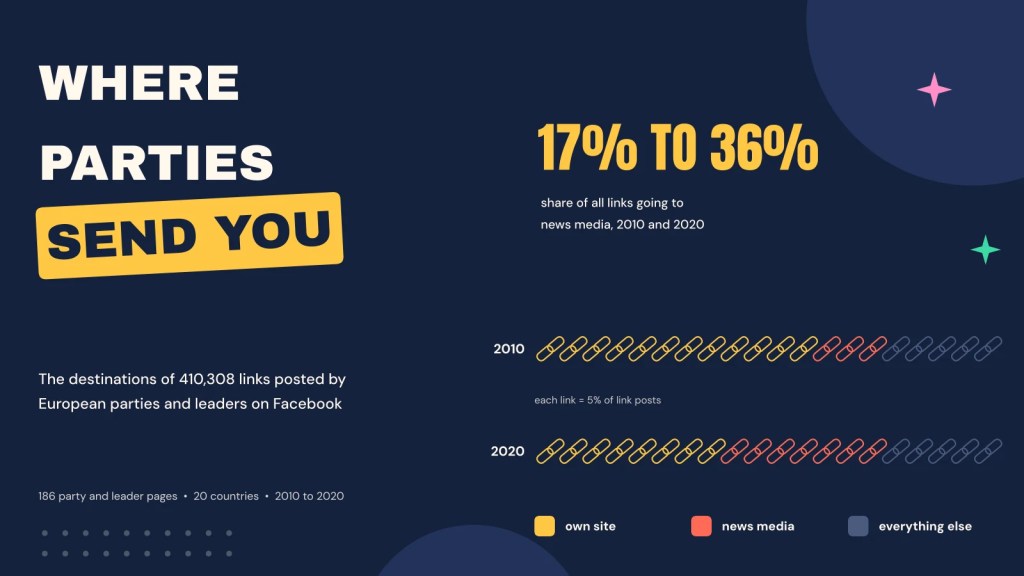
When a party posts a link on Facebook, it is making a choice: where should its followers go next? To the party’s own website, where it controls the message? To a news story? To a petition or an event?
I looked at more than 400,000 links posted by parties and their leaders across Europe over a decade. The big shift was away from parties’ own websites and towards the news.
The paper
Where Parties Send People: The Destinations of Links Posted by European Parties and Leaders on Facebook, 2010 to 2020
Read the paper (open access)
What I did
CrowdTangle, Meta’s tool for tracking public pages, which closed in 2024, recorded every post from 112 party pages and 74 party leaders’ pages in 20 countries. I took every link they posted between 2010 and 2020 and sorted it by website: the party’s own sites, news media, video sites, campaign tools such as events and petitions, other social platforms, government sites and the rest. I checked the most-linked websites by hand, and the lists cover about 95% of links.
From the party website to the news
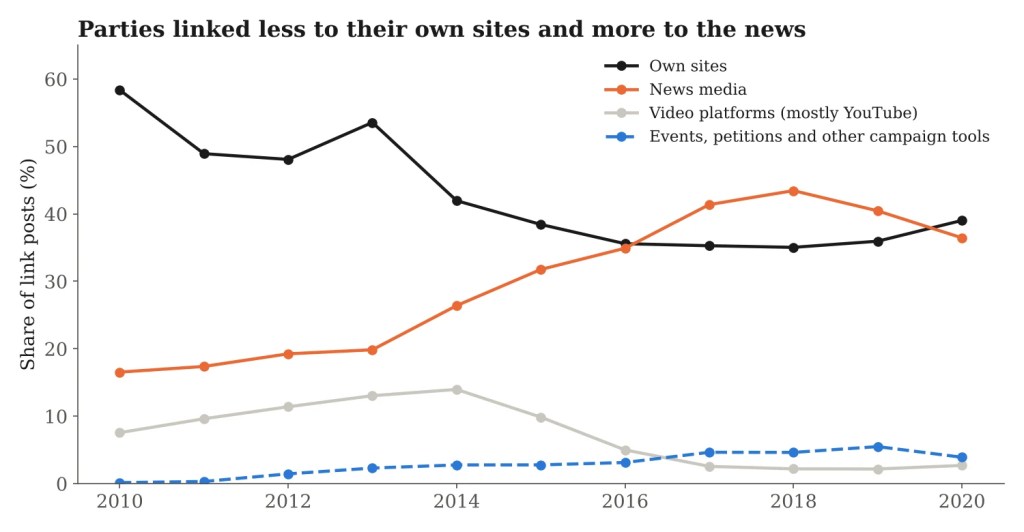
In 2010, 58% of links went to the party’s own sites. From 2016 it was 35% to 39%. News media rose from 17% to a peak of 43% in 2018. Links to YouTube and other video sites peaked in 2014 and then faded, around the time parties moved to posting video directly on Facebook.
Some of this is about which pages were active, but not all. Pages that posted links throughout also moved towards the news, though less sharply.
Leaders were different from parties. 53% of leaders’ links went to news stories and only 14% to their own or their party’s sites. For party pages it was the other way round: 48% own sites, 25% news. The most-linked outlets were mostly big national names: theguardian.com, bbc.co.uk, eldiario.es, aftonbladet.se and yle.fi among them.
The news got the likes
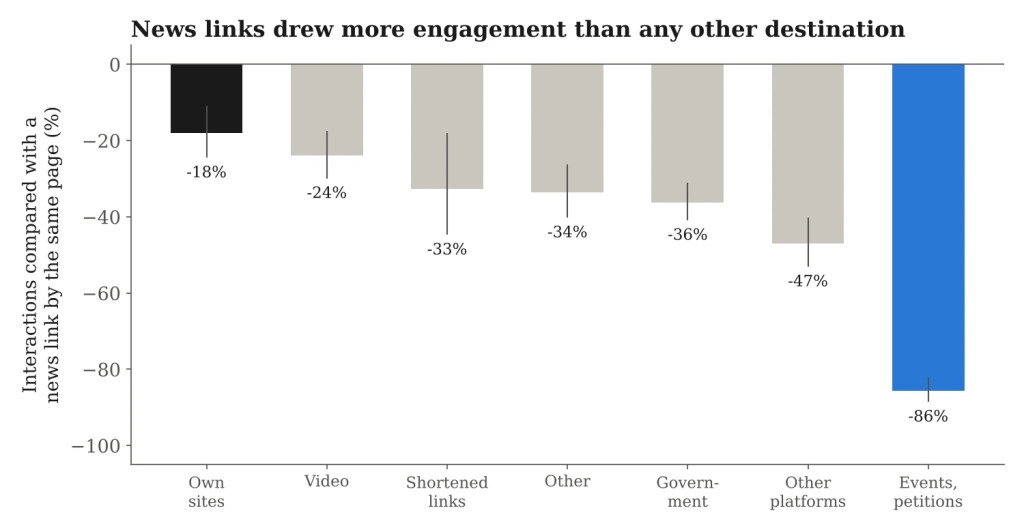
Comparing links posted by the same page in the same month, news links drew the most likes, comments and shares. Links to the party’s own site drew about 18% fewer, video links about 24% fewer, and links to other platforms about 47% fewer. Links to Facebook events and petitions drew about 86% fewer, perhaps because people respond on the event page rather than the post.
When parties sent people away from Facebook, they increasingly sent them to the news.
Populists did not stand out
You might expect populist parties to avoid the news and send people to their own channels. I found no clear difference: comparing parties in the same country and month, populists linked about as much to their own sites and to the news as other parties. I did not try to count “alternative” news sites, because I could not build a fair list across 20 countries.
The caveats
I sorted links by website, not by what they said: a news link might cover the party’s own announcement. About 6% of links went through link shorteners I could not unpack. Engagement is not clicks, and I cannot say whether anyone followed a link. And parties choose what to link to, so these are patterns, not proof of cause and effect.
The views in this post and the paper are my own.

