
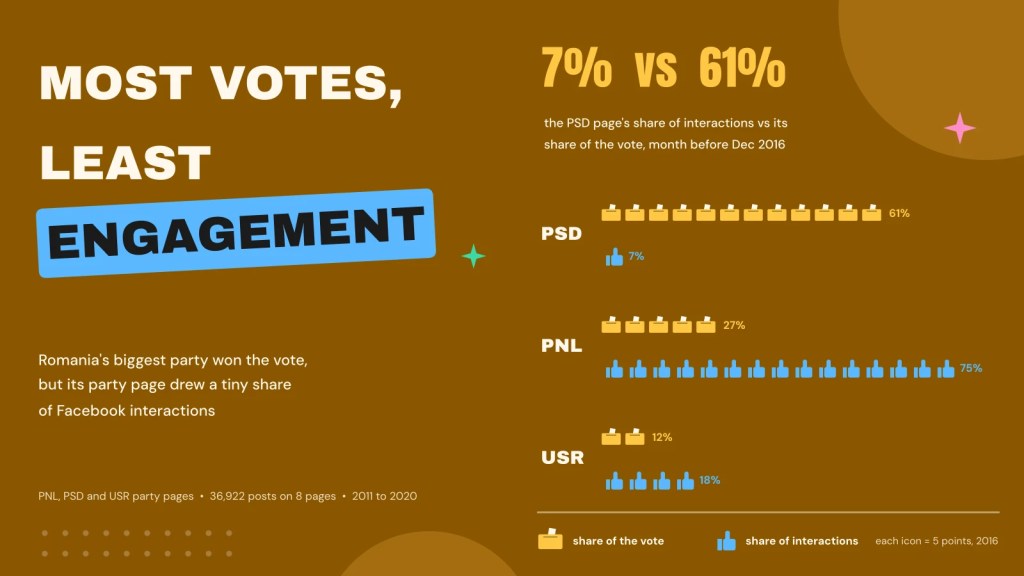
If you judged parties by their Facebook pages, you would have got Romania badly wrong. In December 2016 the Social Democratic Party (PSD) won about 45% of the national vote, more than its two main rivals put together. On Facebook, its party page was barely visible next to theirs.
I wanted to see how long that gap lasted and what lay behind it. The short answer: it lasted through every election I can measure, it narrowed as the PSD’s vote fell and its page got busier, and an important part of the story is simply that its page had a smaller audience. There is also a big hole in the data, which I come to below.
The paper
More Votes Than Interactions: Romanian Parties and Politicians on Facebook, 2011 to 2020
Read the paper (open access)
What I looked at
The data are 36,922 public posts from eight Romanian Facebook pages, 2011 to September 2020, exported through CrowdTangle, Meta’s tool for tracking public pages, which closed in 2024. Together they drew about 59 million interactions. An interaction is any reaction, comment or share.
Three of the pages belong to the main parties of the period: the PSD, the National Liberal Party (PNL) and the Save Romania Union (USR), a party formed in 2016 out of a Bucharest civic movement. The other five belong to politicians and state figures: President Klaus Iohannis, who was backed by the PNL, a PNL deputy, two people who later served as ministers in the PNL government, and the head of the emergency services department.
For each election from 2014 to 2020, I compared each party page’s share of the three pages’ interactions in the 30 days before polling day with the party’s share of the vote among the same three parties. Dividing one by the other gives a ratio: 1 means the page drew exactly its vote share, below 1 means less.
The PSD page drew less than its vote at every election
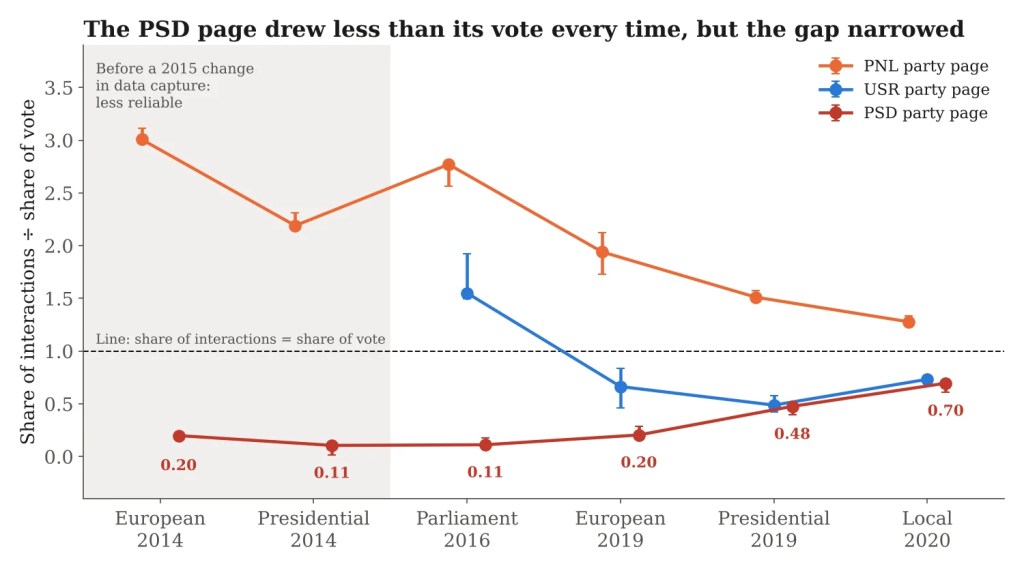
In the month before the December 2016 parliamentary election, the PSD page drew 7% of the three party pages’ interactions. The PSD won 61% of the three parties’ vote. That is a ratio of 0.11: about a tenth of its vote share. The PNL page drew 75% against 27% of the vote, about 2.8 times its share, and the new USR page about 1.6 times.
The PSD page drew less than its vote share at all six elections. The PNL page drew more at all six, from 1.28 to 3.01 times. The 2014 results look the same, but a change in what CrowdTangle collected in May 2015 makes them less reliable, so I treat them as a side note.
The gap narrowed from both ends
After 2016, the PSD’s ratio rose: 0.20 at the 2019 European election, 0.48 at the 2019 presidential election and 0.70 at the local elections of September 2020. Partly its vote fell, to about 30% of the three parties’ vote in 2019. Partly its page got busier and drew more: its share of interactions went from 6% before the European election to 14% before the presidential one and 26% in 2020.
The USR went the other way. It drew more than its vote share in 2016 but less from 2019, between 0.49 and 0.73. In those elections it ran in alliance with a partner party, PLUS, whose page is not in my data, which pulls its ratio down.
During the protests, the opposition page took the attention
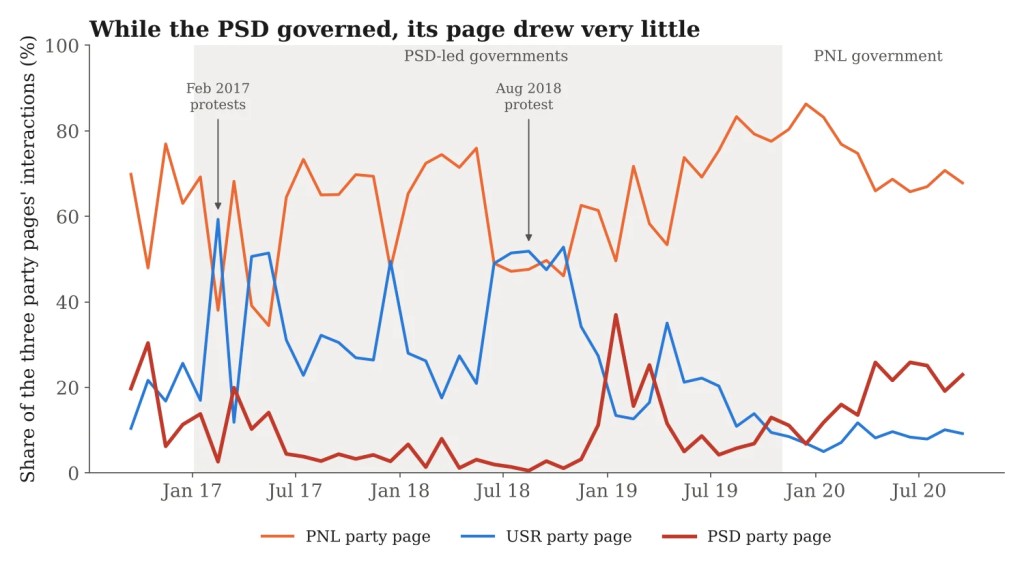
The PSD led the government from January 2017 to November 2019. Those years included the largest protests in Romania since 1989, which began in early 2017 over government plans for pardons and changes to the criminal codes.
In 2017 and 2018, the PSD page drew 4% of the three pages’ interactions, and under 5% in most months. The USR page, which opposed the changes, drew 38%. In February 2017, the month of the largest protests, the USR page drew 59%, and in August 2018, the month of another large protest, 52%. Over the same months the PSD page posted about 28 times a month.
In opposition, from November 2019, the picture changed. The PSD page posted about 127 times a month and drew 18% of the three pages’ interactions. The USR page fell to 8%, and the PNL, now in government, took 74%.
A party can win the vote and still be almost invisible on its own page.
I also compared each page with itself in and out of government. Relative to the USR page, the PSD’s posts drew about 57% fewer interactions while it governed, and the PNL’s about 192% more once it did. That rests on just two changes of government and three pages, so it describes these pages, not an effect of being in office.
A smaller audience, not duller posts
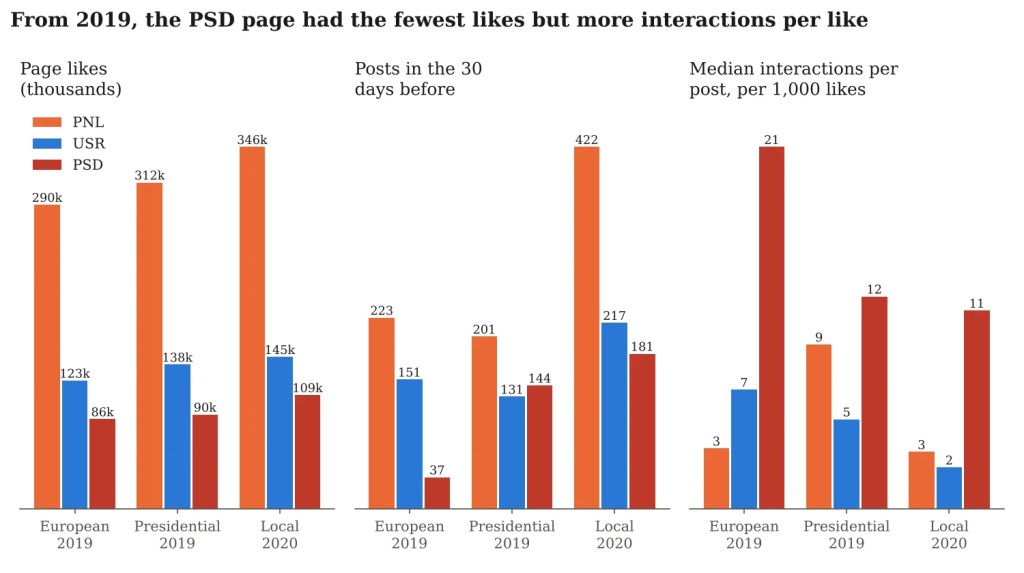
Why so little? CrowdTangle only records the PSD page’s likes from January 2019, so I can only answer for 2019 and 2020. In those windows the PSD page had about 86,000 to 109,000 likes, against about 290,000 to 346,000 for the PNL. Before the 2019 European election it also posted just 37 times, against 223 for the PNL.
But per follower, its posts did well. For every 1,000 page likes, the median PSD post drew about 21 interactions before the European election, 12 before the presidential and 11 before the 2020 locals, against 3 to 9 for the PNL. Smaller pages usually score higher on this measure, so it is partly expected. In 2016, though, the PSD’s median post drew 308 interactions against 848 for the PNL, so then its posts drew less outright.
Beyond the parties
The biggest page in the list was not a party at all. President Iohannis’s page had about 1.9 million likes in 2020 and drew 22.2 million interactions from 1,205 posts, almost as many as the PNL page drew from 16,973. When the Covid state of emergency began in March 2020, the emergency services head’s page drew about 181,000 interactions in a month, against about 27,000 a month before.
The caveats
The biggest one first. The list has no page for any PSD politician, while the PNL-backed president and several PNL-linked figures are in it. Leaders’ pages can draw a large part of a party’s attention. So this compares each party’s own page with its vote, not each party’s whole presence on Facebook, and if the PSD’s attention sat on its leaders’ pages, the comparison overstates its gap. I cannot tell from these data.
Beyond that, eight pages are a small, uneven list, with no pages for other parties or for PLUS. Vote shares are recomputed among just the three parties, with alliance votes counted in full. CrowdTangle’s records are not guaranteed to be complete, and changed at least once. Interactions are not support: they include critics, people outside Romania and possibly paid promotion. Nothing here shows that Facebook moved votes, or the reverse.
The paper is a preprint and has not been peer reviewed. I wrote the text, with drafting and editing assistance from Claude. The views in this post and the paper are my own.

