
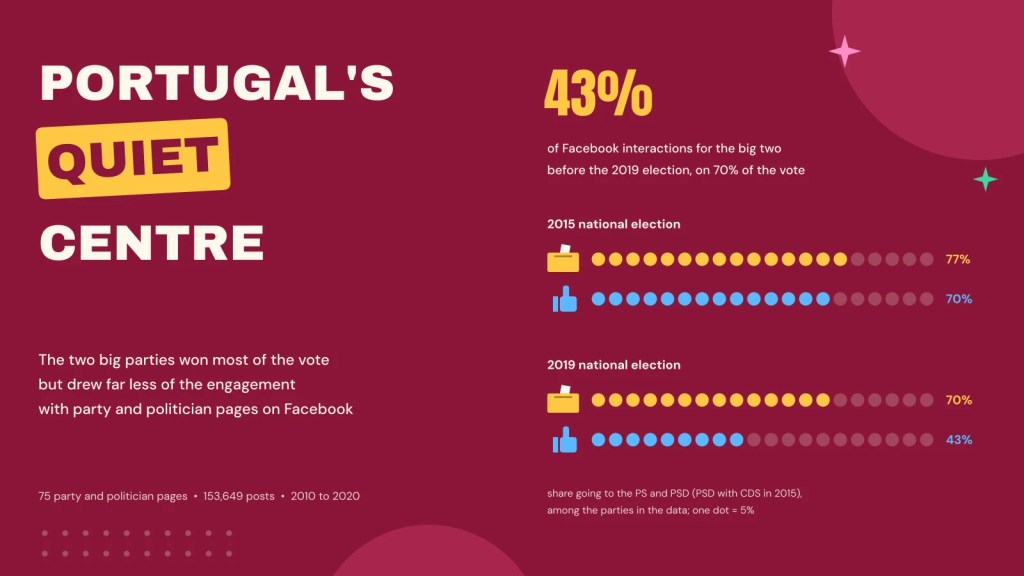
For most of the last fifty years, Portuguese politics has been a contest between two big parties: the Socialists (PS) on the centre left and the Social Democrats (PSD) on the centre right. In 2019 they still won seven in ten votes among the parties I studied. On Facebook, you would hardly have known it.
I went back to my PhD data on Portuguese party and politician pages to see how the party system looked online. The answer is that the centre was the quietest part of it, and the loud parts were the small parties and the radical left.
The paper
The Quiet Centre: Portuguese Parties and Politicians on Facebook, 2010 to 2020
Read the paper (open access)
What I looked at
The data are 153,649 public Facebook posts from 75 pages: 12 party pages and 63 politicians’ pages, mostly MPs and party leaders, from 2010 to September 2020. They were collected through CrowdTangle, Meta’s tool for tracking public pages, which closed in 2024. An interaction is any reaction, comment or share, and there were 24.1 million of them.
Two things to know up front. First, Chega, the radical-right party that entered parliament in 2019 and has grown sharply since, is not in the data at all, and nor is its leader. So this post says nothing about Chega. Second, the politicians’ pages are the ones I chose for my doctoral research, not every MP. Each party’s share of politicians’ engagement partly reflects that choice.
The lists are uneven in other ways too, which I come back to at the end. And because CrowdTangle’s capture of photo posts jumped about fivefold in May 2015, I start all comparisons in June 2015.
For each of three elections, the 2015 and 2019 national elections and the 2019 European election, I compared each party’s share of interactions in the 30 days before polling day with its share of the vote among the parties in the data. Those parties won about 96% of the vote each time.
The big two drew less than their vote, and the gap grew
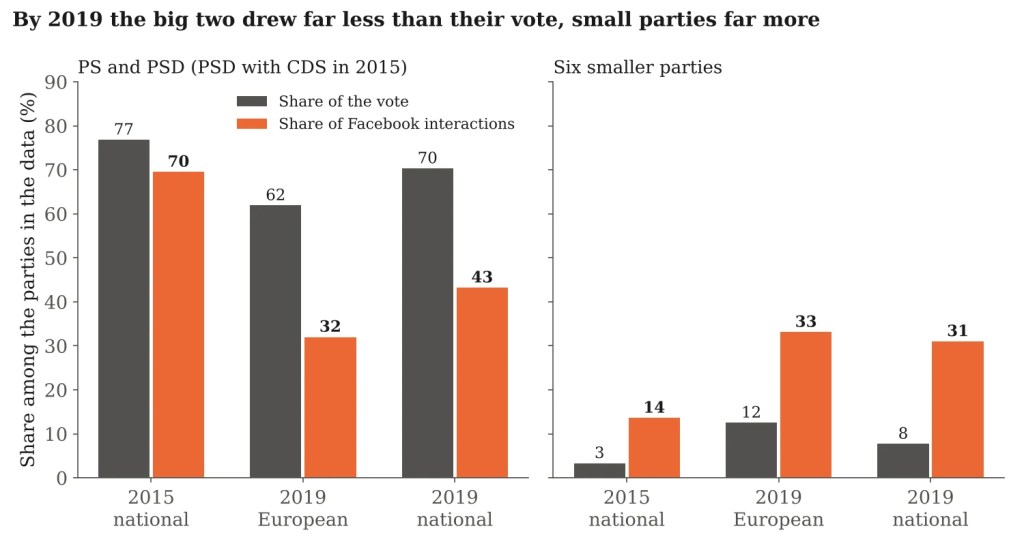
In 2015 the picture was not far off the vote. In the month before the election, the PS and the PSD-led alliance drew 70% of interactions, against 77% of the vote.
By 2019 the gap was wide. Before the European election in May, the PS and PSD drew 32% of interactions against 62% of the vote. Before the national election in October, 43% against 70%. The PSD drew 0.38 times its vote share. The PS drew 0.80 times, helped a lot by Costa’s campaign page, which drew 45% of the party’s interactions in that month. When his page was silent before the European election, the PS drew 0.45 times its vote.
This is not just a quirk of which pages were in the lists. Among the 38 pages that posted before both national elections, the PS, PSD and CDS share fell from 69% to 55%. Quarter by quarter, the PSD and CDS share fell from between 27% and 44% in 2015 and 2016 to between 10% and 18% from mid 2018. The PSD did lose votes in 2019, but its Facebook share fell much further.
Small parties were loud, whether they won seats or not
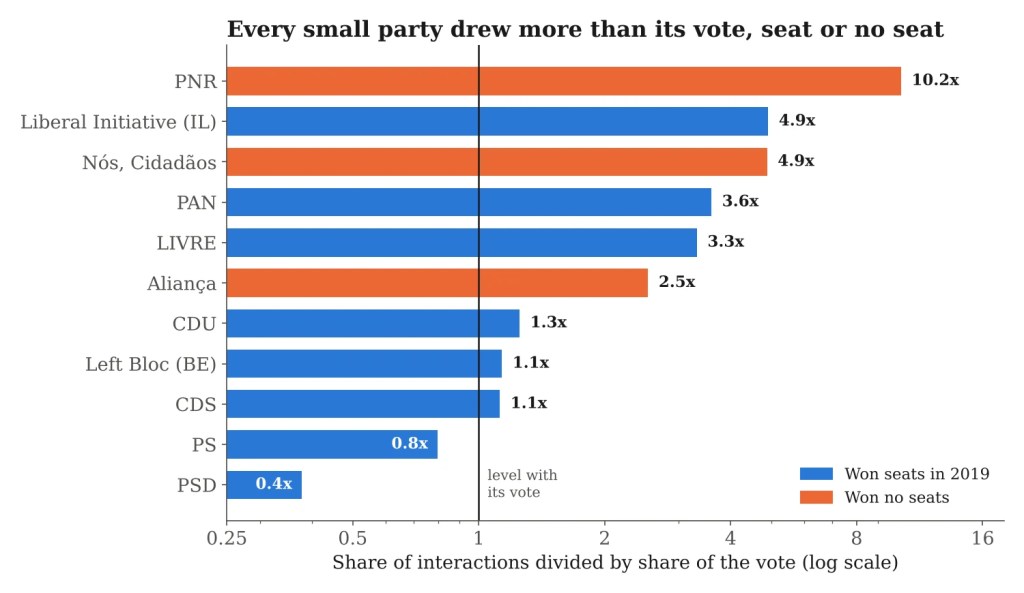
Before the 2019 national election, every small party in the data drew more than its share of the vote, by between 2.5 and 10 times. Together the six small parties drew 31% of interactions against 8% of the vote.
It is tempting to read that as an early signal of who would break through, and in 2019 three new parties did enter parliament. But the signal did not pick them out. Over the year before the election, Liberal Initiative drew 6.1 times its eventual vote share and PAN 4.5 times, and both did well. The far-right PNR drew 16.7 times, Nós, Cidadãos 10.1 times and Aliança 3.5 times, and none won a seat. LIVRE, which did win one, had the weakest ratio of the small parties over that year, 1.6.
Facebook was generous to small parties in general, not only to the ones about to break through.
PAN, a party for people, animals and nature, is the clearest case of a party big on Facebook long before it was big at the polls. From 2016 to 2018 its pages drew 26% of all interactions in the data, more than any other party, while it held one seat. In September 2019 its party page had about 161,000 likes, more than the PSD’s 150,000 and the PS’s 85,000. Its vote did rise in 2019, but only to 3.3%.
Being loud was not about each post doing better. Comparing posts of the same type in the same month, posts on small parties’ own pages drew about as much as posts on the PS and PSD pages. Across all pages, small parties’ posts did draw more, but that may partly reflect the big parties’ many MPs’ pages, most of which drew little.
The Left Bloc spoke through its politicians
The Left Bloc drew more than its vote share at all three elections, 1.14 times in 2015, 1.71 times before the European election and 1.14 times in October 2019. Together with the Communist-led CDU, the parties to the left of the Socialists rose from about a fifth of all interactions each quarter in 2015 to between a third and two fifths in 2020.
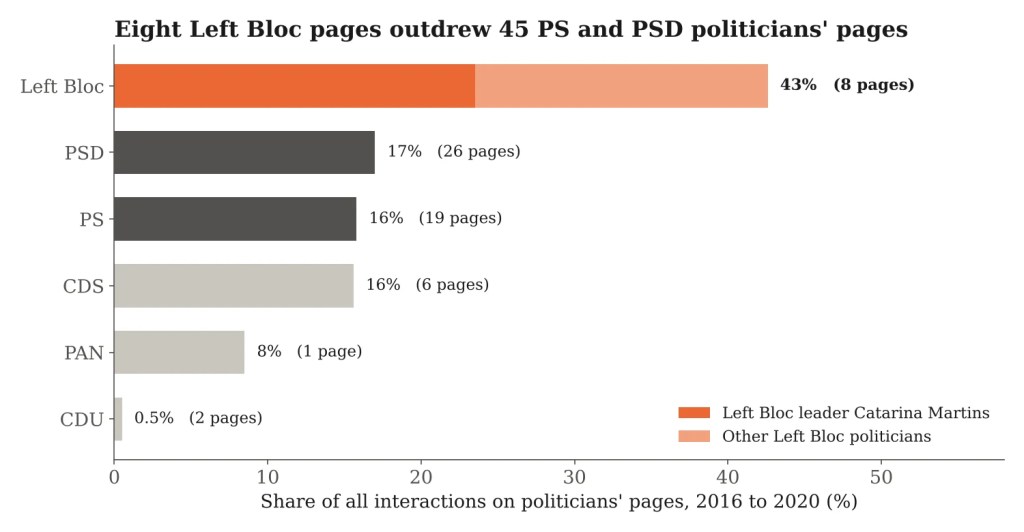
What sets the Bloco apart is where its engagement came from. From mid 2015, 64% of its interactions came from its politicians’ pages, against 42% for the PS and 34% for the PSD. From 2016 to 2020 its eight politicians’ pages, about one in eight of all politicians’ pages in the data, drew 43% of the interactions on politicians’ pages. Its leader, Catarina Martins, drew 23.5% on her own. Its other politicians drew 19%, slightly more than the 26 PSD politicians’ pages together.
Leaders mattered most where a party page was weak or missing. The CDS leader, Assunção Cristas, drew 90% of her party’s interactions from 2016 to 2020, since the CDS had no party page in the lists. Costa’s page drew 88% of PS interactions in the 2015 campaign month. PAN’s leader, André Silva, drew 15% of his party’s, and the newest parties’ engagement came entirely from their party pages.
The caveats
These are uneven lists of pages. Chega is missing, the Bloco is represented by a news site, the CDS has no party page, the PS leader’s page posted only in two spells around the 2015 and 2019 elections, and the PSD leader from 2018, Rui Rio, has no official page in the sample. The politicians’ pages are my selection, so the comparison between parties’ politicians partly reflects how many and which MPs I included.
CrowdTangle’s historical records are not guaranteed to be complete, and the May 2015 jump shows that what it captured changed over time. Esquerda Net’s posting rose from 582 posts in 2017 to 3,164 in 2018, which may be behaviour or capture. Interactions are not support: they include opponents, people outside Portugal and possibly paid promotion. Three elections are too few to generalise from, and nothing here shows that engagement caused votes or reflected them.
The paper is a preprint and has not been peer reviewed. I wrote the text, with drafting and editing assistance from Claude. The views in this post and the paper are my own.

