
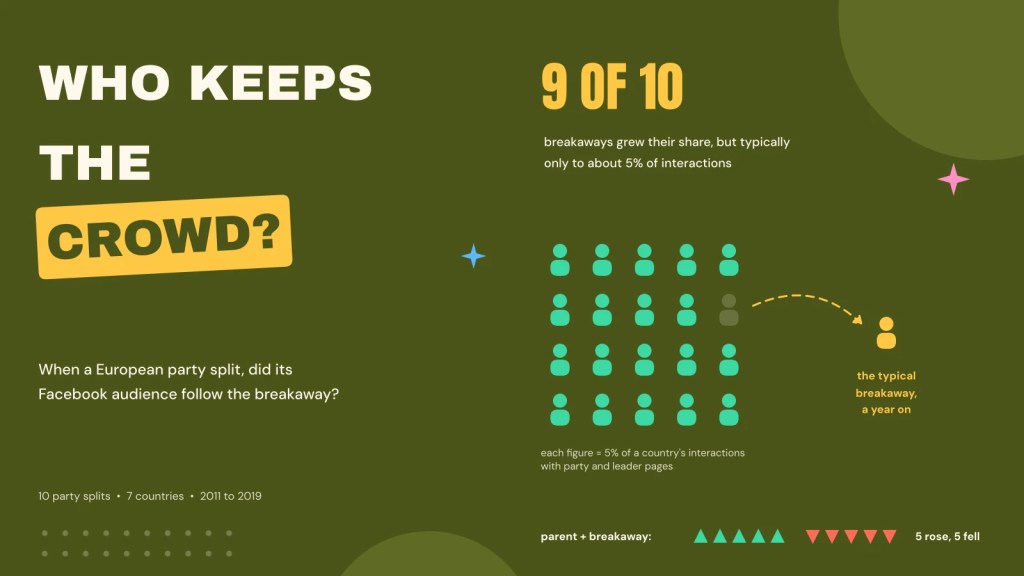
Parties split. A faction loses an argument, a leader loses a contest, a prominent figure walks out and starts something new. The parent keeps the name, the office and the official Facebook page. The breakaway starts with nothing, unless its leader already has an audience of their own.
So when a party splits, who keeps the online crowd? I went looking in my old Facebook data for European splits where I could see both sides, before and after. The answer turned out to be mixed, and more interesting for it.
The paper
Who Keeps the Crowd? Party Splits and Facebook Engagement in Europe, 2011 to 2019
Read the paper (open access)
Finding splits I could actually see
The data are public Facebook posts I exported from CrowdTangle, Meta’s tool for tracking public pages, for my doctoral research in 2020: 1,712 pages and about 2.5 million posts from 20 European countries. I only use counts of posts and interactions, meaning reactions, comments and shares, added up by page and month.
I checked splits in every country. A case counted only if the parent party’s page posted throughout the year either side of the split, and the breakaway’s pages (the new party, the departing figure’s own page, or both) posted after it. Many famous splits failed this test because one side had no page in my data.
Ten cases passed, in seven countries: UKIP to the Brexit Party, Podemos to Más País, the French Socialists to Génération.s, Les Républicains to Agir, Spain’s People’s Party to Vox, the Hungarian Socialists to the Democratic Coalition, LMP to Dialogue for Hungary, Finland’s National Coalition to Liike Nyt, Portugal’s PSD to Aliança, and Sinn Féin to Aontú.
For each one I compared each side’s share of all interactions with the party and leader pages I tracked in that country (6 to 25 pages), in the twelve months before the split and the twelve after. Using shares rather than raw counts takes out national news cycles and the general growth of Facebook.
Breakaways grew, but rarely by much
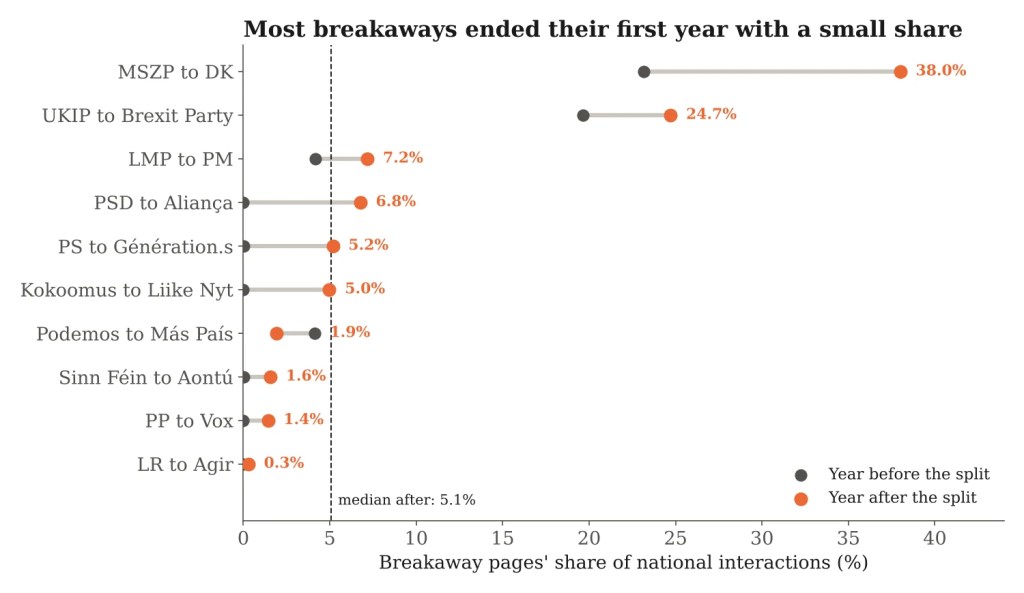
The breakaway’s share rose in nine of the ten cases. But the typical breakaway ended its first year with only about 5% of national interactions. Vox, Agir and Aontú each held under 2%. The one breakaway whose share fell was the Errejón camp, which went from 4.1% to 1.9%.
Breakaways also posted a lot. Across cases their share of posts rose by about 10 points, against about 4 points for their share of interactions. Posting more did not bring a matching share of engagement.
The big audiences were there before the party
Two breakaways stand out: the Brexit Party camp, with 24.7% of UK interactions in the year after, and the Democratic Coalition camp in Hungary, with 38.0%. In both, the departing leader’s personal page already held about a fifth or more of national interactions before the split: 19.6% for Nigel Farage and 23.2% for Ferenc Gyurcsány.
In other words, these audiences did not move from the party page to the new party. They were on the leaders’ own pages all along. Where the departing figures had smaller pages, as with Errejón and the LMP dissidents, the breakaway’s share moved by three points or less.
The large breakaway audiences followed a person who had drawn them before the split, not the new party.
Some parents lost heavily, but not always to the breakaway
The parent’s share fell in six cases and rose in four. The falls for LMP, the PSD, Spain’s People’s Party and the French Socialists were large, in the bottom tenth of the usual year on year changes I measured for 87 other party pages. But at least two of those had other things going on: the French Socialists collapsed in the 2017 elections, and most of the People’s Party’s fall came months after the split, around the 2014 European election.
Where the parent fell, the breakaway made up most of the loss in three cases: more than all of it for the French Socialists, and about 70% each for LMP and the PSD. In three it made up little or none of the loss: Les Républicains (about 4%), the People’s Party (15%) and Podemos, whose breakaway camp shrank too.
No consistent burst of new energy
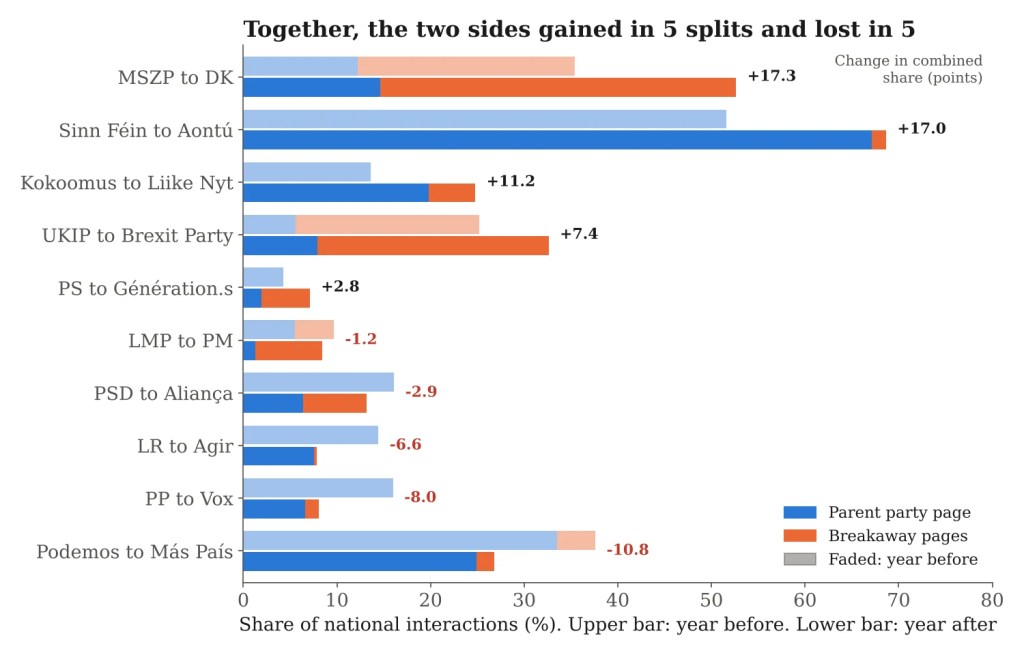
You might expect a split to stir things up, with both sides fighting for attention and the camp as a whole drawing more. It did not, consistently. The combined share of parent and breakaway rose in five cases and fell in five, with a median change of about 0.8 points. Without the UKIP case, the median was a fall of 1.2 points.
Where the combined share rose a lot, as in the Kokoomus and Sinn Féin cases, the rise came mainly from the parent. Many of these windows also contain elections, leadership contests or European votes, so the shares moved for plenty of reasons besides the split.
Engagement and votes lined up, roughly
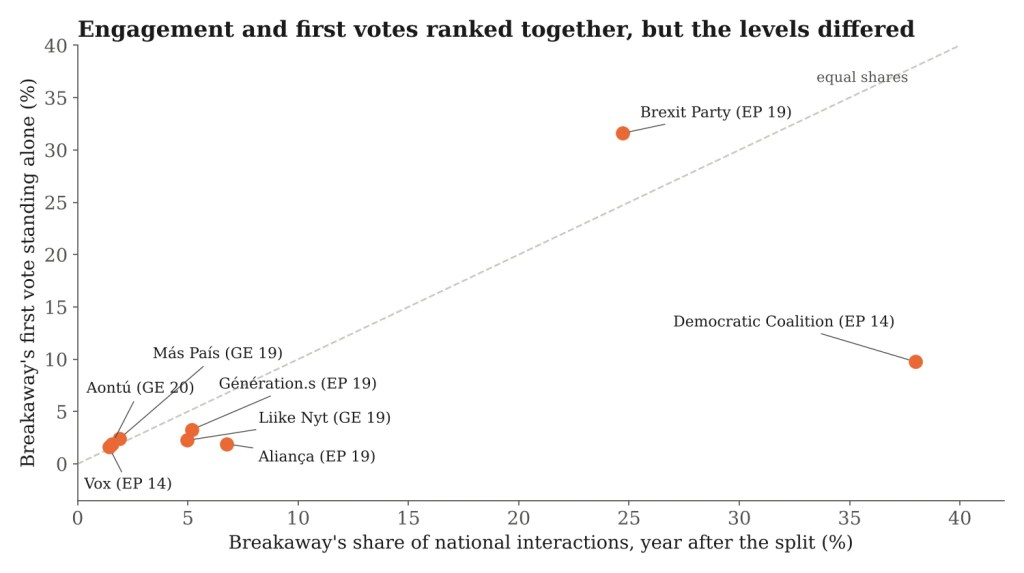
Where a breakaway stood alone at a national or European election, its engagement share ranked broadly with its first vote. The Brexit Party, with the second largest engagement share, won 31.6% in Great Britain at the 2019 European election. Vox, Aontú, Aliança and Más País, with small engagement shares, won between 1.6% and 2.4%.
But the levels differed. The Gyurcsány camp drew 38% of Hungarian interactions with the pages I tracked, while the Democratic Coalition won 9.8% when it first stood alone, at the 2014 European election. With eight cases and different kinds of election, this is a loose ranking, not a forecast.
The caveats
There are only ten cases in seven countries, chosen by what my data happen to contain. Splits whose breakaway had no page are missing, which may leave out the least successful breakaways. The breakaway sides differ in kind, from a brand new party page to a long-standing personal page, and the split dates are approximate.
The before and after comparison mixes the split with whatever else happened that year, so it describes patterns, not causes. National totals cover the pages I tracked, not all political pages. And interactions measure engagement with pages, not people: I cannot tell whether the same users moved from one page to the other, or whether they were supporters at all.
The paper is a preprint and has not been peer reviewed. I wrote the text, with drafting and editing assistance from Claude. The views in this post and the paper are my own.

