
Boris Johnson’s Facebook page drew about 470,000 likes, comments and shares a month in the years I have data for. The Conservative Party’s own page drew about 310,000. Yet when you look at who has paid Facebook to promote them since, the party’s page has spent £3.1 million and Johnson’s has spent £0.2 million.
That seemed odd enough to follow up. Parties have two kinds of audience on Facebook: the one that comes for free, and the one they buy. Do they pay to push the pages that already attract people, or do they use money to fill gaps? And what about the leaders?
The preprint
Paid and Earned on Facebook: Do British Parties Pay for the Pages that People Engage With?
Open access, free to read, share and cite. It links 25 UK party and leader pages to their ad spending in Meta’s Ad Library.
Cite as: Hotham, T. (2026). Paid and Earned on Facebook: Do British Parties Pay for the Pages that People Engage With? Preprint, Zenodo. https://doi.org/10.5281/zenodo.23415020
What I compared
For the free audience I used my own CrowdTangle data from my PhD: how many reactions, shares and comments each of 25 British party and leader pages got each month, from March 2016 to September 2020. For the paid side I used Meta’s public Ad Library Report, which gives how much each page has spent on political and issue ads since October 2019. Then I put the two side by side.
Parties pay for the audiences they already have
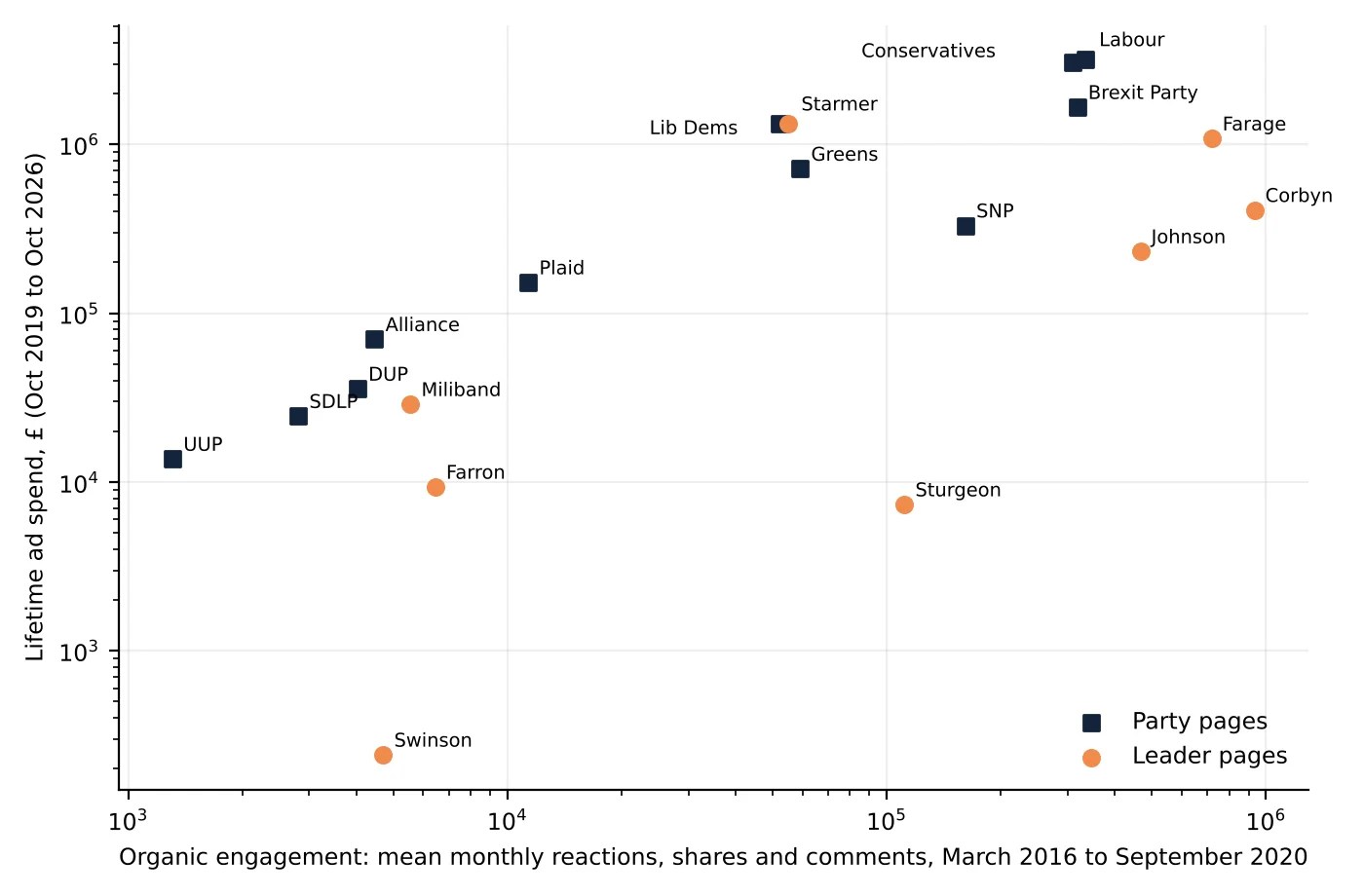
For the party pages, the match is close. Labour and the Conservatives, with about 330,000 and 310,000 interactions a month, have spent £3.2 million and £3.1 million. The Liberal Democrats and Greens, at 50,000 to 60,000, have spent £1.3 million and £0.7 million. The Northern Ireland parties, below 5,000 a month, have spent between £14,000 and £70,000.
Across the party pages, ten times the engagement goes with roughly eight times the spending. In other words, spending follows the audience almost in proportion.
But the leaders get the likes
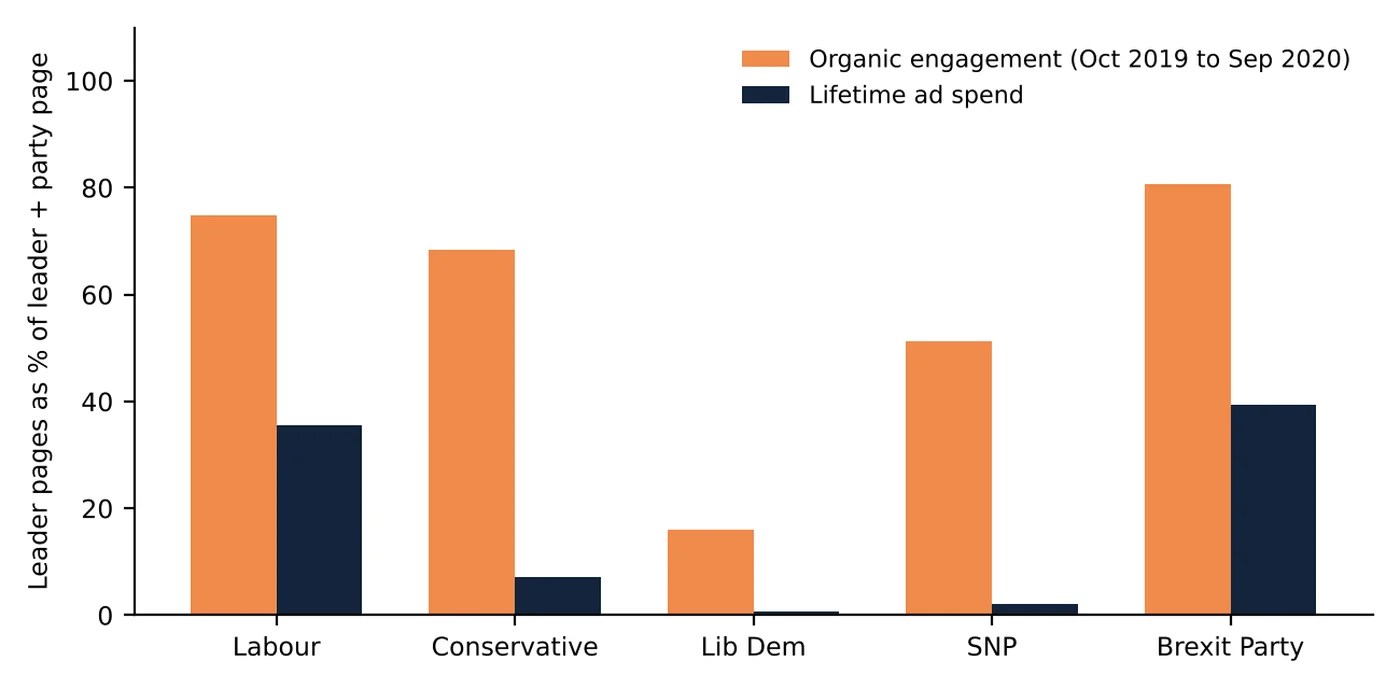
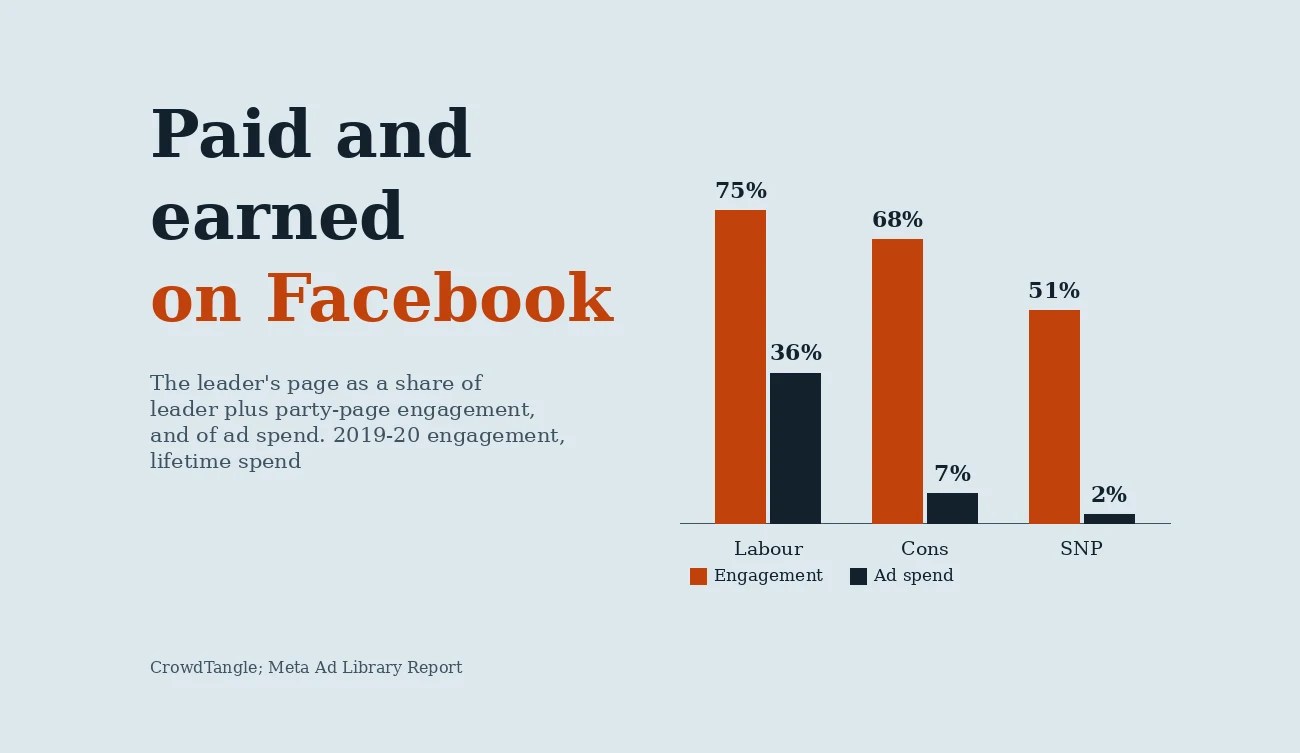
Leaders look different. In the year I can compare, Labour’s leaders’ pages (Corbyn, Starmer, Miliband) took 75% of Labour’s leader-plus-party engagement, but only 36% of its spending. Boris Johnson’s page took 68% of the Conservatives’ engagement and 7% of the money. Nicola Sturgeon’s took half of the SNP’s engagement and 2% of the money.
Parties seem to pay for their own pages and rely on their leaders to bring the audience for free.
Only Nigel Farage’s page comes close to being paid for in line with its audience, and even there the spend share is about half the engagement share. Jeremy Corbyn’s page had the most engagement of any in the data, and has spent £0.41 million. Keir Starmer’s page has spent £1.3 million, with about a tenth of Corbyn’s audience in the year I can compare.
The caveats
The biggest one is time. My engagement data end in September 2020, and the ad data run from October 2019 to October 2026, so they overlap for only a year. Some of the leaders’ spending will be after the period I measured, and some leaders (Sunak, Badenoch) are not in my engagement data at all. When I count every leader’s page I can find in the ad data, the leaders’ share of spending goes up for Labour and the Conservatives, but it stays below their share of engagement everywhere.
Twenty-five pages is a small sample, so this is a description of a pattern, not a test of what causes what. I do not know why parties spend this way. One idea is that a party page is the one the party controls and pays for, while a leader’s page runs on its own energy. That is a guess, and the data cannot show it.
The better test would use dated ads, which Meta’s API provides, to line up weekly spending with weekly engagement around the 2019 election.
I wrote the text, with drafting and editing assistance from Claude.
The views in this post and the paper are my own.

