
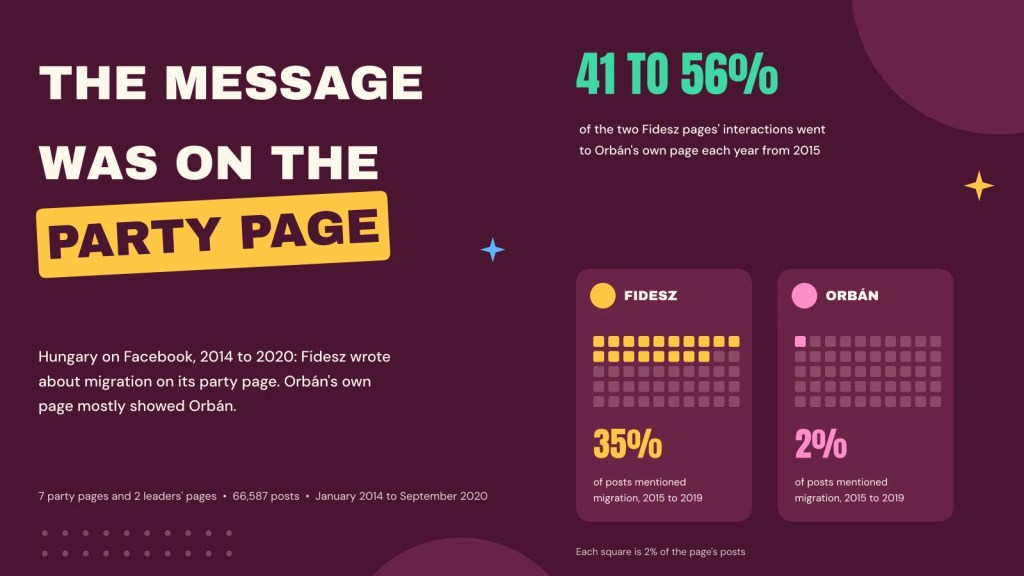
If you want to know what a party is campaigning on, the obvious place to look on Facebook is its leader. In Hungary that would be Viktor Orbán, whose page drew huge engagement. But when I went through six years of Hungarian party pages, the leader’s page turned out to be the wrong place to look for the written campaign. Orbán’s page mostly showed Orbán. The Fidesz party page carried the message.
My new working paper looks at Fidesz, Orbán and the Hungarian opposition on Facebook between 2014 and 2020. It asks three simple questions. Did Fidesz’s share of Facebook engagement match its share of the vote? How much of it came through Orbán’s own page? And where did its migration campaign actually appear?
The paper
The Party Page Carried the Message: Fidesz, Viktor Orbán and the Hungarian Opposition on Facebook, 2014 to 2020
Read the paper (open access)
What I did
I used posts exported from CrowdTangle, Facebook’s research tool, in October 2020 for my PhD. The pages are Fidesz, Jobbik, the Socialists (MSZP), the Democratic Coalition (DK), LMP, Párbeszéd and Momentum, plus the two people who led their party for the whole period: Viktor Orbán and Ferenc Gyurcsány of DK. That gives 66,587 posts and 79.1 million interactions. An interaction is any reaction, comment or share.
For elections, I compared each party page’s share of interactions in the 60 days before the vote with its list’s share of the vote, among the parties I could compare. I did this for the parliamentary elections of 2014 and 2018 and the European elections of 2014 and 2019.
One technical wrinkle needed care. CrowdTangle’s records of photo posts jump in May 2015: across these pages, photo posts per month rose about 3.5 times, while link posts barely moved. That looks like a change in what the tool captured, not in what parties did. So I reran every comparison that reaches back before mid-2015 without photo posts. The main results hold.
Fidesz drew about its share of the vote
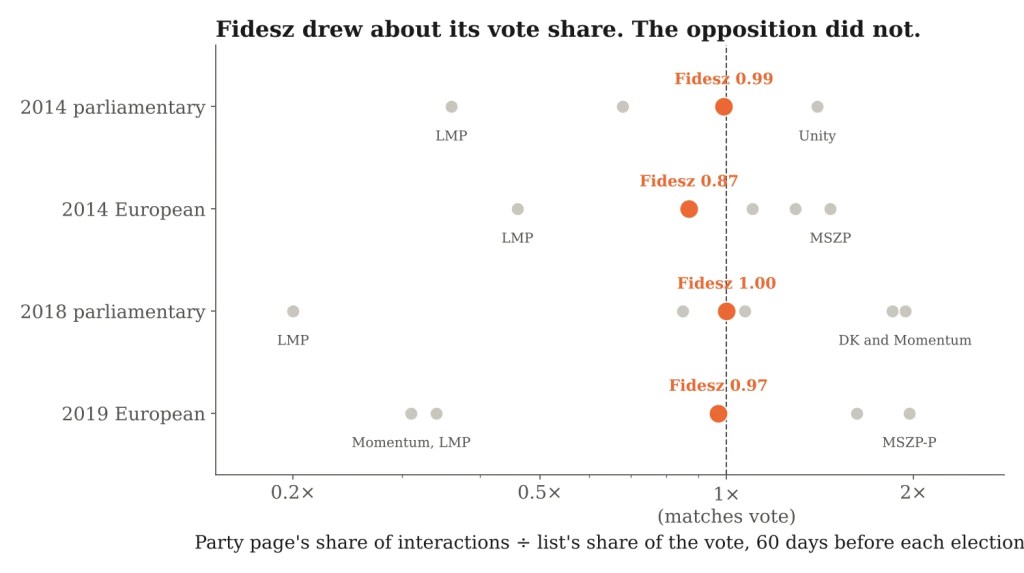
This was the first surprise. At all four elections, the Fidesz party page drew close to its share of the vote: 46% of interactions against 47% of the vote in 2014, and 51% against 52% in 2018. The ratios run from 0.87 to 1.00. Dropping photo posts for the two 2014 elections, before the capture change, gives 1.02 and 0.88.
The smaller parties were all over the place. LMP drew between a fifth and a half of its vote share every time. Momentum drew 1.85 times its vote share in 2018, when it won 3%, and 0.31 times in 2019, when it won 10%. For the opposition, Facebook engagement was a poor guide to the vote, and the gap did not even point the same way from one election to the next.
Two wrinkles. This is the party page alone: count Orbán’s page as part of Fidesz and the ratio rises to between 1.02 and 1.20. And in 2018 and 2019 the match depends on photo posts, which carried much of the Fidesz page’s engagement: without them its ratio falls to 0.62 and 0.34. So how close the match looks depends on what you count.
Orbán drew a big share, but so did the opposition leader
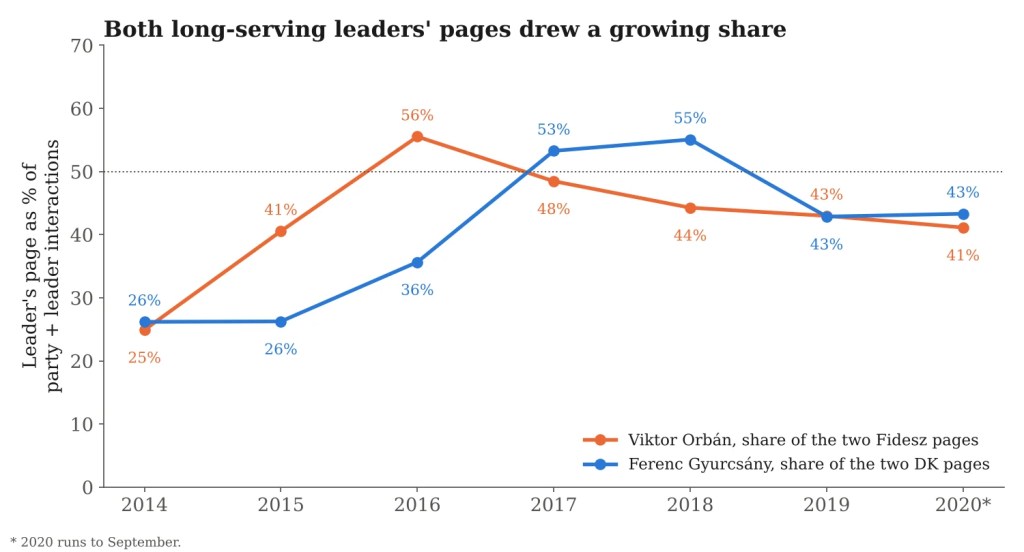
In 2014 Orbán’s page drew a quarter of the engagement on the two Fidesz pages. From 2015 it drew between 41% and 56% every year. His typical post drew between 4.6 and 6 times the engagement of a typical party post from 2016 onwards, even though he posted far less: a few hundred times a year, against up to 2,773 posts a year on the party page.
It would be easy to read that as a story about a powerful prime minister. But Ferenc Gyurcsány, in opposition, followed a similar path: from about a quarter of the DK pages’ engagement in 2014 and 2015 to over half in 2017 and 2018. Some of his early share may be understated, because his photo posts were barely captured before May 2015, but the rise is still there without photos. So in Hungary an opposition leader’s page could draw as large a share as the prime minister’s, though with two leaders I would not generalise from that.
The migration campaign lived on the party page
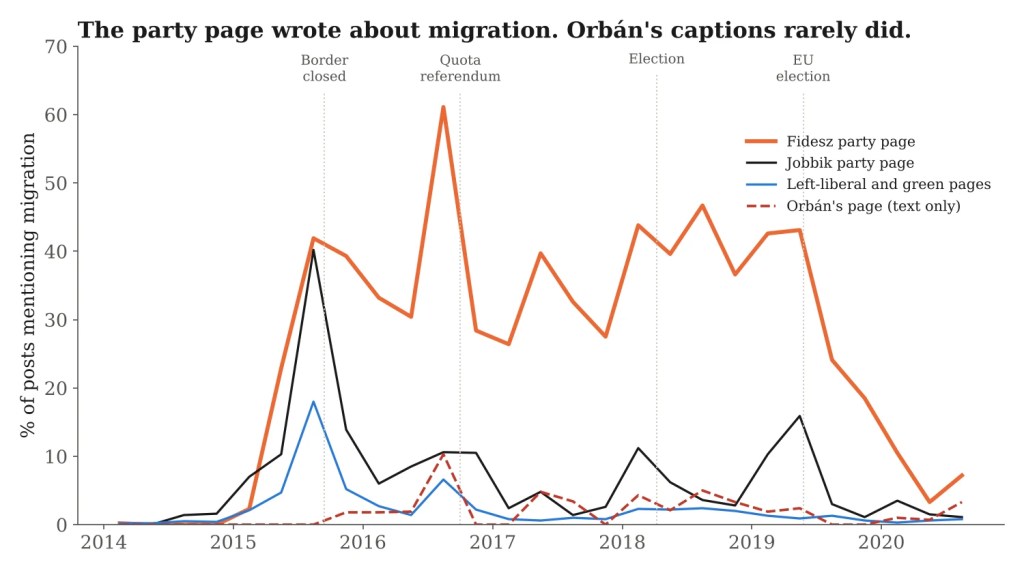
From 2015, migration was central to Fidesz’s campaigns. I flagged posts mentioning it using Hungarian word stems for migration, immigration, refugees, quotas, border protection and resettlement. On the Fidesz party page, the share jumped from almost nothing in 2014 to 42% in the quarter when Hungary closed its southern border in 2015. It peaked at 61% in the quarter before the 2016 quota referendum, and in every year from 2015 to 2019 between 31% and 41% of the party page’s posts mentioned it.
On Orbán’s page, under 4% of posts mentioned migration in their text in any year: just 27 posts from 2015 to 2019. That needs a big caveat. His page is mostly photos and videos with short captions, so a text measure will miss what he said on camera. But the written campaign message was clearly on the party page.
Orbán’s page showed Orbán. The party page carried the written message.
Migration posts didn’t do better for Fidesz
You might expect posts about the government’s signature issue to have been its most engaging. On the Fidesz page they were not. Between 2015 and 2019, its 1,641 migration posts drew about 0.95 times the average engagement of its other posts, with a plausible range of 0.77 to 1.13: in effect, no difference. On Jobbik’s page, by contrast, migration posts drew about 1.5 times as much as its other posts. On the left-liberal and green pages it was about even.
Reactions to migration posts were angrier on every side: 3.8% of reactions on Fidesz migration posts were “angry”, against 1.6% on its other posts. The data can’t say who the anger was aimed at, and angry reactions were much more common on opposition pages in general.
Put together, it looks like a division of labour. The party page carried the written campaign, while Orbán’s page carried photos and video of the leader. That fits other research showing that personal content draws more engagement. But the data only show where things appeared, not why.
The caveats
This is one CrowdTangle list, not every page. Fidesz’s partner KDNP, Együtt, Mi Hazánk and the Two-Tailed Dog Party are missing, and I could only fairly compare two leaders. CrowdTangle’s archive is not guaranteed to be complete: the 2015 photo jump is one gap I could see and handle, and there may be others I cannot. Four elections are too few to call the Fidesz match a rule, and a close match for one party is not a forecast. The migration flag reads text only: a check on 120 posts found 88% of flagged posts really were about migration, but that check was done with an AI model, not a human coder, and I don’t know how much it misses. Interactions are not votes or support, and government advertising ran largely outside these pages. Nothing here shows that Facebook caused any election result.
The paper is a preprint and has not been peer reviewed. I wrote the text, with drafting and editing assistance from Claude. The views in this post and the paper are my own.

