
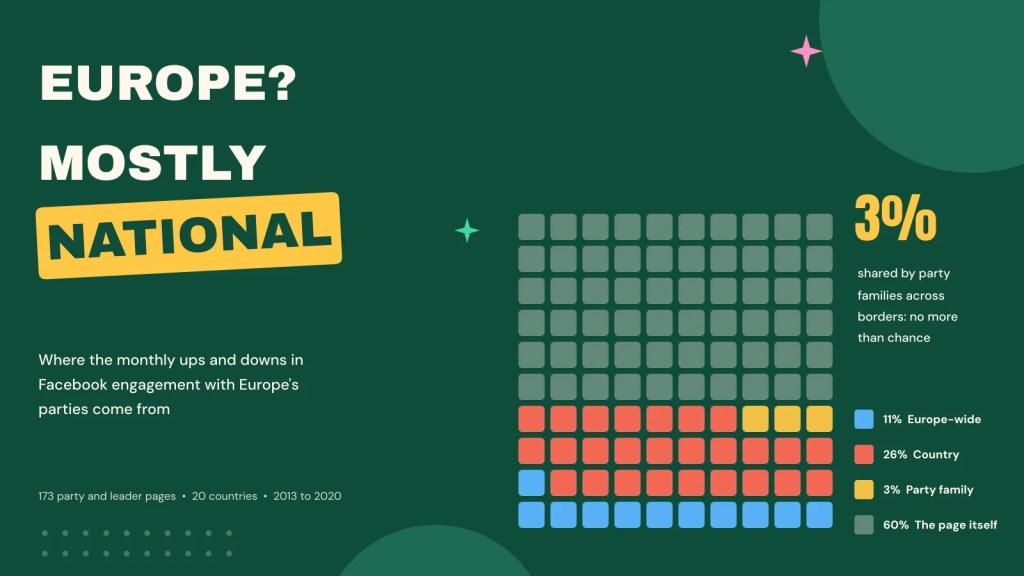
When a party’s Facebook page has a big month, why? Maybe something is happening everywhere in Europe. Maybe it is a national moment, like an election. Or maybe, as people often say about the radical right, parties of one family rise together across borders.
I tested this with 173 party and leader pages in 20 countries, month by month from 2013 to 2020. The answer is mostly national.
The paper
European or National? Common and National Swings in Facebook Engagement with European Parties and Leaders, 2013 to 2020
Read the paper (open access)
What I did
The posts come from CrowdTangle, Meta’s tool for tracking public pages, which closed in 2024. For each page I took its total likes, comments and shares each month and compared it with the page’s own trend. Then I asked how much of each page’s ups and downs it shared with every other page that month, with other pages in its country, and with parties of the same family elsewhere.
National first, family nowhere
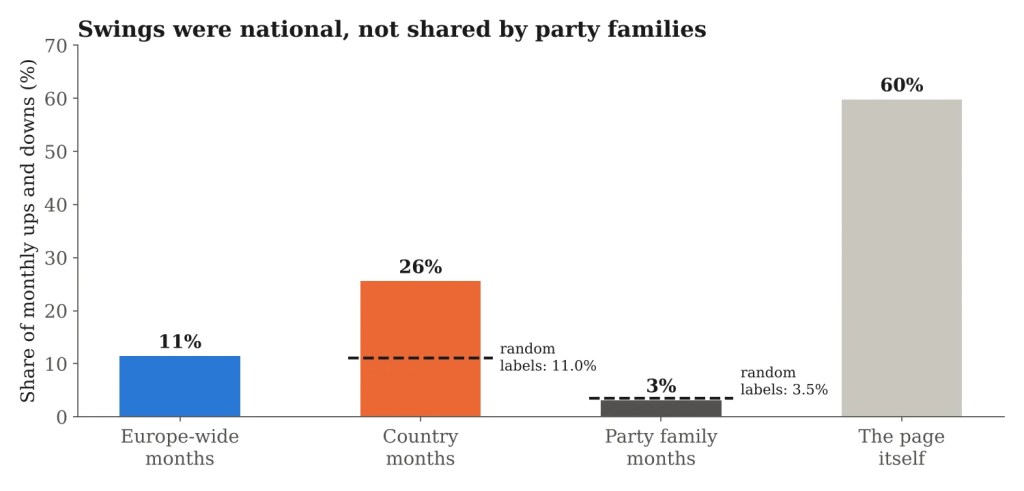
About 26% of the swings were national, well above the roughly 11% you get by shuffling countries at random. About 11% were Europe-wide. Party families accounted for 3%, which is what random groups give too. The rest, 60%, belonged to the page itself.
That includes the radical right. Its pages did not surge together across borders any more than randomly formed groups of pages did, however I coded the families.
A shared ideology did not mean a shared calendar.
Elections matter, and so did Europe twice
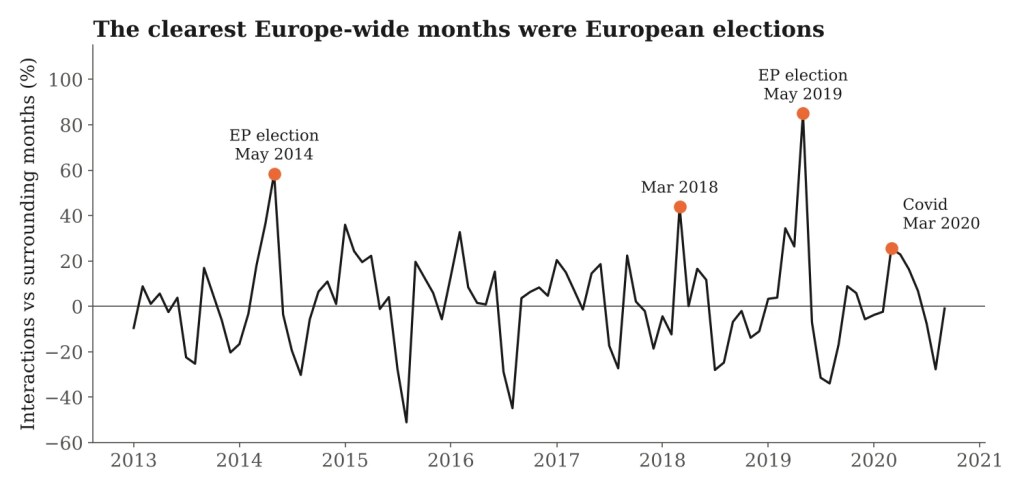
In a national election month, interactions were nearly three times their usual level. Election windows account for about a fifth of the national swings, so most national co-movement happens outside campaigns.
The clearest Europe-wide months were the European Parliament elections: May 2019, about 85% above the surrounding months, and May 2014, about 58% above. March 2018 and the start of Covid in March 2020 also stood out, less robustly. I can describe these months, not explain them.
A trap in the data
My first run showed May and June 2015 as big Europe-wide surges. They were not. That month CrowdTangle started recording far more photo posts from the same pages, so every page seemed to jump at once. Once I allowed for that break, the surge disappeared. It is a good reminder that a shared spike can be a change in the data, not in politics.
The caveats
The Europe-wide share is the least certain number: between about 3% and 17% depending on how I measure it. The pages are my own selection, with many more in Britain than in Latvia. Interactions are not reach, and some come from outside the country. These are patterns, not causes.
The views in this post and the paper are my own.

