
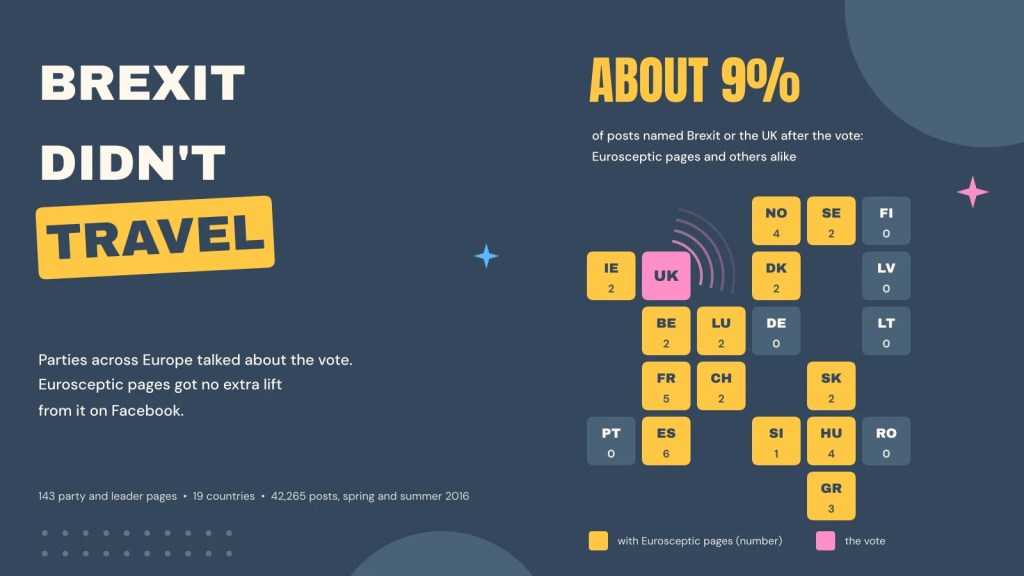
When Britain voted to leave the European Union in June 2016, plenty of people expected the shock to spread. Eurosceptic parties elsewhere would be emboldened, the story went, or perhaps put off once the costs of leaving became clear. Either way, Brexit was meant to be a moment for them.
I wanted to see whether that moment showed up where parties speak to their audiences directly: their Facebook pages. Did people engage more with Eurosceptic parties across Europe after the vote, compared with their rivals at home? In short, no. Pages of every stripe talked about Britain. None of them gained in particular.
The paper
Did Brexit Travel? Eurosceptic Parties across Europe on Facebook after the 2016 Referendum
Read the paper (open access)
What I looked at
The data are 42,265 public Facebook posts from 143 official party and party leader pages in 19 European countries, from the end of March to late September 2016. I collected them through CrowdTangle, Meta’s tool for tracking public pages, which closed in 2024. British pages are kept out of the comparison and shown only as context.
To decide which parties count as Eurosceptic, I used the PopuList, an expert classification of European parties. That gave 37 Eurosceptic pages in 13 countries. It is a mixed group: 15 belong to the populist radical right, 12 to the radical left, and the rest to neither. Each Eurosceptic page is compared with itself in the spring and with the other pages in its own country in the same week. An interaction is any like or other reaction, comment or share.
Pages of every kind talked about Britain
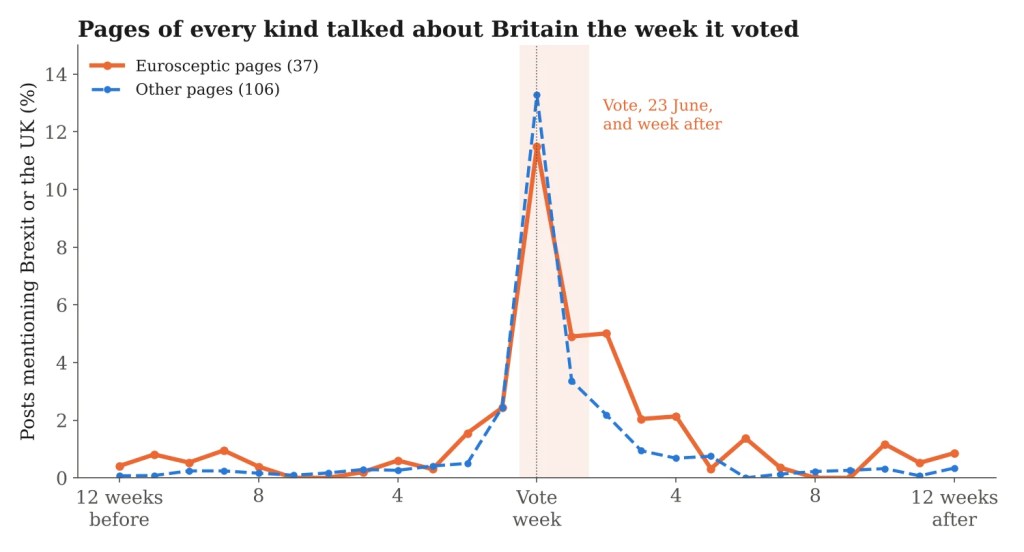
Britain was barely mentioned in the spring. In the comparison weeks, 0.4% of Eurosceptic pages’ posts and 0.2% of other pages’ posts mentioned Brexit or the UK. In the week of the vote and the week after, that rose to 9.2% and 8.5%: 90 of 983 posts, and 227 of 2,667.
So Eurosceptic pages did not talk about it much more than everyone else. Most pages joined in: 28 of the 37 Eurosceptic pages that posted in those two weeks, and 83 of 102 others, mentioned it at least once. Eurosceptic pages kept it up a little longer, but within a few weeks the topic had faded for both.
No lift for Eurosceptic pages
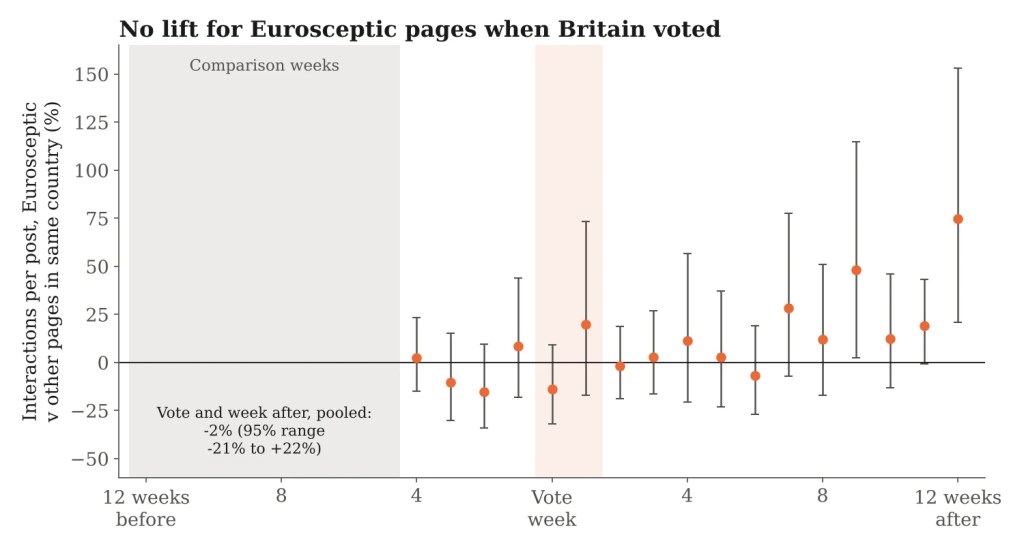
This is the core result. In the week of the vote and the week after, Eurosceptic pages drew about 2% less per post than their pattern in the spring would predict, relative to other pages in their country. That is in effect zero, and the uncertainty runs from about -21% to +22%. It held with borderline Eurosceptic parties added, without Spain (which held its own election three days after the vote), for radical right and radical left pages separately, and for party and leader pages.
Later in the summer, Eurosceptic pages did draw about 20% more per post, mostly in August. But the same summer window in 2015, with no referendum, shows a similar gap. That looks like a seasonal pattern, not Brexit.
Brexit was a shared topic across Europe, not a shared moment for its Eurosceptics.
The mood did not shift either
Facebook added Angry, Haha, Love, Wow and Sad reactions four months before the vote, which gives a rough sense of how audiences responded. If Brexit had been a celebration or a provocation for Eurosceptic audiences, the mix might have moved. It did not, relative to other pages: the Angry share changed by -0.3 percentage points, and Love by -0.1, both well within the noise.
Eurosceptic pages did post about 16% less than other pages in those two weeks. That sounds like a story, but it probably is not one: similar relative dips show up in late June 2014, 2017 and 2018, with no referendum, though not every year. These pages often seem to slow down relative to others as summer starts.
In Britain, it was a big event
At home, the referendum showed up clearly. In the two weeks from the vote, the 23 British party and leader pages that posted drew about 2.2 times as many interactions per post as before, relative to pages elsewhere. The three Eurosceptic British pages in the sample did not gain relative to other British pages, though.
Later Brexit moments looked like ordinary weeks
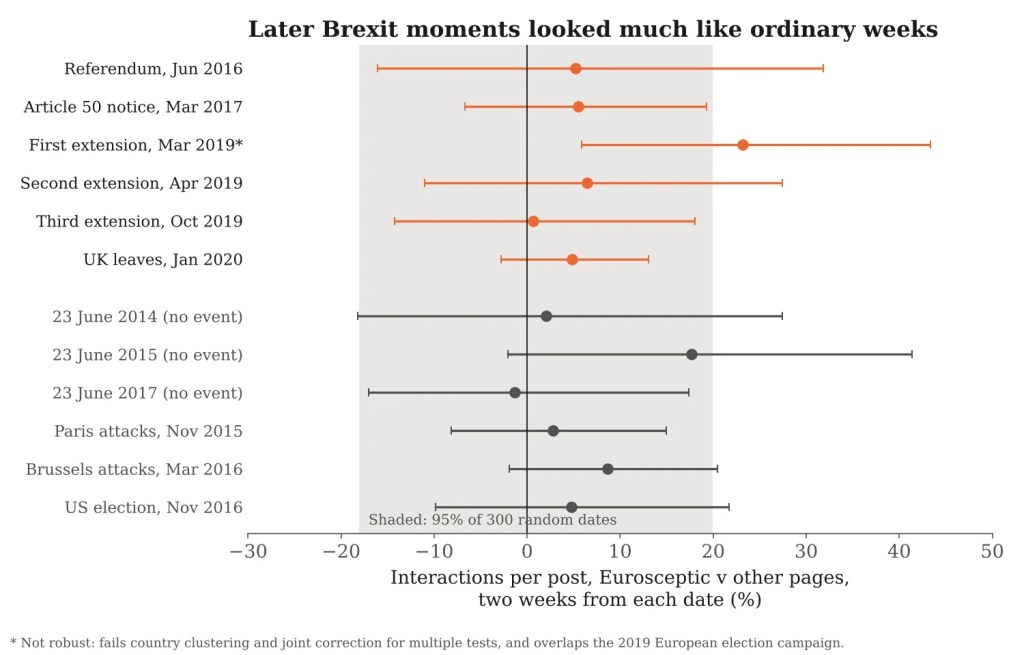
I also looked at five later milestones: the Article 50 notice in March 2017, the three extensions in 2019 and the departure in January 2020. For comparison, I ran the same test on 23 June in years without a referendum, on other international news such as the Paris and Brussels attacks and the 2016 US election, and on 300 random dates.
Most of these estimates sit close to zero and inside the range of the random dates. One stands out on its face: the first extension in March 2019, at about 23%. I would not put weight on it. It is not robust: it loses statistical significance when the uncertainty is measured by country rather than by page, and when corrected for the number of tests I ran. The window also overlaps the run-up to the 2019 European Parliament election, and Eurosceptic pages did not post more about Brexit than others at the time. With six milestones and two measures, one or two results of that size are not surprising.
The caveats
The sample misses several of the best-known Eurosceptic parties, including the FPÖ in Austria, the AfD in Germany, the Lega in Italy, the PVV in the Netherlands and PiS in Poland. The Eurosceptic group mixes the radical right, the radical left and others, though the first two were also checked separately. With 37 Eurosceptic pages, differences smaller than about a third would be hard to detect.
The comparison is relative. If Brexit raised engagement with all parties in a country equally, this design would not see it. The keyword flag is approximate. Facebook also announced a News Feed change within a week of the vote, which affected all pages. Interactions are not reach, and can come from anyone, anywhere. None of this says what Brexit did to votes or opinions: these are patterns on Facebook pages, not causes.
The paper is a preprint and has not been peer reviewed. I wrote the text, with drafting and editing assistance from Claude. The views in this post and the paper are my own.

