
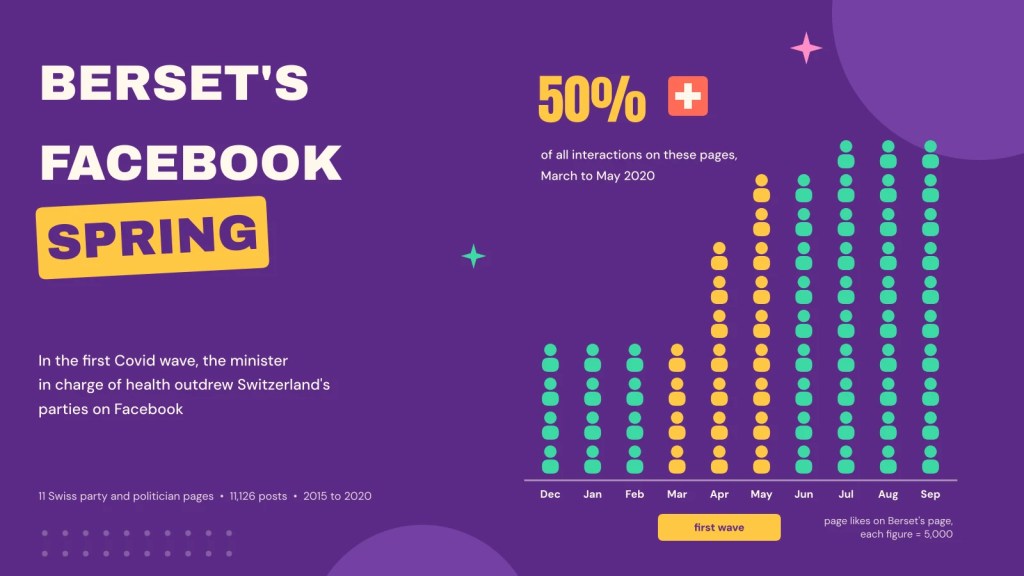
When a crisis hits, who do people turn to? In much of Europe, trust in government rose during the first Covid lockdowns. I wanted to know whether attention on Facebook moved the same way: towards the person explaining the rules, and away from the parties.
Switzerland is a neat place to look. Its government is a seven-member Federal Council drawn from the main parties, and in 2020 the councillor in charge of public health was Alain Berset, a Social Democrat. On the small set of Swiss pages I could study, his page briefly outdrew all three party pages put together.
The paper
The Health Minister’s Spring: Alain Berset, Covid-19 and Swiss Parties and Politicians on Facebook, 2015 to 2020
Read the paper (open access)
What I looked at
The data are 11,126 public Facebook posts from 11 Swiss pages, May 2015 to September 2020, collected through CrowdTangle, Meta’s tool for tracking public pages, which closed in 2024. The pages are those of three parties (the Social Democrats or SP, the liberal FDP and the Swiss People’s Party or SVP), five party presidents and three federal councillors. An interaction is any reaction, comment or share.
This is a small and uneven set. There is no party page for the Centre, the Greens or the Green Liberals, and only two federal councillors posted regularly. So everything below describes these pages, not Swiss politics as a whole.
For three months, half the attention went to one minister
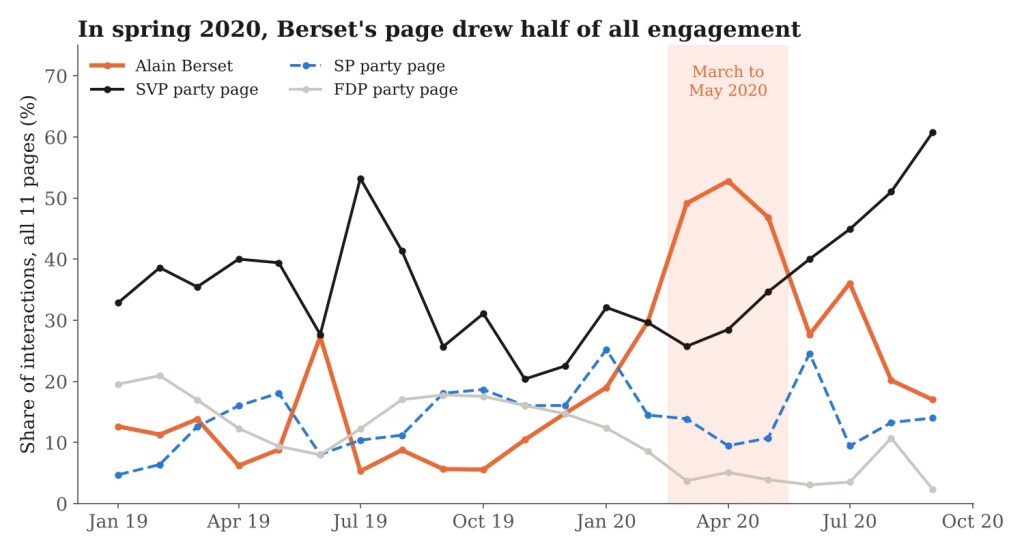
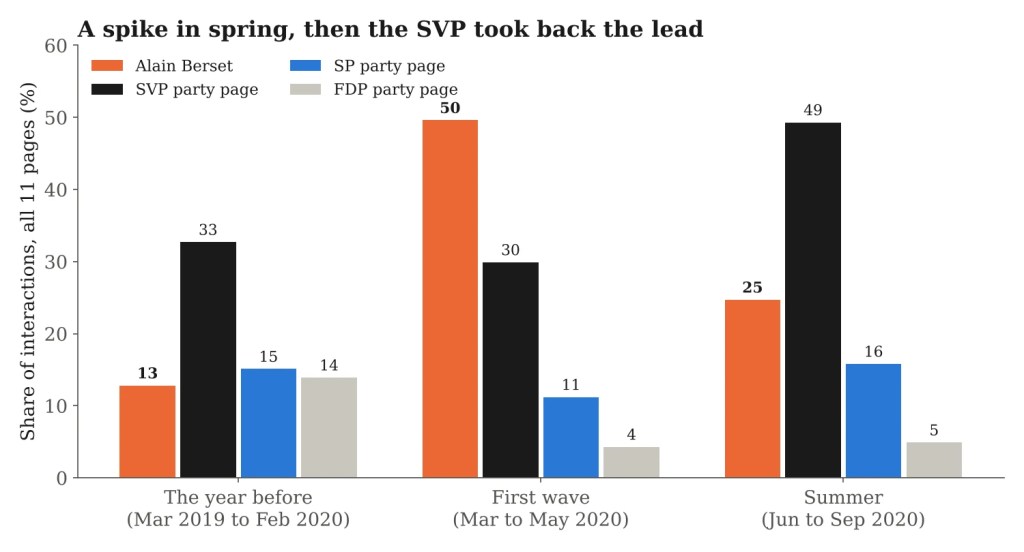
In the twelve months before the pandemic, Berset’s page drew about 13% of interactions on these pages. The SVP party page led with 33%. In March to May 2020, Berset’s share jumped to 50%: 49% in March, 53% in April and 47% in May.
Over those three months his page drew 1.09 times as many interactions as the three party pages combined. In the year before, it was 0.21 times. From February to May 2020 his was the most engaged page every month. In every other month of 2019 and 2020, that was the SVP page, or its president’s page at the end of 2019.
Not more posts, just far more reaction
Berset did not post more. His page posted 90 times in March to May 2020, about 30 a month, much as in the year before. What changed was the response. His median post drew 1,088 interactions, against 75 before: about 14.5 times as many. For the other pages, the same ratio ranged from 0.48 to 2.15.
Nor was it a handful of viral posts. His five most engaged posts made up 21% of the page’s interactions in the first wave. Take them out and the page still drew 1.31 times as many interactions as the SVP page. His following grew too: page likes rose from 19,868 in February to 47,484 in June and 51,273 by September, with most of the gain in April and May.
The attention went to a member of the government, not to his party.
That matters in a system where ministers come from parties but govern collectively. The SP party page’s share did not rise in the spring: it was about 15% in the year before and 11% in the first wave.
The parties did not go quiet, and the SVP came back
This was not attention taken away from the parties. Even with a May popular vote cancelled, the three party pages drew more interactions a month in the first wave than in the year before, about 41,480 against 22,402. Berset’s page simply grew faster.
It did not last as a share. In June to September his median post still drew about 1,183 interactions, but his share fell to 25% as the SVP page rose to 49%. In the four weeks before the vote on the SVP’s Limitation initiative on immigration in September 2020, the SVP page drew 62% of all interactions, and Berset’s page 16%.
There is a smaller echo in 2018, when Berset was President of the Confederation, a rotating one-year role. His page’s share rose from about 1% to 14%, though it also posted 402 times, against 94 the year before. Office, not only the pandemic, seems to draw attention to the page.
Elections beat popular votes
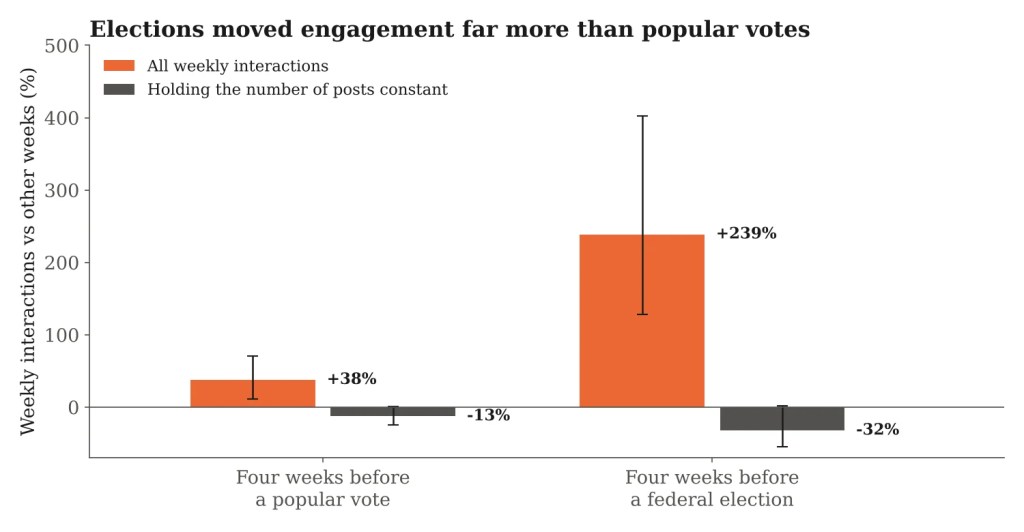
Swiss voters decide national questions directly several times a year, so I also asked whether these campaigns lifted engagement. They did, a little: weekly interactions were about 38% higher in the four weeks before a popular vote. Before a federal election they were more than three times as high.
Much of that went with extra posting. Pages posted about 22% more before a vote and about twice as much before an election. Holding the number of posts constant, I could not detect higher engagement before either. The Limitation initiative stood out, at about 145% above usual.
Before the pandemic, the SVP and SP pages led, with the FDP page well behind despite posting the most. In the month before the 2019 election, the party pages’ shares sat close to their shares of the three parties’ vote, for example 48% against 44% for the SVP. In 2015 they did not: the SP page drew 51% against 29% of the vote. One close match in two elections is not evidence that engagement tracks votes.
The caveats
This is a small study. There are eleven pages, three of them party pages, and none for the Centre, the Greens or the Green Liberals, so it says nothing about the Green surge of 2019. The Berset finding rests on one page, and only one other federal councillor posted regularly, so I cannot compare him with his colleagues. With so few pages, the statistical uncertainty is only roughly measured.
Interactions are not support: they include critics and people outside Switzerland, and could reflect paid promotion. CrowdTangle’s records are not guaranteed to be complete. And none of this shows that the pandemic caused the rise, or that engagement moved votes. These are patterns on these pages, not causes.
The paper is a preprint and has not been peer reviewed. I wrote the text, with drafting and editing assistance from Claude. The views in this post and the paper are my own.

