
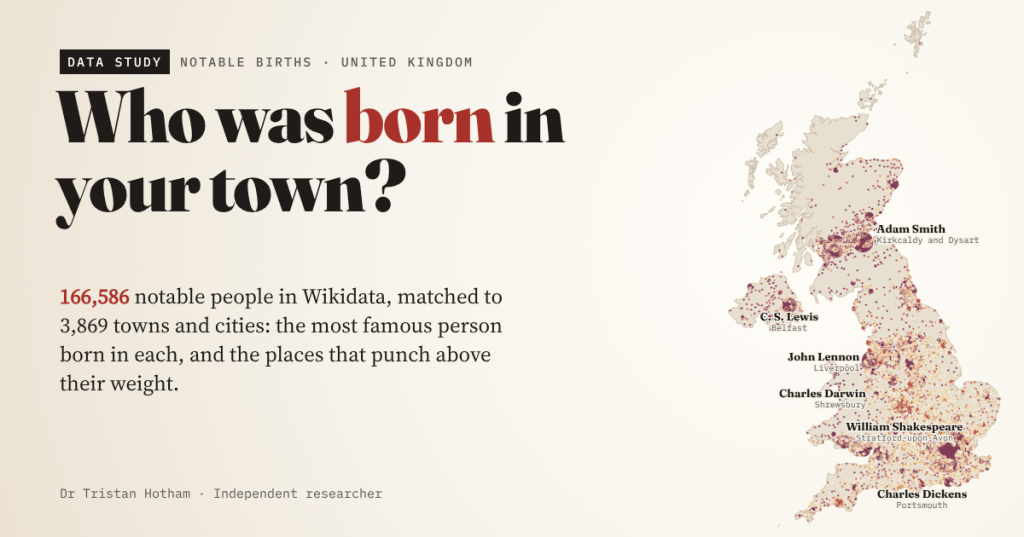
Every town has a famous son or daughter. I matched 166,586 notable people in Wikidata to the UK towns and cities they were born in, to find the most famous person from each place, and the towns that punch above their weight.
Drive into almost any British town and a sign, a plaque or a statue will tell you who was born there. Stratford has Shakespeare, Liverpool has John Lennon, Kirkcaldy has Adam Smith. I wanted to see all of them at once, and to ask a question the signs never answer: which places produce more famous people than their size would lead you to expect?
Wikidata, the open database behind Wikipedia, records a place of birth for 200,835 people born in the UK, from medieval kings to footballers born this century. I placed 166,586 of them in 3,869 towns and cities that have an official population, and measured fame by how many language editions of Wikipedia have a page about each person.
A map of famous names
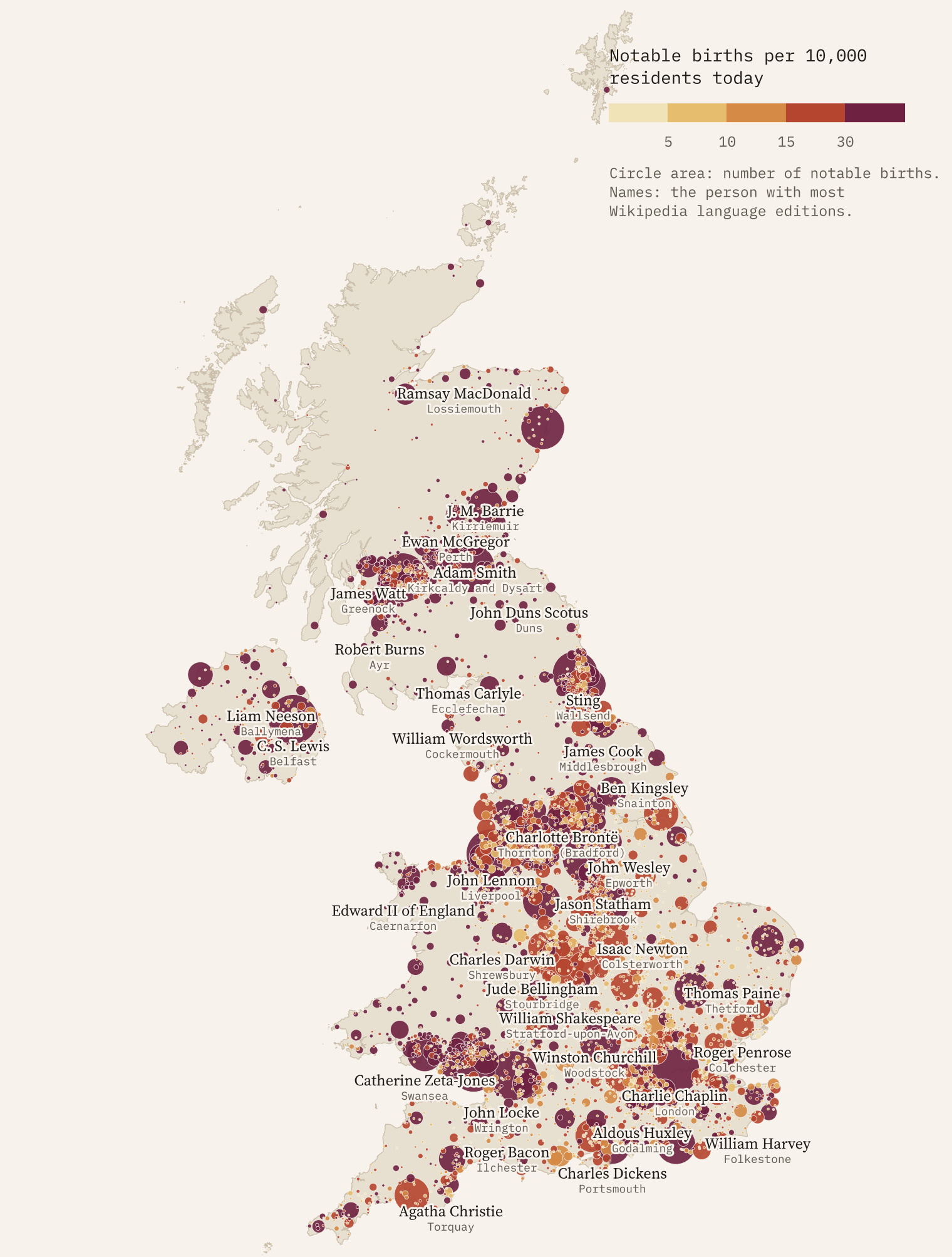
Ranked by the number of Wikipedia language editions and sister sites with a page about them, the three most famous people born in the UK are William Shakespeare, Isaac Newton and Charles Darwin. Town by town the winners are a mixed crowd: in 32% of towns the most famous person is a footballer or other sportsperson, and in 966 towns they were born in 1950 or later. Only 14% of these local champions are women.
Fame is slippery, so I measured it a second way too: how many people read each person’s English Wikipedia article over the last 30 days. The two measures pick the same person in 71% of towns. Languages favour sportspeople and scientists; English readers favour actors and people born since 1950 (32% of the most-read winners, against 26% by languages). London’s most famous by languages is Charlie Chaplin; its most read is Harry Kane. The interactive map lets you switch between the two.
Big places punch harder
Bigger places produce more notable people, and more than in proportion. Across 957 towns of 10,000 people or more, doubling the population goes with about 2.5 times as many notable births. London alone has 26% of the births I could place, but only 14% of the people living in these towns today.
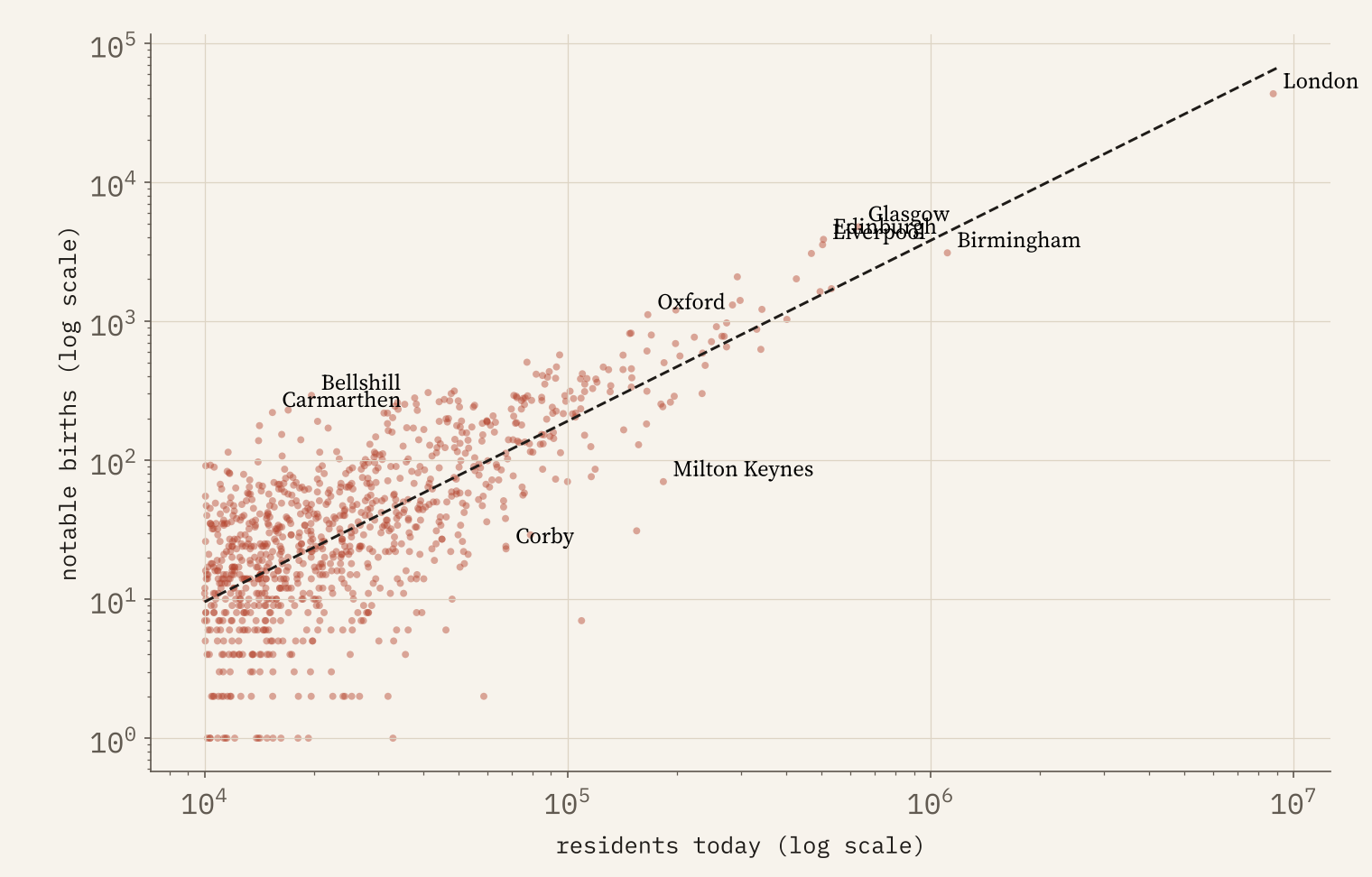
Per head, among places of 50,000 or more, Edinburgh leads with 76 notable births for every 10,000 people living there today, followed by Glasgow, Belfast, Liverpool and Oxford. At the bottom are the post-war new towns, such as Cumbernauld (3.4), Corby (3.4), Bracknell (3.7) and Milton Keynes (3.8): they had few residents before the 1950s, and their babies were usually born in a hospital somewhere else.
The hospital effect
That last point turned out to be the biggest story in the data. Split the births by era and the rankings scramble. For people born before 1900, the towns of 10,000 to 50,000 with most notable births per head are old county, cathedral, port and university towns: Armagh, Carmarthen, Montrose, Caernarfon. For people born since 1950 the list is led by Bellshill, Carmarthen, Bangor and Chertsey.
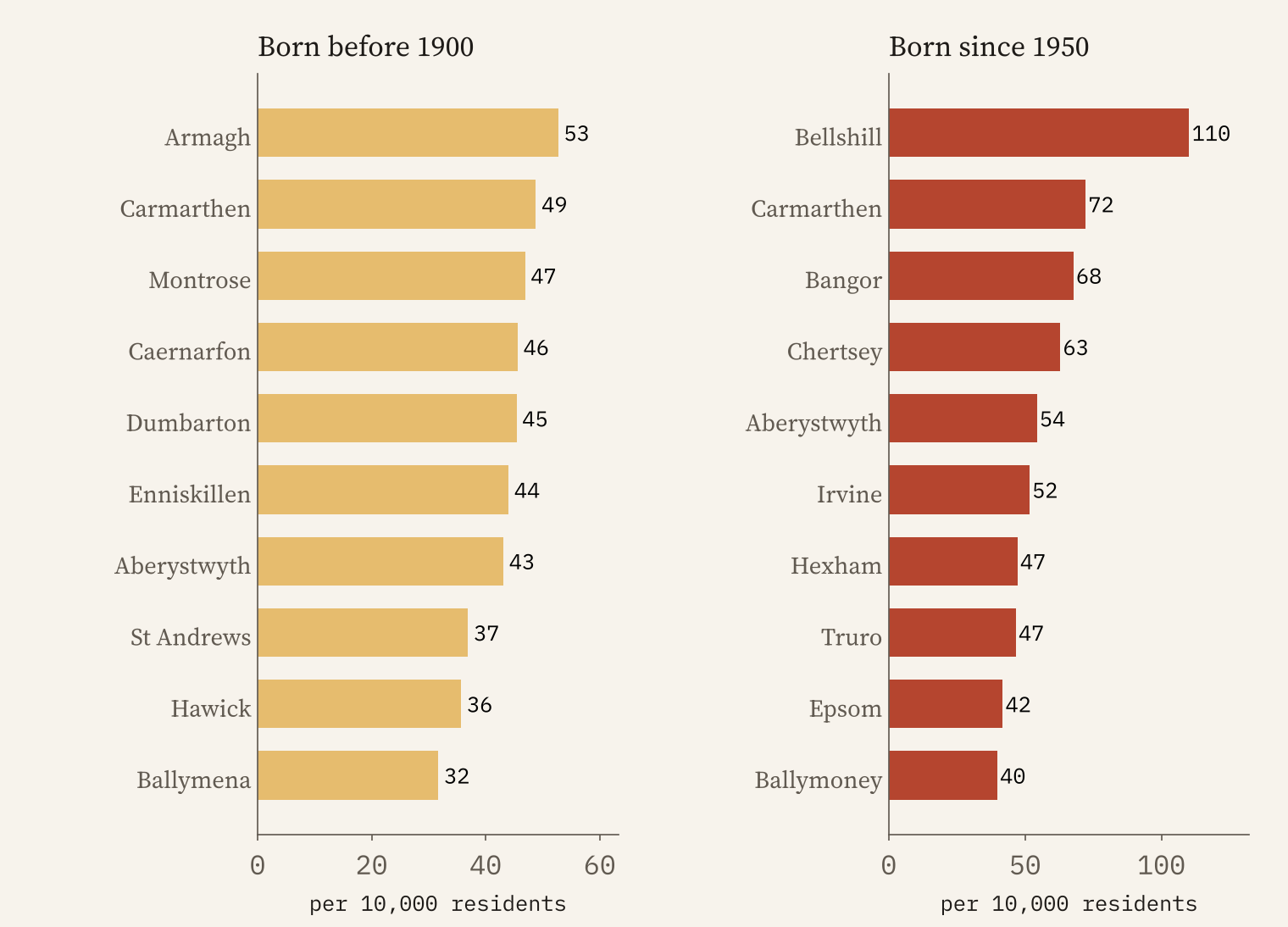
Bellshill in Lanarkshire has 292 notable births for 19,700 residents, and 74% of them were born since 1950. Several of the towns at the top of the modern list have, or had, large hospitals with maternity units serving a wide area. Since the middle of the 20th century, most British babies have been born in hospital, and Wikidata almost always records the town rather than the hospital. So “born in” a town often means born in its hospital, not raised in its streets.
In the hospital era, the most “productive” small towns are the ones with a maternity ward.
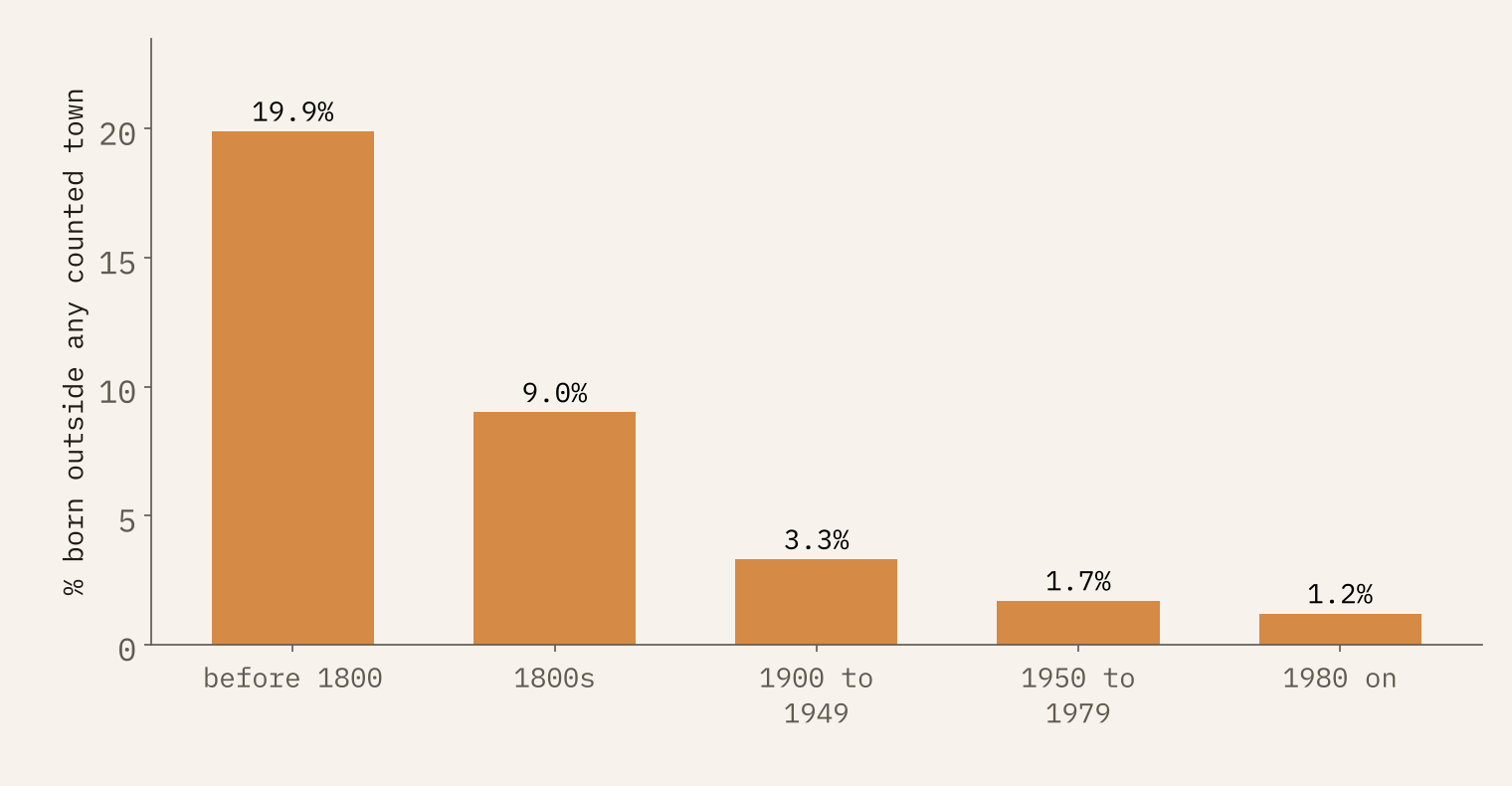
You can see the shift in the data as a whole. Of births I could put on the map, 9.0% of those in the 1800s were outside any town I count. Since 1980 it is 1.2%.
Footballers, scientists and the Clyde
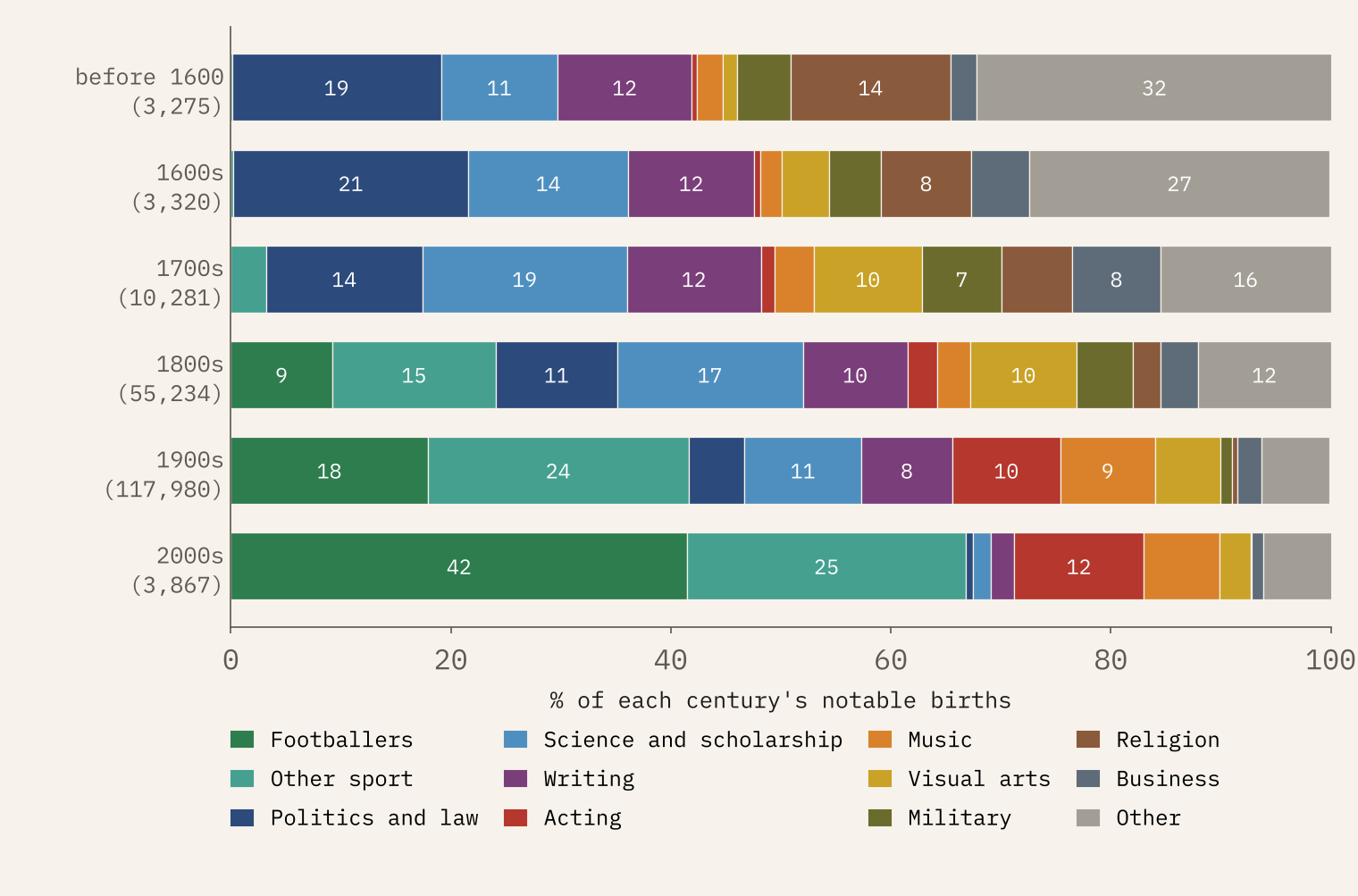
I sorted everyone into one broad group from their Wikidata occupations. Sport is the biggest: 14% are footballers and 19% other sportspeople. Science, scholarship and medicine make up 13%, writing 9%, politics and law 8%. The mix has changed: the military and the church fade over the centuries and sport takes over.
Each group has its capitals. Per head, the footballer capital among towns of 20,000 or more is Dumbarton, then Irvine and Bishop Auckland. Science and scholarship belong to the university cities: Edinburgh, Aberdeen, Oxford and Cambridge. And the military capitals are on the Clyde: Greenock, Dumbarton and Falkirk.
Women: one in ten, then one in four
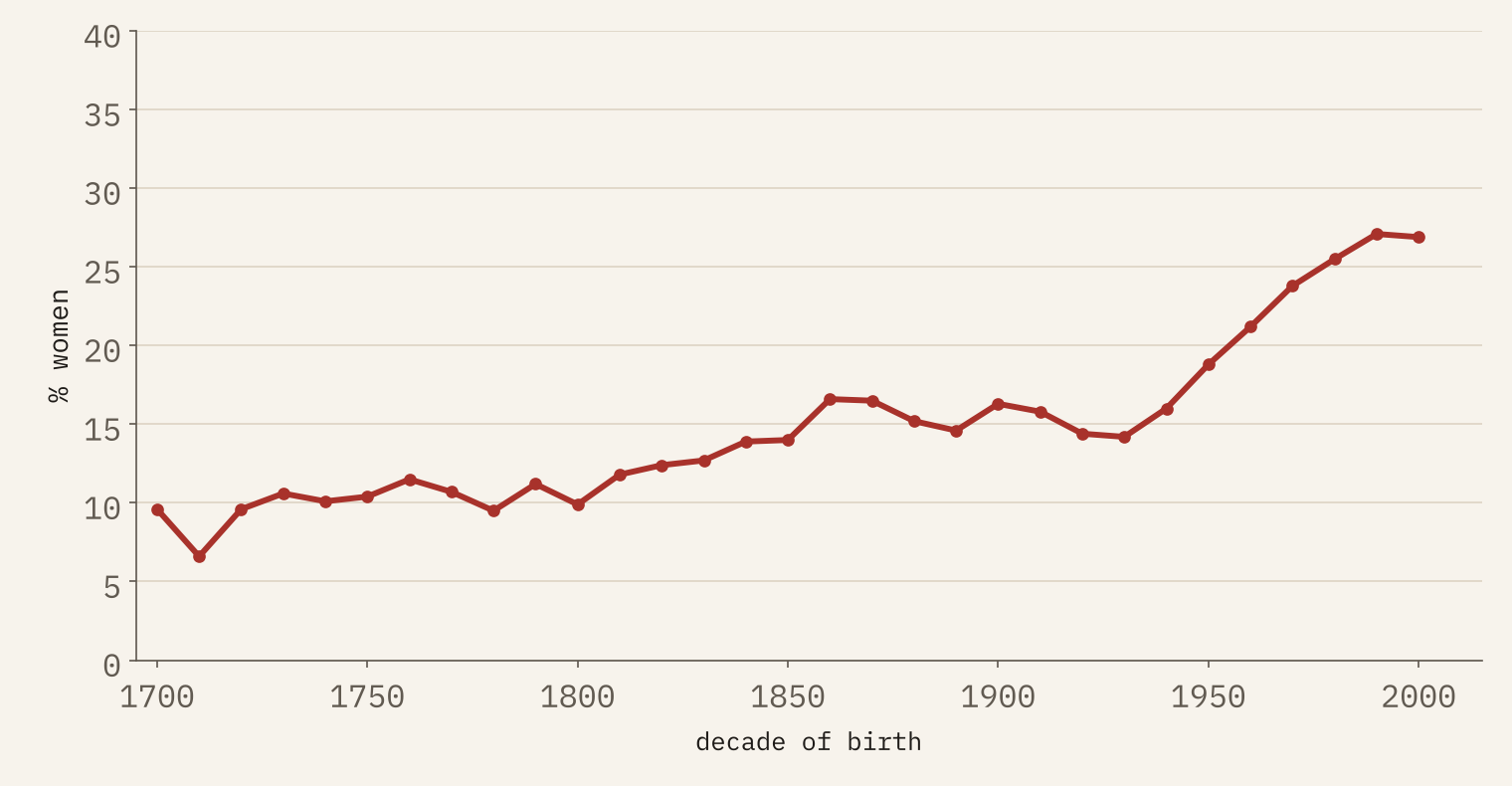
Women are 18% of the notable people in the data. That share was 10% for people born in the 1700s and 14% in the 1800s, and reaches 28% for those born since 2000. It says as much about who gets written down as about who did what.
Per head, Scotland has the most notable births (43.6 per 10,000 residents of its towns), then Wales (35.6), Northern Ireland (34.2) and England (24.9). I cannot say how much of that is history and how much is how thoroughly each nation’s people have been entered into Wikidata.
How I did this
I queried Wikidata on 29 October 2026 for every person whose place of birth is in the UK or one of its predecessor states. Towns are ONS built-up areas with Census 2021 populations for England and Wales (with London’s boroughs merged into one London), NRS localities for Scotland and NISRA settlements for Northern Ireland. I matched each birthplace to a town by its coordinates, so two places called Newport cannot be confused by name, though a wrong link made by a Wikidata editor would still put someone in the wrong town. 19,908 people are recorded as born in somewhere as broad as “England” or a county and could not be placed.
Fame is the number of Wikimedia sites with a page on each person; page views come from English Wikipedia over 30 days for the three best-known people at each birthplace. Births from every century are set against today’s population, which flatters old towns that have shrunk. A companion project, Has your surname left home?, uses the same Wikidata births to follow surnames instead of places.
Notes and sources
- People: Wikidata (CC0), queried through the QLever endpoint of the University of Freiburg.
- Page views: English Wikipedia, 30 days to 28 October 2026, through the MediaWiki pageviews API.
- Populations: Office for National Statistics built-up areas and Census 2021; National Records of Scotland settlements and localities, mid-2020; NISRA Census 2021 settlements (all Open Government Licence v3.0).
- Place names: OS Open Names, contains OS data © Crown copyright and database right 2026.
- Paper, data and code: Zenodo and GitHub.
- I wrote the text, with drafting and editing assistance from Claude (Anthropic), which also helped prepare the analysis code. I reviewed and checked all text and results.

