
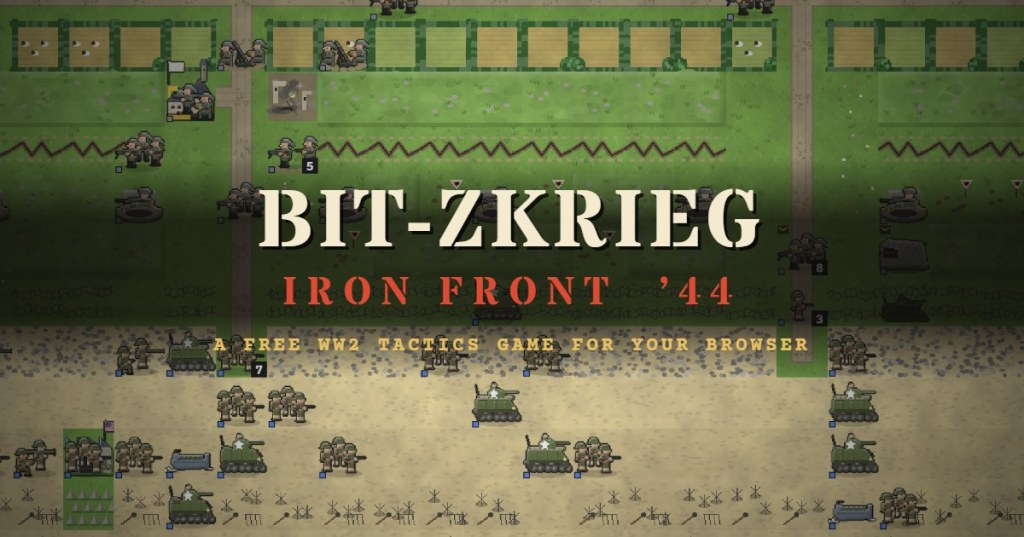
Bit-zkrieg: Iron Front ’44 is my new free browser game: a turn-based tactics game of the Second World War, in the spirit of Advance Wars, but built around the war as it was actually fought. Sixty-six historical battles, from the Sihang Warehouse in Shanghai in 1937 to the Reichstag in 1945, with the real generals, the real tanks, ships and aircraft, and a soundtrack of period recordings.
Play it free in your browser (laptop, phone or controller). There’s nothing to download.
History, not a costume
Most war games treat history as a skin. I wanted the history to be the point. Every battle opens with a briefing built on the historical record: who fought, with what, and what was at stake. When it ends, an aftermath tells you what really happened, and what became of the commanders. Rommel, Zhukov, Patton, Chiang Kai-shek, Yamashita and Kœnig are all here, 81 generals and admirals in all, each with their own powers and temperament. Aggressive commanders attack; cautious ones dig in.
Every unit has its real name and armament, from Polish uhlans and the Matilda tank to the Tiger, the Zero and the Bismarck, 274 kinds in all across 18 armies. The 8.8 cm flak gun really is better at killing tanks than aircraft, because Rommel used it that way.
Twelve campaigns
- The War of Resistance: China against Japan, 1937 to 1945.
- Fall Weiss and Fall Gelb: Poland and France, played from the German side.
- The War at Sea and the Battle of the Atlantic: the River Plate, the Bismarck, Midway, and U-boats that hide beneath the surface.
- The Desert War: Beda Fomm, Tobruk, Bir Hakeim, the minefields of El Alamein, Kasserine and Tunis.
- The Rising Sun and the Pacific War: Pearl Harbor to Singapore from the Japanese side, then Guadalcanal to Okinawa.
- The Eastern and Western Fronts: Moscow to Berlin; Omaha Beach to the Rhine. Plus Basic Training, and a short Axis campaign.
A soundtrack of real recordings
No synthesised music. The game has 60 tracks of real recordings, many from the period itself: Chopin played by Josef Hofmann in 1923, the Red Army Ensemble, the Imperial Japanese Navy Band, the Polish Radio Orchestra in 1939, and the original 1935 Shanghai recording of the March of the Volunteers. Each army has its own music, and defeats get the Last Post or Taps. Everything is public domain or openly licensed. Checking that meant checking the composers as well as the recordings: two lovely period songs had to go because their composers died too recently.
Tested by eight AI players
As with Neon Protocol, the game was played to destruction by AI testers before release: eight temperaments (methodical, aggressive, cautious, opportunist, reckless, a rusher, a turtle and a sniper) playing every battle, over 500 games at a time. The difficulty on each briefing comes from their results. They also found bugs no person would have spotted quickly:
- At Dunkirk, the AI built nineteen artillery pieces in a row. It turned out it was counting the value of British destroyers offshore that the guns could never reach.
- At Singapore, fifty Japanese units jammed the only road into the British HQ while a bomber sat parked on the HQ itself, so the infantry could never capture it.
- Quitting during the computer’s turn left a ghost of it still playing in the background.
- And since the very first build, every tuft of grass on every map had been drawn in the top-left corner of the map.
Iron Front and Neon Protocol are sister games built on the same bones, and the two projects swapped notes as they went. Iron Front’s mirrored-map test found a biased general in Neon; Neon’s checklist found Iron Front’s ghost turn.
And then there are zombies
Beyond the campaigns there’s Last Stand, where you hold your HQ against endless waves, and its night-time cousin, Dead of Night. The dead come from every edge of the map, in field grey, olive drab and khaki alike, and every soldier they pull down gets up again on their side. Machine-gun nests are your friends. There’s also a Map Builder with share codes, skirmish, and online play against a friend.
How the trailer was made
The trailer is the game playing itself. A small recording tool plays real AI-versus-AI battles in the game’s own engine, cuts between them, adds newsreel captions, a film grade and grain, and records it all to video, cut to the build and climax of Holst’s “Mars”.
A note on content: it’s a game about a real war, so it shows period flags (German flags can be switched to the Balkenkreuz only) and stylised violence (gore can be turned off). Briefings follow the record; the generals’ dialogue is dramatised. It’s a personal project, made with AI assistance (Claude), and your progress stays in your own browser.
Play Bit-zkrieg: Iron Front ’44, and see the rest of my games.

