
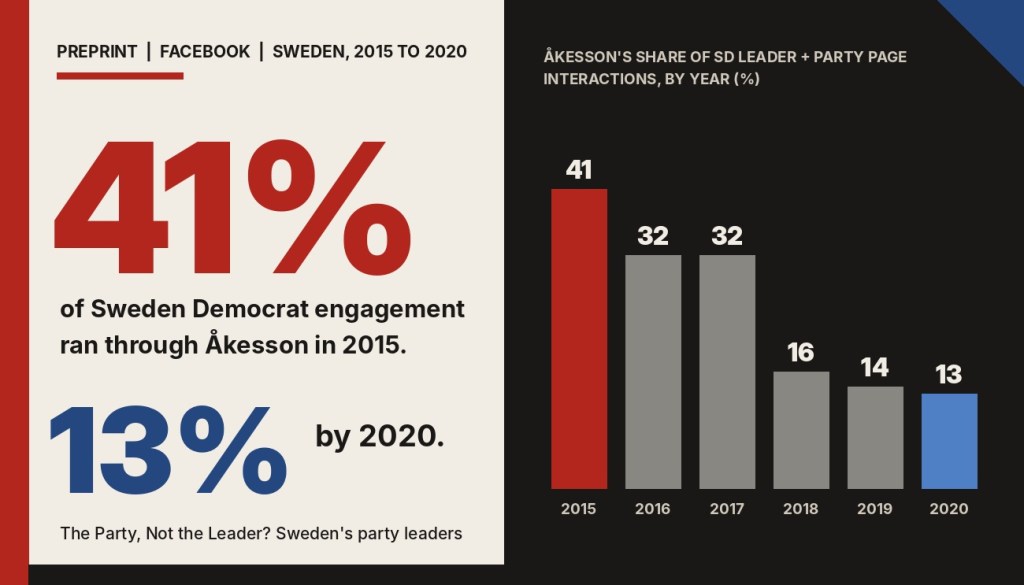
Jimmie Åkesson’s page drew 41% of the Sweden Democrats’ engagement in 2015 and only 13% by 2020. The Centre Party’s Annie Lööf went the other way.
Swedish parties choose their own leaders and elections are fought on party lists, yet the leaders have their own Facebook pages, some with large audiences. So who carries a party’s presence on Facebook: the leader or the party page? The answer turns out to depend on the party.
I have written it up as a preprint: “The Party, Not the Leader: Sweden’s Party Leaders on Facebook, 2015 to 2020.”
The preprint
Open access, free to read, share and cite. Eight pages, with the data, methods, robustness checks and limits.
Cite as: Hotham, T. (2026). The Party, Not the Leader: Sweden’s Party Leaders on Facebook, 2015 to 2020. Zenodo. https://doi.org/10.5281/zenodo.23396563
What the data cover
The data come from my doctoral research and were collected through CrowdTangle. They hold 33,958 posts and 48.9 million interactions from the Facebook pages of Sweden’s eight parliamentary parties and seven of their leaders, from 2015 to 2020. An interaction is a reaction, a comment or a share. The lists have no pages for the leaders of the Christian Democrats or the Greens, and Jan Björklund’s page only begins in 2017, so those parties are thinner in the data.
What I did
For the six parties with a leader page, I worked out the leader’s share of the interactions on their page and their party’s page together, by year, counting only the years the person led the party. For the 2018 general election and the 2019 European election, I compared each party’s share of interactions in the 30 days before with its share of the vote among the eight parties. The ratio is Facebook share divided by vote share.
What I found
- Åkesson’s share fell while his page held up. His page drew 41% of the engagement on the two Sweden Democrat pages in 2015 and 32% in 2016 and 2017, then between 13% and 16% from 2018. His page did not shrink: it drew between 0.6 and 0.9 million interactions every year.
- The party page grew far faster. It went from 0.9 million interactions in 2015 to 4.2 million in 2018, and it posted much more, from 319 posts in 2015 to more than 1,300 a year from 2018. It is the largest political page in the data.
- Åkesson still outdrew the prime minister. His page drew more interactions than Stefan Löfven’s in every year, from 0.60 million against 0.38 million in 2015 to 0.90 million against 0.69 million in 2020 so far.
- Lööf went the other way. Her share of the Centre Party’s engagement was 47% to 49% from 2015 to 2017, then 57% in 2018, 68% in 2019 and 60% in 2020. Her median post drew more than the party page’s in every year, and from 2019 about three to six times as many.
- Others sat in between. Jonas Sjöstedt’s share of the Left Party’s engagement rose from 29% in 2015 to about half by 2019 and 2020. Löfven drew 45% to 52% of the Social Democrats’ engagement from 2015 to 2017 but 25% in the 2018 election year, when the party page posted 962 times. The Moderate leaders drew less: 32% to 41% for Anna Kinberg Batra and 14% to 26% for Ulf Kristersson.
- The radical right dominated both elections. The Sweden Democrats’ pages drew 46% of interactions against 18% of the vote in 2018, and 52% against 16% in 2019, ratios of 2.6 and 3.3. The Left Party drew a little more than its vote share (1.24 and 1.34). Every other party drew less: the Social Democrats 0.64 and 0.41 times their vote share, the Moderates 0.76 and 0.91, the Centre Party 0.32 and 0.29, and the Greens 0.42 and 0.24.
Figure 1. Two leaders, two directions
2015
Åkesson, Sweden Democrats: 41%
Lööf, Centre Party: 48%
2016
Åkesson, Sweden Democrats: 32%
Lööf, Centre Party: 47%
2017
Åkesson, Sweden Democrats: 32%
Lööf, Centre Party: 49%
2018
Åkesson, Sweden Democrats: 16%
Lööf, Centre Party: 57%
2019
Åkesson, Sweden Democrats: 14%
Lööf, Centre Party: 68%
2020*
Åkesson, Sweden Democrats: 13%
Lööf, Centre Party: 60%
Figure 2. Facebook share against vote share, 2019 European election
Sweden Democrats
51.9% of interactions
15.7% of the vote
Moderates
15.6% of interactions
17.3% of the vote
Social Democrats
9.9% of interactions
24.1% of the vote
Left Party
9.3% of interactions
7.0% of the vote
Christian Democrats
4.8% of interactions
8.8% of the vote
Centre Party
3.2% of interactions
11.1% of the vote
Greens
2.8% of interactions
11.8% of the vote
Liberals
2.5% of interactions
4.2% of the vote
What held steady, and what did not
The Sweden Democrats’ ratio is between 2.3 and 3.3 under every way of counting pages and windows I tried. Everyone else’s position depends on which pages you count. The Centre Party’s ratio is 0.16 and 0.13 on its party page alone but 0.77 and 0.52 on Lööf’s page alone, because most of its engagement ran through her. For the Moderates at the 2019 European election it runs the other way: 1.20 on the party page alone and 0.14 on Kristersson’s page alone. So a comparison that only looks at party pages would understate the Centre Party and the Left Party and overstate the Moderates.
The limits
The lists do not include the leaders of the Christian Democrats or the Greens, and Björklund’s page begins in 2017. CrowdTangle’s coverage of the Sweden Democrats’ page is clearly incomplete in 2014, which is why I start in 2015, and I cannot check coverage in later years against another source. Interactions are not support: they include engagement from opponents, from outside Sweden and possibly from paid promotion. Two elections are too few to say whether the ratios are stable. This is a descriptive paper, not a causal one.
Why it matters
The radical right’s large share of engagement survives every way of counting pages. The position of the other parties depends on which pages are counted.
If you compare a party’s Facebook engagement with its votes, the pages you choose to count can change the story for some parties a great deal. Parties in the same political system differed in whether their engagement ran through the leader or the party page, and that is worth knowing before anyone reads a single page as a verdict on a party.
This paper is one of a series from the same CrowdTangle export. I wrote the text, with drafting and editing assistance from Claude.
The views in this post and the paper are my own.

