
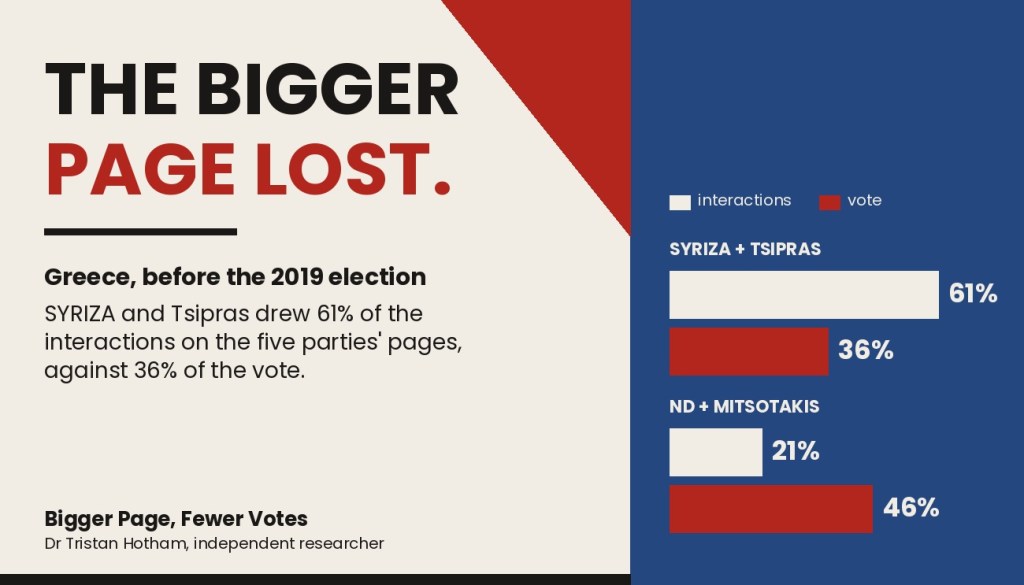
In Greece in 2019 the party with the bigger Facebook presence lost. Before the national election, SYRIZA and Alexis Tsipras drew 61% of the interactions on five parties’ pages, against 36% of the vote. New Democracy won.
Facebook size is easy to mistake for political strength. Greece is a tidy test of that, because the biggest page in my data belonged to the prime minister who then lost office.
I have written the data up as a preprint: “Bigger Page, Fewer Votes: SYRIZA, New Democracy and Facebook in Greece, 2015 to 2020.”
The preprint
Open access, free to read, share and cite. 9 pages with full methods and robustness checks.
Cite as: Hotham, T. (2026). Bigger Page, Fewer Votes: SYRIZA, New Democracy and Facebook in Greece, 2015 to 2020. Zenodo. https://doi.org/10.5281/zenodo.23396365
Why Greece makes a good test
Greece’s party system changed twice in five years. SYRIZA won the first 2015 election on an anti-austerity platform and won again later that year. In 2019 New Democracy, led by Kyriakos Mitsotakis since 2016, won an outright majority with 39.9% of the vote against SYRIZA’s 31.5%. Throughout, Tsipras’s page was the largest Greek political page in my data. So the question is simple: did the party with the bigger Facebook presence win? It did in 2015. It did not in 2019.
What I did
The data come from my doctoral research and were collected through CrowdTangle. They cover 31,532 posts, drawing 23.6 million interactions, from the pages of five parties (SYRIZA, New Democracy, KINAL, MeRA25 and Greek Solution) and four leaders, from 2015 to 2020. I compared each party’s share of interactions in the 30 days before an election with its share of the vote, asked how much of each party’s engagement came through its leader’s page, and followed the two main leaders’ pages through the change of government.
What the data show
- The bigger page lost in 2019. Before the European election the SYRIZA and Tsipras pages drew 56% of interactions against 33% of the vote, while New Democracy and Mitsotakis drew 25% against 46%. Before the national election the figures were 61% against 36% for the SYRIZA side and 21% against 46% for New Democracy and Mitsotakis. New Democracy drew about half its vote share on Facebook (ratios of 0.53 and 0.46) and SYRIZA about 1.7 times its share.
- The SYRIZA side also dominated in 2015. Counting Tsipras’s page, it drew about four-fifths of the two main parties’ interactions before both 2015 elections (81% and 79%), and won both. Using party pages alone, the two pages split interactions close to the vote at the second 2015 election, 53% for SYRIZA against 56%.
- Both main parties ran through their leaders. Tsipras’s page drew between 74% and 90% of the interactions on the two SYRIZA pages in every year from 2015 to 2020, and Mitsotakis’s page between 82% and 96% of the two New Democracy pages in every year from 2016. Those shares are at or above the top of the range I found for British leaders.
- When government changed, the leader share reverted. Mitsotakis’s share of the interactions on the two leaders’ pages fell to 36% in the quarter before the 2019 national election, then returned to between 51% and 64% once he became prime minister, close to his level from 2016 to 2018.
- Anger followed the office, partly. On Tsipras’s page 4.2% of reactions were angry while he was prime minister and 1.0% in opposition. But much of the earlier anger came from a few episodes, including the Prespa agreement, and twenty posts account for 38% of all the angry reactions on his page in that period.
Figure 1. Facebook share and vote share, 2019 national election
SYRIZA and Tsipras
60.7% of interactions
36.4% of the vote
New Democracy and Mitsotakis
21.0% of interactions
46.0% of the vote
KINAL and Gennimata
13.5% of interactions
9.4% of the vote
MeRA25 and Varoufakis
3.6% of interactions
4.0% of the vote
Greek Solution
1.3% of interactions
4.3% of the vote
Share of interactions Vote share
Why the bigger page lost
The gap does not seem to mean that New Democracy’s posts were less engaging. Tsipras’s page had about 442,000 to 450,000 likes in the two 2019 windows, about three times Mitsotakis’s 139,000 to 147,000. The SYRIZA side also posted far more: 370 and 310 posts in the two windows, against 90 and 75 for New Democracy and Mitsotakis, and most of that difference came from the party pages. Relative to page size, Mitsotakis’s page drew more per like than Tsipras’s.
Figure 2. Interactions per 1,000 page likes, 2019
19 Mitsotakis, before the European election
26 Mitsotakis, before the national election
14 Tsipras, before the European election
11 Tsipras, before the national election
Mitsotakis Tsipras
My reading is that Facebook engagement shares mostly measure the size and activity of a party’s existing audience, built up over years, much of it while Tsipras was in office. They are not a guide to the electorate on the day. The paper does not formally decompose the gap, and I say so.
The limits
The sample has no official pages for the KKE or Golden Dawn and no leader page for Greek Solution, so the five-party comparison leaves out about 13% of the national vote in 2019 and about 28% of the European vote. One leader’s page has a gap in coverage during the national campaign, probably a CrowdTangle gap, and I cannot check CrowdTangle’s historical coverage against another source. For 2015 I can only compare the two main party pages. Interactions are not support: they include engagement from opponents, from people outside Greece and possibly from paid promotion. The reaction comparison spans years when the use of reactions changed and the pandemic began. Four elections and one change of government are too few to generalise. This is descriptive and observational.
Why it matters
Engagement on Facebook measured an audience built over years. It did not measure the electorate on the day.
If you read page size or engagement as a forecast, Greece in 2019 is a warning. The party with the larger, busier audience lost both elections by large margins.
This is one of a series from the same data. I wrote the text, with drafting and editing assistance from Claude. The aggregated data, with no post text, are available from me on request.
The views in this post and the paper are my own.

