
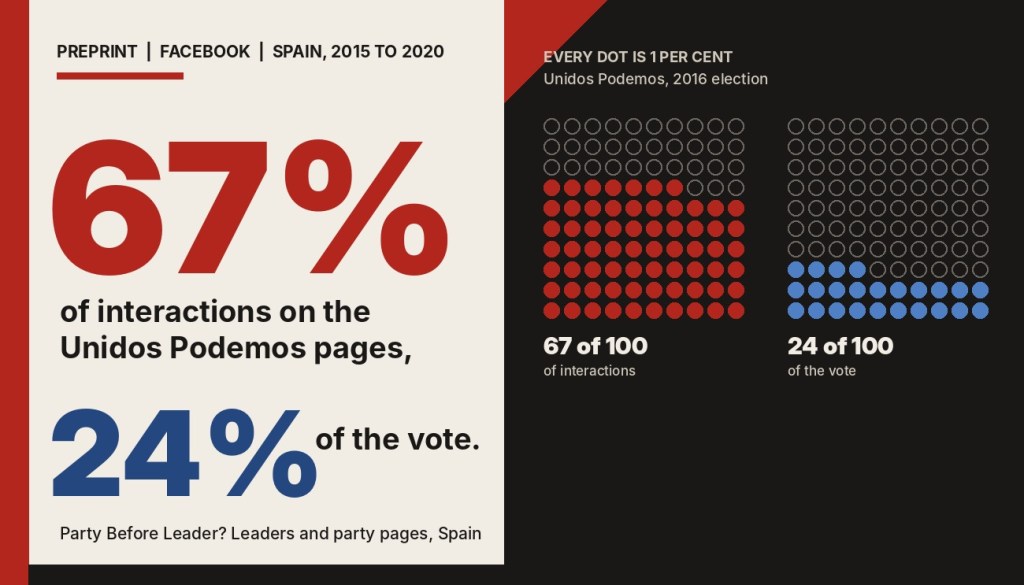
In Spain, the parties that led the country’s governments were the quietest ones on Facebook. The party that won both elections in 2019 drew a fraction of its vote in interactions.
Spain held four general elections between 2015 and 2019 as a two-party system gave way to five national parties. I wanted to know two simple things about that stretch of Facebook. How much of each party’s engagement came through its leader’s page? And how did a party’s engagement compare with its votes?
I have written the answers up as a preprint: “Party Before Leader? Leaders’ and Party Pages on Facebook in Spain, 2015 to 2020.”
The preprint
Open access, free to read, share and cite. Eight pages, with the data, methods, robustness checks and limits.
Cite as: Hotham, T. (2026). Party Before Leader? Leaders’ and Party Pages on Facebook in Spain, 2015 to 2020. Zenodo. https://doi.org/10.5281/zenodo.23396523
Why Spain is a good test
Several of Spain’s leaders, Pablo Iglesias, Albert Rivera, Pedro Sánchez and later Pablo Casado, were new to leading a national campaign. Spain’s new parties were also founded around prominent people, so you might expect their Facebook presence to run through the leader. That is the expectation I wanted to test.
The data come from my doctoral research and were collected through CrowdTangle. They cover 74,884 posts from the Facebook pages of seven parties and seven of their leading politicians, from 2015 to 2020, with 231 million interactions in all. An interaction is a reaction, a comment or a share. One gap to flag early: Vox’s leader has no page in the data, so Vox appears through its party page only.
What I did
For each leader I worked out their share of the interactions on their own page and their party’s page together, year by year, counting only the years they led the party. For the elections, I compared each list’s share of interactions in the 30 days before each general election with its share of the vote among the lists compared. The ratio of the two is the number to watch: above 1, a list drew more engagement than its vote share, and below 1, less.
What I found
- Leaders carried less than you might expect. The Podemos party page drew more than Iglesias’s own page in every year. His share of the two pages was between 17% and 30% every year except 2016, when it reached 49%.
- The People’s Party’s party page outdrew its leaders. Rajoy drew between 29% and 38% of the two PP pages while he led the party, and Casado between 33% and 46%.
- Others leaned on the leader. Alberto Garzón (Izquierda Unida) drew between 58% and 73% of his party’s pages, more than the party page in every year. Sánchez drew between 43% and 73% of the PSOE’s, more than the party page from 2016 to 2018, with his highest share in the second half of 2017 after he won back the party leadership.
- Rivera’s share rose as his party faded. It went from 20% in 2015 to 51% in 2018 and 67% in 2019. That reflects his party page’s decline more than his own growth: his median post drew about 2,800 to 3,400 interactions each year from 2016 to 2019, while the Ciudadanos page’s median post fell from 1,800 in 2016 to 550 in 2019. In 2019 the party’s vote fell from 15.9% at the first election to 6.8% at the second.
- The challengers punched far above their votes. At all four elections the Podemos pages (from 2016, United Podemos) drew between 2.1 and 3.2 times their share of the vote, and Izquierda Unida’s pages 5.8 times in 2015. In 2016 the combined United Podemos pages drew 67% of interactions against 24% of the vote.
- The governing parties were the quietest. The PSOE and the PP drew between 0.21 and 0.45 times their vote shares, up to 0.63 when United Podemos is limited to two pages. That includes the PSOE in both 2019 elections, which it won with 28% of the vote while its two pages drew 14% and 10% of interactions.
- Vox was loud for a party with one page. Its party page alone drew 1.4 times its vote share at the first 2019 election and 1.8 times at the second. At the second, its share of interactions (31%) was six times the PP’s (5%), although the PP won more votes.
Figure 1. Who carried the party in 2018?
68% Garzón (Izquierda Unida)
62% Sánchez (PSOE)
51% Rivera (Ciudadanos)
46% Casado (PP)
38% Rajoy (PP)
22% Iglesias (Podemos)
Figure 2. Facebook share against vote share, second 2019 election
United Podemos
41.4% of interactions
15.0% of the vote
Vox (party page only)
31.2% of interactions
17.5% of the vote
PSOE
9.9% of interactions
32.6% of the vote
PP
5.1% of interactions
24.2% of the vote
Ciudadanos
8.3% of interactions
7.9% of the vote
Más País
4.1% of interactions
2.8% of the vote
What held up, and what did not
The election pattern held when I limited United Podemos to two pages, used party pages only, used leader pages only, and changed the window to 14 and 60 days. Two cases moved a lot. Ciudadanos and Más País at the second 2019 election had ratios from 0.37 and 0.33 with party pages only to 2.03 and 3.16 with leader pages only, because Rivera’s and Errejón’s pages carried most of their parties’ engagement. And Ciudadanos in 2016 reaches a ratio of 1.05 when United Podemos is limited to two pages, rather than 0.75.
One more caveat on timing: from 2020 Podemos and Izquierda Unida were in government, so their 2020 figures are no longer those of challengers.
The limits
The page lists contain only some pages for each party. Vox has no leader page, Más País only has a party page from 2019, and I do not count regional pages, including those of Podemos’s allied lists. The “leader” at each election is the national leader or candidate, which fits some parties better than others. CrowdTangle’s historical coverage is not guaranteed to be complete. Interactions are not support: they include engagement from opponents, from outside Spain and possibly from paid promotion. And four elections in four years, with the same parties and leaders, are not independent tests. This is descriptive work, not a causal claim.
Why it matters
A high leader share can mean a strong leader, or a weak party page.
Facebook engagement measures the size and activity of a party’s online audience, and in Spain that audience was not a guide to who would govern. If you read a crowded page as a sign of electoral strength, 2015 to 2019 in Spain is a good reminder not to.
This paper is one of a series from the same CrowdTangle export. I wrote the text, with drafting and editing assistance from Claude.
The views in this post and the paper are my own.

