
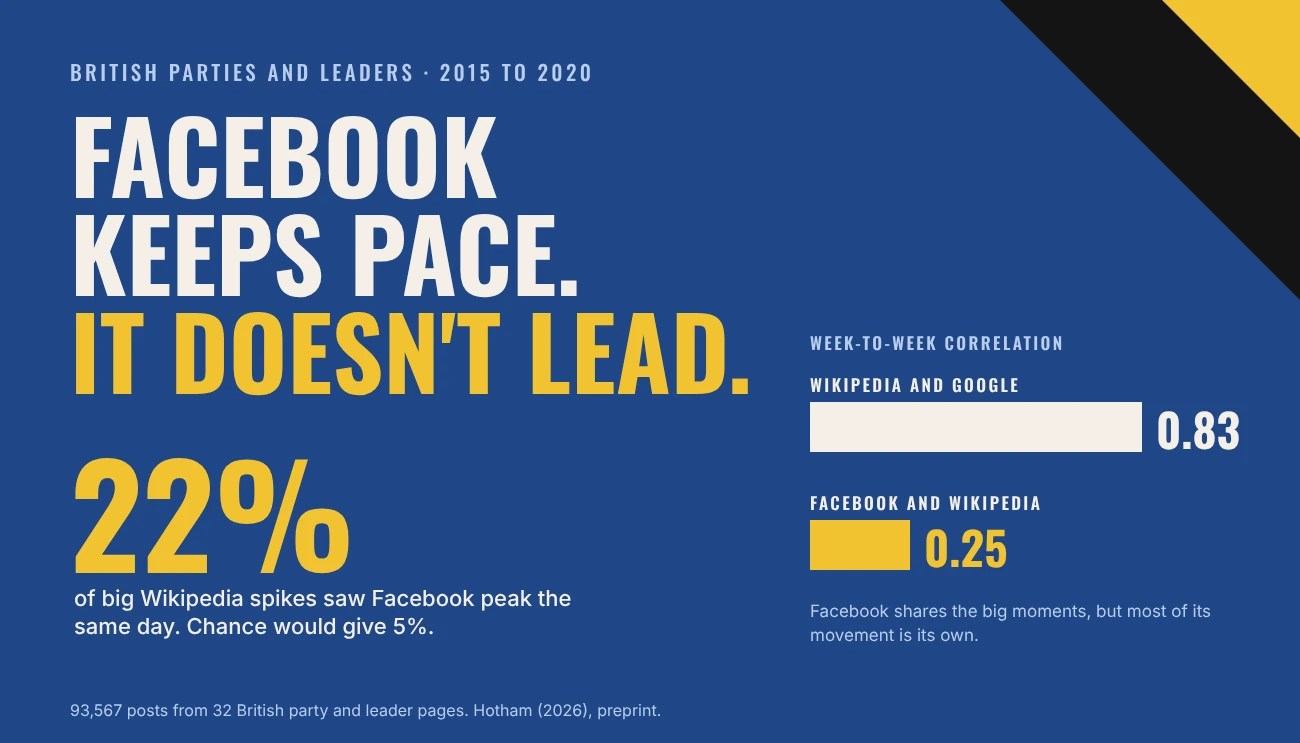
When a politician’s post goes viral, it is tempting to read it as a sign of where the public is heading. Lots of likes and shares feel like a crowd gathering. But is Facebook engagement ahead of public interest, or just keeping up with it?
I tested this by setting Facebook engagement for British parties and their leaders against two free measures of public attention: how often people read their Wikipedia articles, and how often they searched for them on Google. The answer, for 2015 to 2020, is that Facebook mostly kept pace. It rarely ran ahead.
The preprint
Does Facebook Lead Public Attention or Follow It? Facebook Engagement, Wikipedia Pageviews and Google Searches for British Parties and Leaders, 2015 to 2020
Open access, free to read, share and cite. It uses 93,567 posts from 32 British party and leader pages, 2015 to 2020, with Wikipedia pageviews and Google search data.
Cite as: Hotham, T. (2026). Does Facebook Lead Public Attention or Follow It? Facebook Engagement, Wikipedia Pageviews and Google Searches for British Parties and Leaders, 2015 to 2020. Zenodo. https://doi.org/10.5281/zenodo.23399784
What I did
The Facebook data are 93,567 posts from 32 British pages: 13 parties, 18 current or former leaders, and Momentum. I exported them in 2020 using CrowdTangle, Meta’s tool for tracking public pages, which closed in 2024. Between them they drew about 245 million likes, comments, shares and reactions.
I matched each page to the English Wikipedia article on the same party or person, about 126 million views in total, and, where it worked, to a Google search term. Google Trends gives a weekly index of search interest in the UK. Some search terms were too rare or too ambiguous to use: people search for ‘SNP’ rather than ‘Scottish National Party’, and ‘Momentum’ is an ordinary word. That left 12 actors with usable Google data.
Then I asked two things. How closely do the three measures rise and fall together for the same party or person? And when there is a big spike, which one moves first?
Facebook tracks attention, but loosely
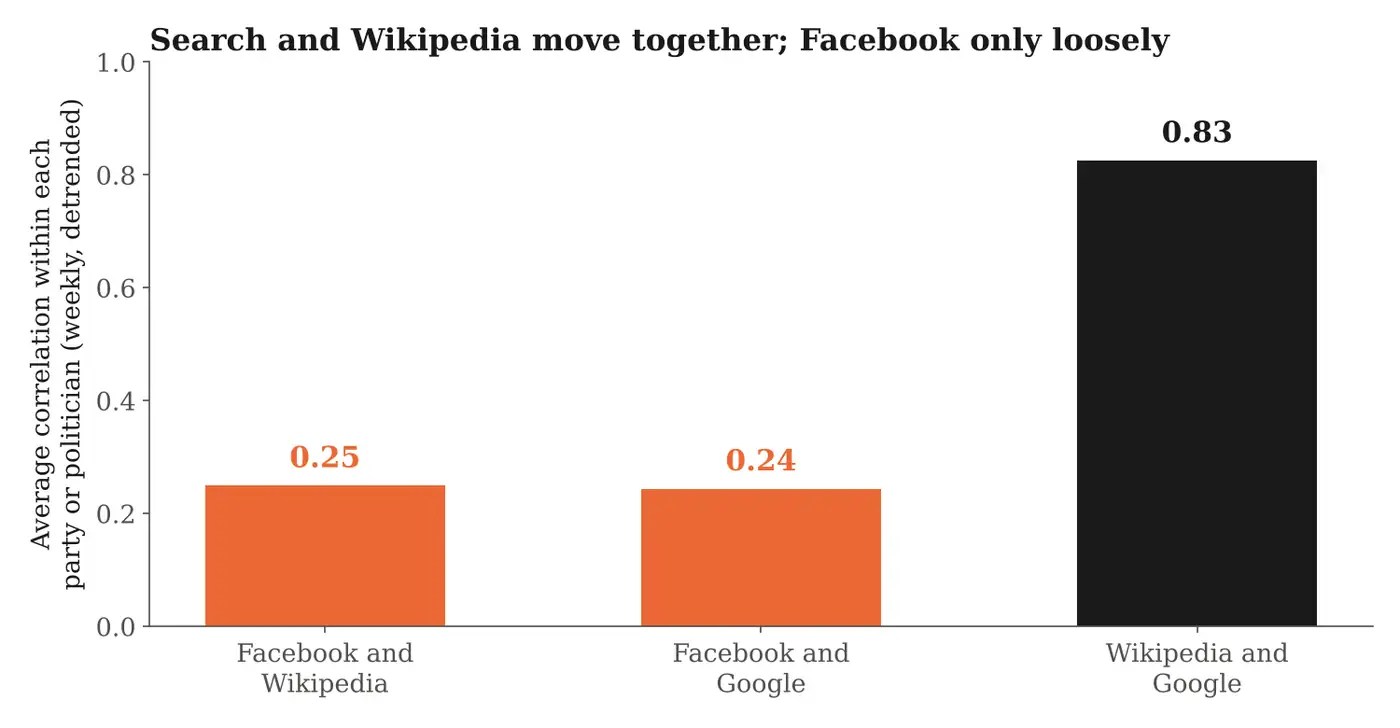
Wikipedia and Google behave almost like twins. Week to week, their ups and downs within the same party or person correlated at about 0.83. Facebook engagement correlated with each of them at only about 0.25. Day by day the link was weaker still, around 0.12, though it was positive for every one of the 32 pages.
So Facebook shares the big moments with the rest of the public, but most of its movement is its own. That makes sense. A page’s engagement depends on when it posts, what it posts and how loyal its followers are. A Wikipedia view or a Google search is someone looking something up. They are different acts.
On the big days, it was the same day
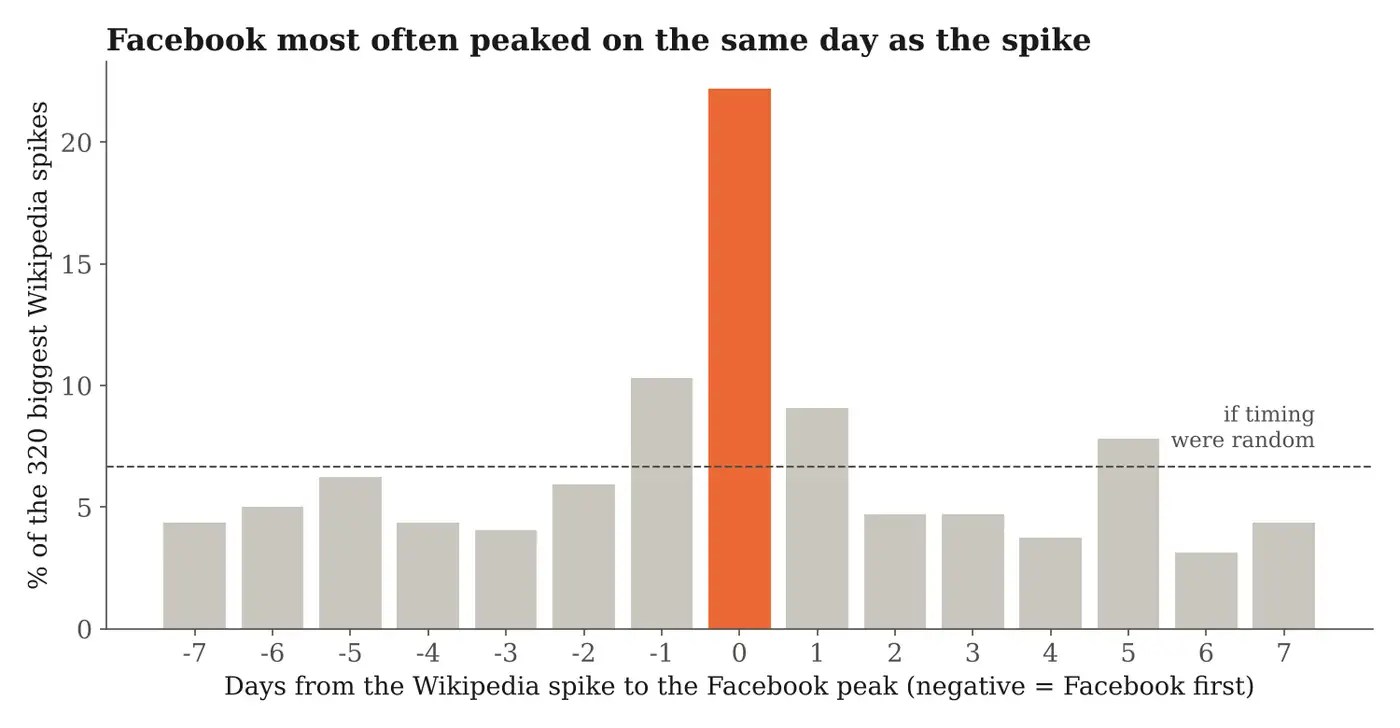
I took the ten biggest jumps in Wikipedia reading for each party and politician, and looked at when their Facebook page peaked in the week either side. In 22% of cases it was the same day, about four times what chance would give. In 42% it was within a day. When Facebook did peak on a different day, it was about as likely to be before as after.
There is one exception that shows how this works. Around elections, party pages post hardest on polling day, while Wikipedia readers pile in the day after, when the results come in overnight. Pages mobilise before a scheduled event; the public reads up after it. That is the calendar, not Facebook steering anyone.
Facebook engagement behaves like one more reading of public attention, not an early warning of it.
The statistical tests point both ways
I also ran more formal tests, asking whether yesterday’s change in one measure helps to predict today’s change in the other. Day by day, the links were small and ran in both directions. Tested page by page, Wikipedia helped to predict later Facebook engagement for 14 of the 32 pages, and Facebook helped to predict Wikipedia for 2. If anything, Facebook was more often the follower.
Week by week, the tilt went the other way: a rise in Facebook engagement was followed by slightly higher Wikipedia reading over the next few weeks. But the effect was modest, and for Google it did not hold up once I left out election campaigns or used stricter statistics. Part of it may also come from how the data are dated, since CrowdTangle counts every like on a post on the day the post went up, even if it arrived the next day. I read the overall picture as moving together, with no reliable leader.
None of them is a poll
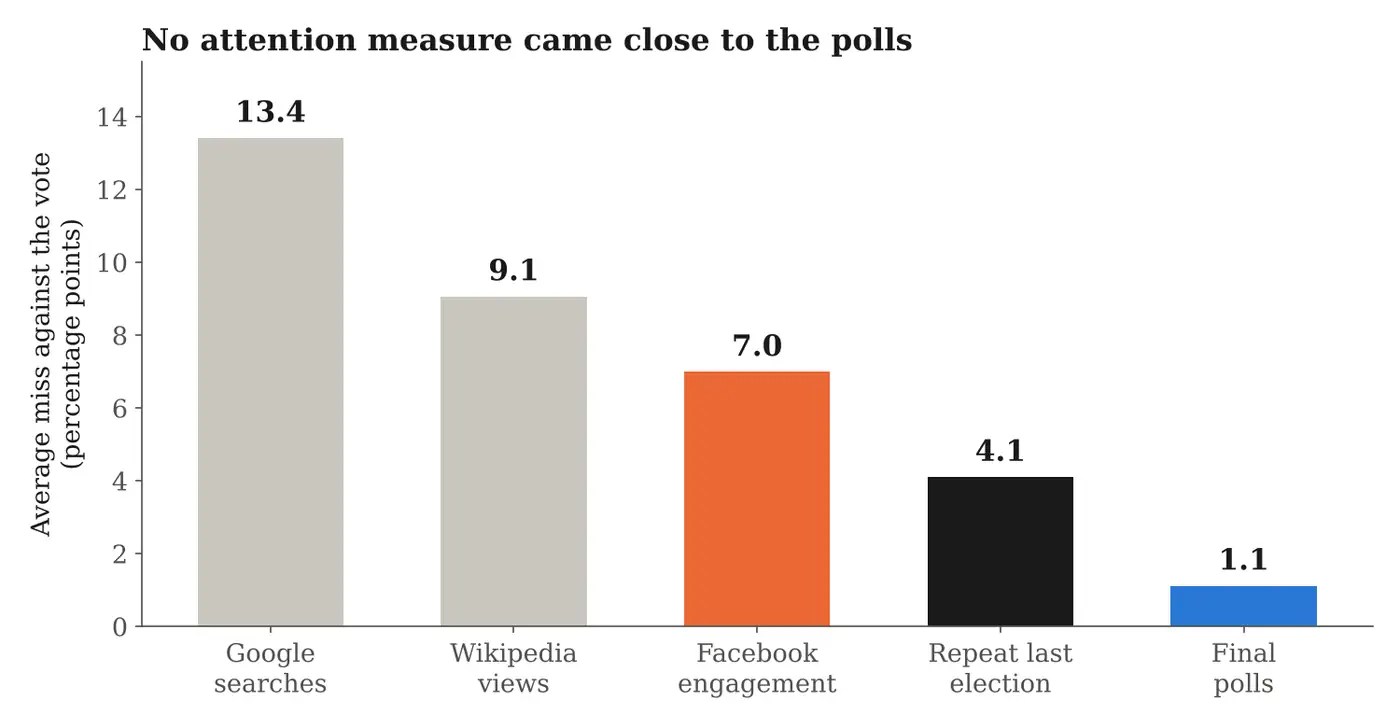
I have shown before that Facebook engagement is a poor guide to vote shares. So I checked whether the other attention measures did any better at the 2017 and 2019 general elections and the 2019 European election. They did not. Across all three elections, Facebook shares missed the vote by about 8 points on average, Wikipedia shares by about 7 and Google shares by about 11.
At the two general elections, the final polls missed by about 1.1 points, and simply repeating the previous election’s result missed by about 4.1. Every attention measure was further away than both. Facebook overstated Labour and understated the Conservatives; Wikipedia understated the Conservatives too and overstated smaller parties; Google’s numbers were thrown off by the words people actually type, since few people search for ‘Conservative Party’.
That matters. It suggests the problem with reading social media as a forecast is not something peculiar to Facebook. Attention is simply not the same thing as support.
The caveats
This is a description of how the measures moved, not proof that any one caused another. Wikipedia views are global, not just British, which matters for figures like Boris Johnson and for Sinn Féin. Google Trends is a sampled index, rounded to whole numbers, and many search terms sat near zero for most weeks. Facebook interactions are dated by when a post went up, not when people reacted. Many leaders’ pages posted on fewer than half of days. And three elections with six or seven parties each are far too few to rank these measures as forecasts in general.
Still, the picture is consistent. On the biggest days, the public’s reading, searching and liking moved together. Facebook kept pace with public attention. It did not lead it, and it was no better than the other measures at telling who would win.
I wrote the text, with drafting and editing assistance from Claude.
The views in this post and the paper are my own.

