
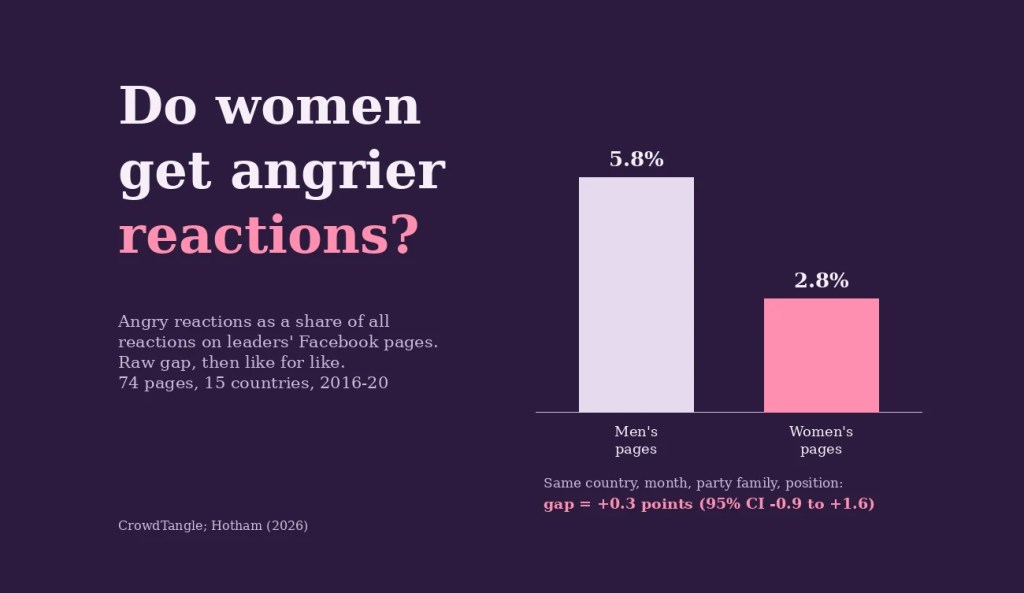
Women’s Facebook pages drew about half the share of angry reactions that men’s pages did. Pooled across 74 European party leaders, 2.8% of reactions on women’s pages were Angry, against 5.8% on men’s.
That looks like good news. Then you ask who the angriest pages belong to. The top seven are all men: leaders of opposition parties on the radical right and left, such as Vlaams Belang’s Tom Van Grieken, the Workers’ Party of Belgium’s Peter Mertens and Nigel Farage. No woman in the data led a populist radical-right party.
The preprint
Love, Anger and Laughter: Do Women and Men Leading European Parties Get Different Reactions on Facebook?
Open access, free to read, share and cite. It uses 125,056 posts from 74 leaders’ pages in 15 countries, 17 of them women’s.
Download the PDFRecord and DOI
Cite as: Hotham, T. (2026). Love, Anger and Laughter: Do Women and Men Leading European Parties Get Different Reactions on Facebook? Preprint. https://doi.org/10.5281/zenodo.23403629
The question
Women in politics get more abuse online, at least on some measures. Most of the evidence is about the words people write, mainly on Twitter. Facebook’s emoji reactions are a different record: millions of quick, public verdicts on what politicians post. If audiences are harsher on women leaders, it should show up as more Angry and Haha reactions and less Love.
I used my own CrowdTangle data from my PhD: every post from 74 pages of party leaders and leading politicians in 15 countries, from March 2016 to September 2020.
The raw gap is about party, not gender
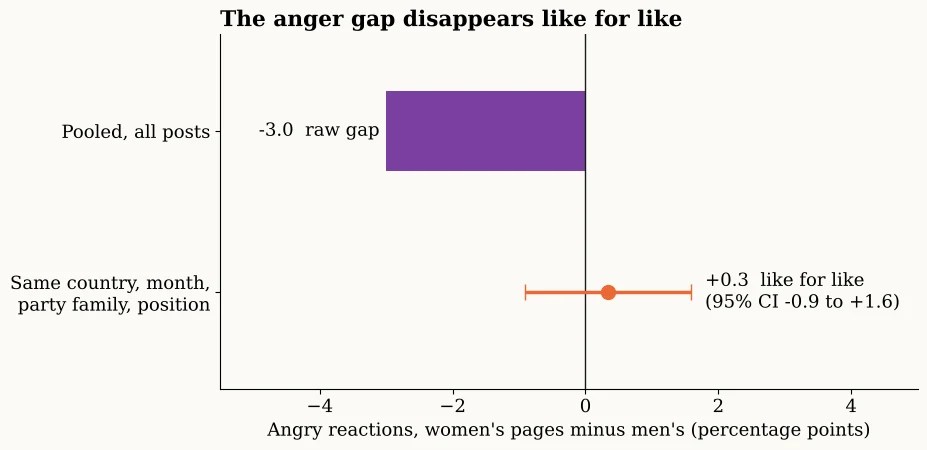
Men lead the parties whose supporters are angriest, so comparing all women with all men mostly compares kinds of party. The fair test is to compare women and men in the same country in the same month, with the same party family and the same position in or out of government.
When I do that, the gaps vanish. Women’s pages drew 0.3 points more Love reactions and 0.3 points more Angry reactions, and the same share of Haha, against men’s averages of about 6%, 6% and 2%. Sad, Wow, comments and shares also show nothing.
The large raw difference in anger reflects party and position: men led the parties whose audiences were angriest.
What the data can and cannot rule out
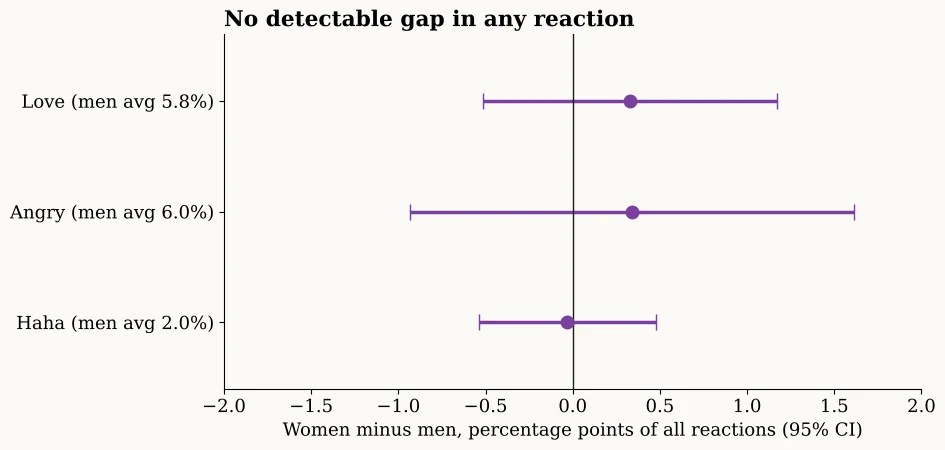
Zero is not the same as precisely zero. With 17 women’s pages the confidence intervals run from -0.9 to +1.6 points for anger, so gaps of a point or two cannot be excluded. But the result is stable: it holds with controls for page size, without heads of government, without the UK, in randomisation tests, and when each leader is compared with their own party’s page.
There are hints, and they rest on few pages. Women whose parties were in government drew about 1.7 points less Love and 1.4 points more Haha than expected, a pattern that is mostly Theresa May. I treat that as a lead, not a finding. Women’s pages also drew fewer interactions per post, by about 35%, but that estimate is imprecise and reverses once the UK is dropped.
The caveats
This does not contradict the research on online abuse of women politicians. Reactions are not comments. Hostility may come as words rather than emoji, from people who do not follow the page, or in a small share of interactions that a page-level percentage hides. And Haha can mean amusement as well as ridicule.
Seventeen women’s pages in eight countries is a small sample. No woman in the data led a populist radical-right party, the women led mainstream, green, left and centre parties, and the data end in September 2020. The sensible next step is to combine reactions with the text of comments on the same posts.
I wrote the text, with drafting and editing assistance from Claude.
The views in this post and the paper are my own.

